

More news on this day
United Airlines is testing a new home bag collection service for travelers flying out of Chicago O’Hare, signaling a potential shift in how U.S. passengers check luggage and move through one of the nation’s busiest hubs.
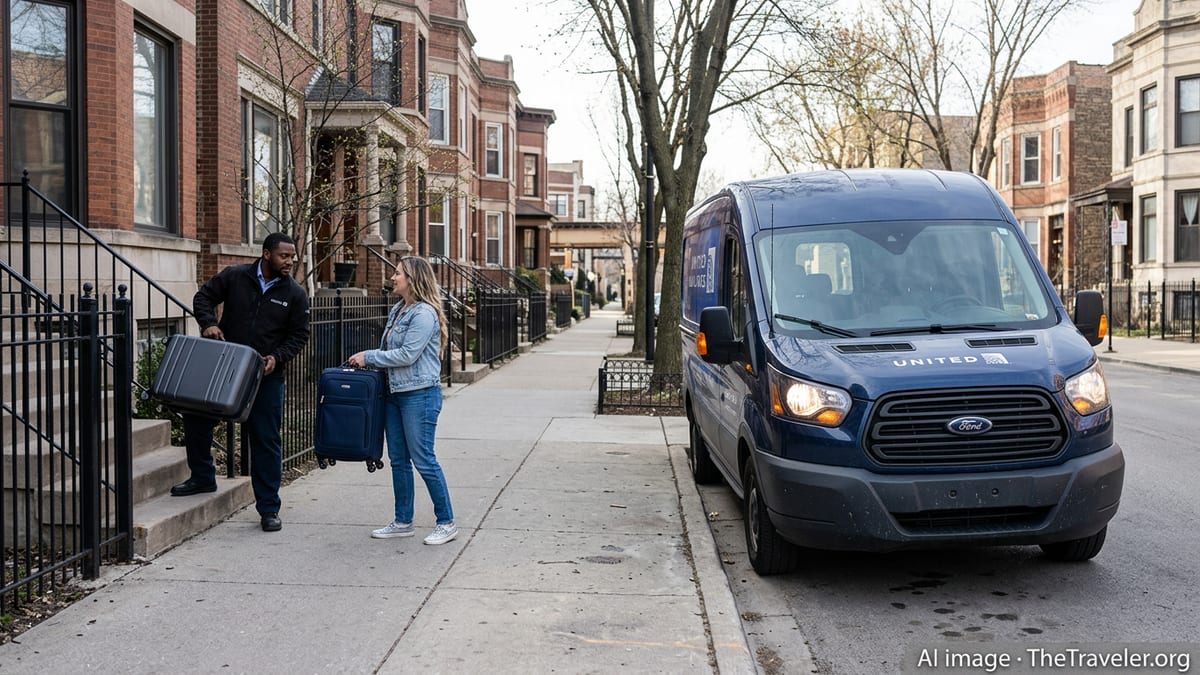
A Quiet Pilot Aims to Rethink Pre-Flight Logistics
The experimental service surfaced this week as some United customers reported seeing a “Home Bag Pick-Up” option while booking or managing trips, indicating the airline is exploring door-to-airport luggage transfer ahead of departures from Chicago O’Hare International Airport. Aviation outlets and frequent flyers describe the offering as a limited pilot, available only to select customers within specific Chicago-area ZIP codes and for certain itineraries.
Early descriptions of the concept suggest that United, working with a third-party logistics provider, would collect checked bags at passengers’ homes the day before travel. Those bags would then be screened and inducted into the airline’s baggage system ahead of time, allowing travelers to arrive at the airport with only their carry-ons or personal items.
While the airline has long offered post-flight baggage delivery in some markets, picking up bags before a trip represents a more ambitious reconfiguration of the check-in process. For United’s sprawling Chicago hub, which handles hundreds of daily departures across multiple terminals, even small shifts in when and where baggage is processed can ripple through security, ramp operations, and passenger flows.
United has not widely promoted the trial, and the service appears as a pop-up or targeted offer rather than a standard option in the booking path. That low-key rollout underscores how sensitive operational experiments around security-screened luggage can be, particularly in a tightly regulated environment.
Operational and Regulatory Hurdles in Handling Bags From Home
Moving checked luggage from doorsteps to airline conveyor belts is far more complex than a typical courier run. Any home bag collection program must satisfy Transportation Security Administration requirements for chain-of-custody and screening, as well as airport and local security protocols. Industry analysts note that U.S. regulators have historically taken a cautious approach to third-party handling of bags bound for commercial aircraft.
According to people familiar with the pilot, United’s trial appears to be structured so that the airline or its vetted partners maintain control and documentation from the moment a bag is collected. That would likely include identity verification at pickup, sealed tracking, and integration with the airline’s existing baggage tags and digital tracking tools already used at O’Hare.
Any scaling of the service would also require close coordination with the airport’s ramp and baggage teams. United already manages a dense baggage operation at O’Hare, where bags checked at multiple terminals are funneled to the carrier’s main sorting facilities. Introducing a stream of pre-collected luggage into that system would demand clear cut-off times, contingency plans for delays at pickup, and robust communication with travelers if a bag misses its induction window.
Insiders say the pilot is intentionally narrow, allowing United to test procedures on a manageable volume of bags while monitoring performance, mishandling rates, and customer satisfaction. Even in a limited form, the project offers a live proving ground for new processes that could eventually complement or partially replace traditional check-in queues.
Passenger Experience: Convenience Versus Control
For travelers, the appeal of home bag collection is straightforward: one less step at the airport. Chicago-based passengers who rely on public transit or rideshares to reach O’Hare could especially benefit from not hauling large suitcases through train stations, onto shuttles, or across long terminal walks. Families, older travelers, and those on longer international trips may also see strong value in outsourcing the heaviest part of the journey.
Yet the pilot also arrives against a backdrop of anxiety around lost or delayed baggage. Online forums and consumer boards regularly track stories of misdirected luggage through major hubs including Chicago, and some travelers now attach trackers to their checked bags to monitor their location. Asking passengers to surrender bags even earlier in the process may heighten expectations that the airline will get those items to the carousel or final destination without fail.
Customer reaction to early sightings of the service has been mixed. Some frequent flyers welcomed the option as a “pro move” to streamline their O’Hare departure day, while others voiced skepticism about handing off luggage to a third party, raising questions about liability, insurance, and how quickly issues could be resolved. There is also concern that any misalignment between pickup windows and flight times could leave passengers anxious if bag status updates are not frequent and transparent.
United’s challenge will be to frame the service as an enhancement rather than another layer of complexity. Clear rules about latest collection times, bag weight and size limits, and what cannot be accepted from home pickups will likely be crucial, as will reliable digital tracking from the doorstep to the aircraft hold.
Strategic Timing Amid O’Hare Capacity Pressures
The timing of United’s experiment is notable. Chicago O’Hare is a cornerstone of the carrier’s network, and regulators are examining how to manage congestion and delays at the busy hub. Any solution that reduces passenger queues in terminal lobbies, speeds up check-in, or smooths peak-time flows could help the airline respond to mounting pressure around on-time performance and passenger experience.
By shifting some baggage handling off-site and off-peak, United may be looking to re-balance workloads at the airport, particularly during morning and evening rush periods when check-in counters, self-service kiosks, and baggage drops can become crowded. If home collection proves operationally sound, bags that once arrived in big waves just before departure could instead be staged at O’Hare hours earlier, creating a more predictable workload for ground crews.
The pilot also fits within a broader industry movement toward “friction-light” travel, in which more administrative and logistical steps occur before passengers reach the terminal. Airlines have spent years encouraging travelers to check in online, prepay for bags, and use digital boarding passes. Collecting luggage in advance is a logical, if more complicated, extension of that trend.
For United, successfully executing such a service in its largest hub would send a signal to other airports in its network that similar models might be viable, especially in dense metropolitan areas where same-day courier infrastructure is already well developed.
What Comes Next for United’s Home Bag Pick-Up
So far, United has offered few public details about the duration of the trial, pricing, or plans for expansion. Observers say that, in its early phase, the service may be discounted or even complimentary for select customers, allowing the airline to gather data without directly tying customer expectations to a new fee line item.
If the program advances beyond a narrow test, questions will quickly arise over geography and eligibility. It is not yet clear whether United would roll out home bag collection only for Chicago-area flyers within a limited radius of O’Hare, or whether future versions could serve suburbs and satellite cities where travel times to the airport are longer but customer demand for convenience is high.
There are also competitive dynamics in play. Carriers in Europe and parts of Asia have experimented with similar services in recent years, and U.S. airlines are watching to see whether customers will embrace paying for more “off-airport” services. United’s early move at O’Hare could spur rivals to consider their own versions, particularly if the pilot shows measurable gains in customer satisfaction scores or reduced pressure on airport infrastructure.
For now, the experiment remains small, visible only to a subset of United customers and aviation watchers. But as one of the first prominent U.S. tests of large-scale home bag collection tethered to a major hub, it signals how airlines, airports, and regulators are beginning to rethink what it means to start a journey long before passengers see a departure board at Chicago O’Hare.