


More news on this day
Urban rail systems across the globe are entering a pivotal stretch this summer, balancing major construction, capacity upgrades and record ridership as cities push to modernize how people move.
Get the latest news straight to your inbox!
Manila’s LRT-1 hub clears key hurdle for network integration
In Metro Manila, a long-planned ambition to knit together the Philippine capital’s fragmented rail services took a significant step forward this week. Recent government announcements indicate that the Economy and Development Council has approved a variation order for the Light Rail Transit Line 1 South Extension Project, clearing the way for completion of a long-delayed “Common Station.”
The interchange is designed to connect LRT-1 with Metro Rail Transit Line 3 and Line 7, with provisions to integrate the future Metro Manila Subway. Publicly available information describes the node as the country’s largest rail interchange, intended to become the central pivot of a more coherent urban rail network serving the metropolis.
Project documents show that the revised scope covers station completion works, viaduct construction, systems and signaling, and the integration of a unified fare collection system. This is expected to allow passengers to move between multiple lines using a single ticketing platform, reducing transfer times and simplifying journeys across the dense capital region.
While no firm opening date for the full interchange has been set, the latest approvals remove a major procedural obstacle. For Manila’s commuters, who currently navigate a patchwork of rail lines and congested roads, the move is seen by local observers as a crucial precondition for any meaningful shift toward rail-based urban mobility.
Washington’s Metro juggles record ridership and a Red Line shutdown
In the United States, the Washington region’s Metrorail system is experiencing a summer of contrasts, combining major construction on its busiest line with near-holiday record ridership elsewhere on the network. According to published coverage, the system carried unusually high passenger volumes around Independence Day, with ridership figures described as among the strongest since before the pandemic.
At the same time, riders in Maryland face a two-month suspension of Red Line service between North Bethesda and Friendship Heights. Notices from the Washington Metropolitan Area Transit Authority outline a complex program of works, including construction of a second mezzanine at Bethesda station for a future light rail connection, platform rehabilitation at Grosvenor-Strathmore and extensive maintenance on elevated structures along Rockville Pike.
Free shuttle buses are operating in the corridor, supported by temporary bus-only lanes coordinated with state and county transportation agencies. Reports from local outlets describe long queues and crowded buses in the opening days of the shutdown, highlighting the difficulty of replacing a high-capacity urban rail artery, even on a temporary basis.
The construction is scheduled to continue through early September, positioning the shutdown as a stress test for the region’s broader mobility network. Planners have framed the works as an investment in long-term reliability and connectivity, particularly as Metro positions itself for sustained growth in ridership and future rail extensions.
Houston and Seattle test rail capacity during major sporting events
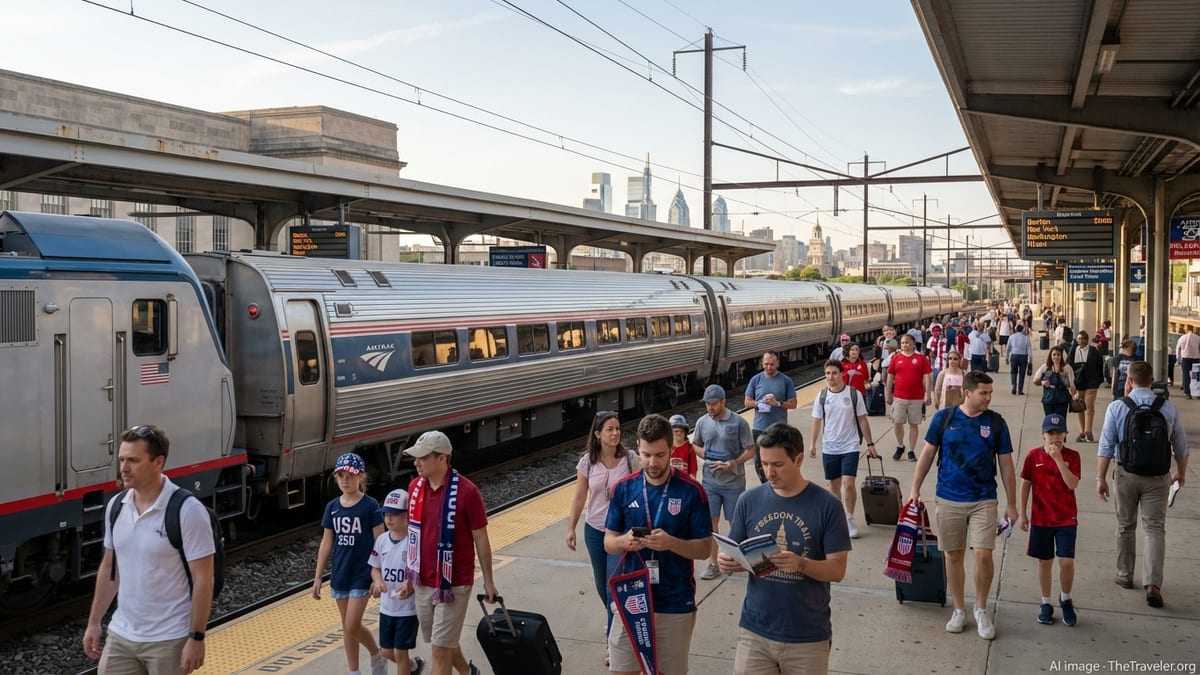
In Houston, preparations for the 2026 World Cup have effectively turned the city’s light rail corridors into a live experiment in high-frequency service. Recent local reporting notes that Metro, the region’s transit agency, has been running extended rail and bus hours since early June to move hundreds of thousands of visitors between stadiums, fan zones and key activity centers.
The enhanced timetable includes late-night operations and more frequent trains, a level of service that transit advocates in the city have long sought for everyday travel. Commentators tracking the changes argue that the World Cup operations could serve as a proof of concept for permanently stronger evening and weekend rail service, provided ridership and funding align once the tournament ends.
Farther north, Seattle’s Link light rail system is also emerging as a case study in event-driven demand. Regional coverage and agency updates indicate that key World Cup matches have driven ridership on Link to some of the highest levels in the network’s history, with multiple days reportedly exceeding 200,000 boardings.
The Seattle experience is drawing attention from transit planners worldwide because Link functions as a hybrid between light rail and light metro, combining frequent service with grade separation on much of the alignment. During large events, the system has effectively acted as the spine of regional mobility, underscoring how sustained investment in urban rail can pay off when cities host global gatherings.
Los Angeles and other North American cities advance light rail corridors
On the project delivery front, several North American cities are pushing ahead with new or expanded light rail corridors aimed at reshaping urban travel patterns. In the Los Angeles region, board reports and advocacy coverage show steady progress on the East San Fernando Valley light rail project, a 6.5-mile line planned along Van Nuys Boulevard that would add 11 stations linking existing bus rapid transit and commuter rail services.
The corridor has been framed in local analysis as a key component of a wider shift toward rail in a traditionally car-dominated region. By placing dedicated rail in the median of a major arterial street, the project is expected to provide more reliable travel times than surface buses, while also supporting higher-density development around stations.
Elsewhere, planning continues in New York on the Interborough Express, a proposed light rail line reusing a freight corridor to create a circumferential link across Brooklyn and Queens. Agency materials and recent commentary describe the project as a high-capacity, mostly grade-separated light rail system designed to connect numerous existing subway and commuter rail lines without entering Manhattan.
Together, these projects signal a growing preference among North American agencies for light rail or light metro solutions that can deliver frequent, urban-scale service at lower cost than traditional heavy rail subways, while still providing substantial capacity and speed improvements over buses.
Global outlook: integration, capacity and resilience at the forefront
Beyond individual projects, current developments point to several shared priorities across the urban rail sector. Integration is a central theme, illustrated by Manila’s Common Station plan, Washington’s construction of a new transfer point for its future light rail, and New York’s efforts to create orbital connections that reduce dependence on radial downtown routes.
Capacity and resilience are also shaping investment decisions. Systems in Washington, Houston and Seattle are all testing the limits of their infrastructure under the strain of large-scale events and seasonal peaks. Their experiences are feeding into debates about fleet size, signaling upgrades and the relative merits of fully grade-separated metro systems versus modern light rail.
Finally, the current wave of upgrades highlights the role of construction management and passenger communication in maintaining public support. Summer shutdowns such as Washington’s Red Line closure are drawing attention to the short-term costs of essential renewal, even as agencies emphasize long-term gains in safety, reliability and accessibility.
For travelers and daily commuters alike, the result is a moment of noticeable change on many city rail maps. New links, temporary gaps and intensified service patterns are converging to redefine how urban rail supports mobility in some of the world’s busiest metropolitan regions.