

More news on this day
Thousands of air travelers across the United States and Canada faced cascading disruption on Tuesday as more than 100 flights were canceled and hundreds delayed at major hubs, with Emirates, Delta, Jazz, Etihad Airways, United and other carriers struggling to keep schedules intact amid turbulent weather and widening knock-on effects from Middle East airspace closures.
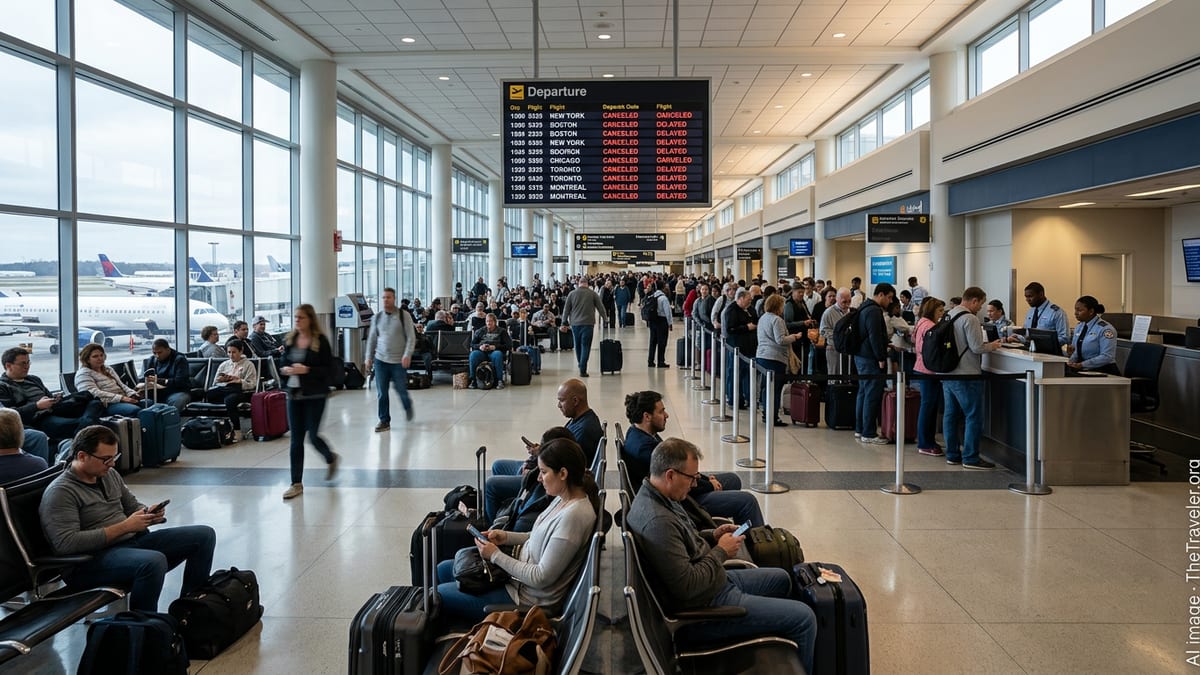
Major Hubs From New York to Montreal Buckle Under Strain
The latest data from aviation trackers and airport operations show at least 104 flights canceled and more than 200 delayed across North America, hitting key gateways including New York, Boston, Chicago, Toronto and Montreal. The disruption has left departure boards splashed with red and terminals crowded with passengers waiting for rebooking options that, in many cases, stretch days into the future.
In the United States, New York area airports and Chicago O’Hare are once again among the hardest hit, reflecting their role as critical connectors for domestic and long-haul international traffic. A mix of lingering winter weather impacts, tight runway capacity and crew duty-time limits has magnified every operational hiccup. Even modest schedule changes have quickly snowballed into missed connections and aircraft out of position.
In Canada, Toronto Pearson and Montreal-Trudeau have been dealing with their own elevated rates of cancellations and delays. Regional carrier Jazz, which feeds Air Canada’s network, has seen a noticeable share of flights disrupted, amplifying the difficulties for travelers relying on connections to and from smaller communities across the country.
For travelers, the result is a familiar but still bruising picture: overnight stays on terminal benches, long lines at service desks, and scarce same-day alternatives as popular routes quickly sell out. Airlines have urged passengers to use mobile apps and online tools for rebooking, warning that phone and in-person wait times remain high.
Global Ripples: Gulf Airspace Closures Reach North American Gates
Behind the immediate numbers lies a more complex and increasingly global story. Continuing airspace closures and operational suspensions across the Middle East, including the grounding of most commercial operations in Dubai and Abu Dhabi, have sent shockwaves through international networks. Emirates and Etihad Airways, which typically funnel vast flows of traffic between North America, Europe, Africa and Asia via their Gulf hubs, remain under severe constraints.
With Emirates suspending scheduled passenger flights to and from Dubai and Etihad sharply curtailing Abu Dhabi operations, long-haul itineraries that once moved smoothly through the Gulf have been thrown into disarray. Aircraft and crews that would normally be cycling through Middle Eastern hubs are instead parked, diverted or reassigned, shrinking the pool of available long-haul capacity worldwide.
That pressure is now evident at North American gateways. Flights linking cities such as New York, Boston, Chicago, Toronto and Montreal to onward destinations in South Asia, Southeast Asia and Africa have become harder to secure, as carriers ration seats on remaining services and grapple with longer reroute times around closed airspace. Even airlines not directly operating to the region are feeling the knock-on effects as displaced passengers hunt for alternative routings through Europe or other hubs.
Industry analysts say the combination of extended flight times, complex diversions and constrained airport capacity has eroded the usual operational buffers that help airlines absorb weather or technical disruptions. The result is a network that reacts more sharply to every new delay, leaving passengers in North America exposed to crises unfolding thousands of miles away.
Airlines Facing Mounting Operational and Customer-Service Challenges
For airlines, the latest wave of disruption has highlighted the fragility of tightly wound schedules at the tail end of the winter season. Delta and United, both with large domestic and transatlantic footprints, have been forced to trim flights and juggle aircraft assignments when weather systems or overseas airspace restrictions upset carefully planned rotations.
Emirates and Etihad Airways, though based far from North American shores, have become central characters in the story as their hub-and-spoke models stall under regional airspace constraints. Their services to Canadian and US cities feed an intricate web of onward connections; when those hubs are partially shut down, the impact reverberates across multiple continents and time zones.
Canadian regional operator Jazz has also been affected, with a cluster of cancellations and delays that ripple outward through Air Canada’s network. Each canceled feeder flight can strand passengers at smaller airports or sever connections to transborder and transatlantic services from Toronto and Montreal, compounding the sense of uncertainty for travelers trying to reach Europe or the United States.
At the same time, carriers are under pressure to manage customer expectations and regulatory obligations. While weather-related disruptions and airspace closures typically fall under force majeure provisions, consumer advocates have renewed calls for clearer communication, more proactive rebooking and better accommodation options when large numbers of travelers are stranded overnight.
Travelers Confront Long Lines, Limited Options and Rising Fares
On the concourses at New York, Boston, Chicago, Toronto and Montreal, the human impact is most visible. Families cluster around power outlets, business travelers refresh airline apps in hope of an earlier seat, and international passengers juggle visa rules and connection windows as they evaluate whether to wait, reroute or abandon trips entirely.
With capacity constrained and rerouted long-haul flights taking longer than usual, remaining seats on alternative services have become harder to find. Some passengers are being offered departures days later than originally planned, while others are forced into complex multi-stop itineraries via secondary hubs that add hours of travel time and multiple changeovers.
Pricing dynamics have added another layer of difficulty. As airlines manage inventory on fewer available long-haul flights, fare classes with change flexibility have become scarce and more expensive. Travelers who booked basic economy or heavily restricted tickets now face a maze of conditions that can limit their ability to switch routes without paying substantial fees or fare differences, even when disruption stems from factors beyond their control.
Airport staff and frontline airline employees, often the only visible representatives of large carriers during a crisis, have reported heightened tension and frustration at customer-service counters. Many are balancing strict policy guidelines with attempts to find creative solutions, such as rerouting via smaller hubs or coordinating with partner airlines to secure final-leg connections.
What Passengers Can Do Now as Disruptions Continue
With schedules for the coming days still in flux, travel experts advise that passengers treat any itinerary touching New York, Boston, Chicago, Toronto or Montreal with caution, especially if a Gulf or South Asia connection is involved. Those with imminent departures are urged to monitor flight status frequently and to assume that previously confirmed routings may change at short notice.
Travel planners recommend that affected passengers focus first on securing a new seat, even if the replacement routing is less than ideal, as capacity tightens quickly when major hubs are under stress. Once confirmed on an alternative flight, travelers can then pursue refunds, vouchers or travel insurance claims, documenting delays and cancellations with screenshots and airline communications.
For future bookings, specialists suggest building in longer connection windows on complex international itineraries and considering travel insurance products that specifically cover missed connections and extended delays. While no policy can eliminate the risk of disruption, additional protection can soften the financial blow when operational shocks cascade across global networks.
As airlines, regulators and airport authorities grapple with the immediate crisis and its underlying causes, passengers across the United States and Canada remain on the front line of an aviation system under exceptional strain, reminding the industry that in an era of tightly linked global routes, local weather and distant conflicts can combine to upend travel plans in an instant.