

More news on this day
Thousands of travelers across the United States and Canada are facing fresh disruption today as at least 104 flights are canceled and more than 200 delayed, with major carriers including Emirates, Delta, Jazz, Etihad Airways and United reporting schedule upheaval on key routes through New York, Boston, Chicago, Toronto and Montreal.
Middle East Airspace Closures Ripple Into North American Hubs
The latest wave of disruption follows the abrupt closure of large sections of Middle East airspace after late February strikes on Iran, which forced Gulf states and neighboring countries to restrict overflights and halt operations at key hubs. The resulting gridlock at Dubai, Abu Dhabi and Doha is now clearly visible on departure boards in North American cities that depend on those hubs for long-haul connectivity.
Emirates and Etihad Airways, which funnel tens of thousands of connecting passengers each day between the Americas, Europe, Africa and Asia via their Gulf hubs, have suspended large portions of their operations while airspace restrictions remain in place. That has cascaded into cancellations out of New York and Toronto on some of their most popular North American services, stranding passengers who were due to connect onward through the United Arab Emirates.
Schedule data and airport operations logs reviewed today indicate that at least 104 flights serving North American passengers have been canceled or terminated early as carriers attempt to reposition aircraft and crew. More than 200 additional flights are operating with significant delays, in many cases because they are forced to reroute around closed skies, adding hours of flying time and squeezing already tight aircraft rotations.
Aviation analysts say the disruption is among the most complex the industry has faced since the pandemic, because it simultaneously affects airspace, hub airports, and long-haul fleet planning. For passengers in the United States and Canada, the practical effect is immediate: fewer available long-haul seats and heavily disrupted daily schedules at key airports.
New York, Boston and Chicago See Mounting Knock-On Cancellations
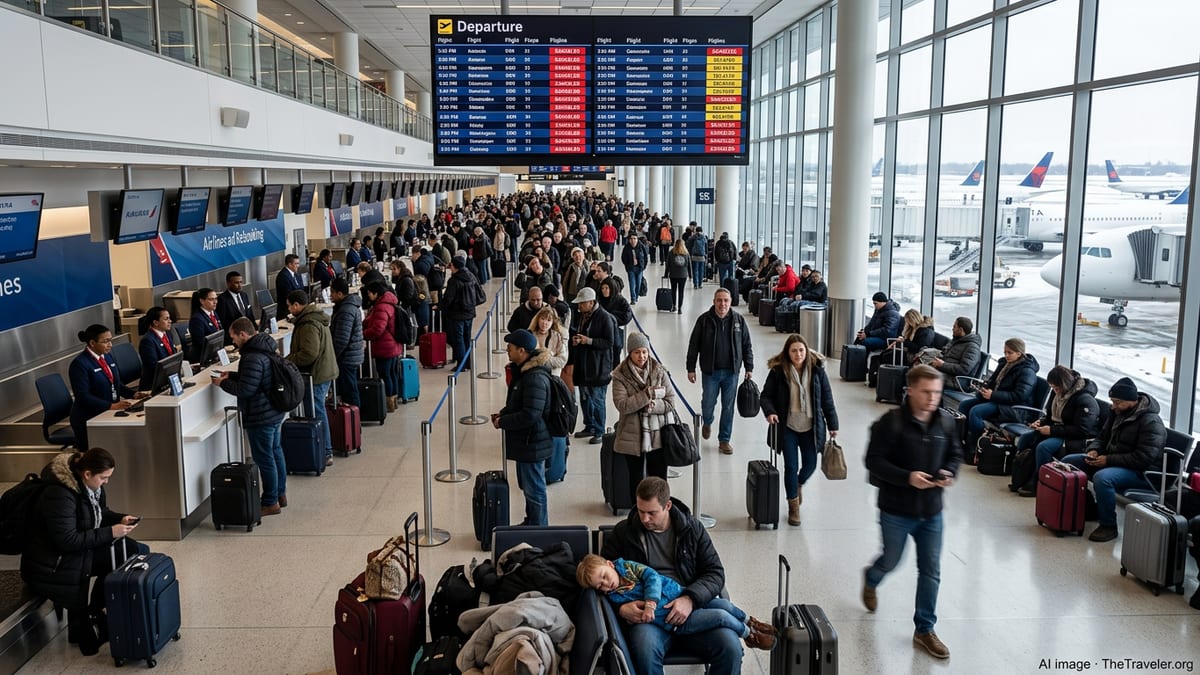
Across the northeastern United States, New York area airports are absorbing much of the initial shock. Long-haul departures linking John F. Kennedy and Newark with Dubai and Abu Dhabi have been trimmed back or scrubbed from schedules, prompting airlines to issue rolling updates and travel waivers for affected customers. Ground staff report crowded rebooking desks and extended queues at customer service counters as travelers scramble for alternatives.
Delta and United, which operate a dense web of transatlantic and connecting services via East Coast hubs, are contending with aircraft and crew displaced by diversions and extended routings around the Middle East. While most of their domestic operations continue, selective cancellations and delays on connecting sectors are emerging as the airlines work to accommodate passengers whose long-haul flights have vanished from the schedule.
In Boston, where Gulf carriers have cultivated a growing long-haul market, morning departures to the Middle East and onward to South Asia have been among the first to be affected. Some flights left hours behind schedule after crew duty-time limits forced last-minute swaps, while others were downgraded or canceled outright, leaving passengers to be rerouted through European hubs instead.
Chicago, a key Midwestern gateway, is also grappling with thinner long-haul options today. Travelers connecting from regional cities onto Chicago flights bound for the Middle East, India or Southeast Asia are finding that their itineraries have been rebooked via Frankfurt, London or Paris as airlines lean on European partners to bridge the gap left by Gulf hub closures.
Toronto and Montreal Struggle With Capacity Crunch
Canadian hubs are feeling similar strain. Toronto Pearson, already one of North America’s busiest international gateways, has reported mounting cancellations and rolling delays on services operated by global network carriers that feed into Gulf and Middle East routes. Passengers heading from Toronto to destinations across the Indian subcontinent and beyond are encountering last-minute schedule changes, often involving additional stops or overnight stays in Europe.
Regional carrier Jazz, which feeds major Canadian hubs with short-haul traffic, has been drawn into the disruption as missed connections and misaligned schedules force adjustments further down the network. Travelers arriving late into Toronto and Montreal because of upstream delays are sometimes finding their onward domestic connections canceled or retimed, adding to the perception of nationwide chaos even among those not traveling long haul.
Montreal-Trudeau, a key transatlantic and Middle East gateway for Quebec, is reporting fewer departures than usual on certain international corridors as airlines trim frequencies and consolidate loads. Long queues at transfer desks and baggage claim areas reflect the confusion typical of sudden large-scale disruptions: passengers waiting for luggage from flights that turned back mid-route, and others seeking clarity on when their rescheduled departures will actually operate.
Airport operators in both Toronto and Montreal have urged travelers to arrive earlier than usual, monitor flight status closely, and be prepared for last-minute gate or timing changes. They also emphasize that, while local weather remains favorable, external geopolitical and airspace factors are driving the current turbulence.
Airlines Juggle Rebooking, Waivers and Crew Constraints
Carriers are responding with an evolving mix of waivers, flexible rebooking policies and tactical schedule cuts. Emirates and Etihad Airways have prioritized limited repatriation services and cargo flights out of their Gulf hubs while encouraging passengers with nonessential travel to postpone trips or accept rebooking on later dates. Tickets issued for travel in the coming days are generally being revalidated without change fees, although fare differences can still apply on certain routes.
Delta has extended change-fee waivers on itineraries touching affected Middle East destinations and has paused some services to Tel Aviv and other points while conditions remain volatile. United is similarly allowing affected passengers to move their travel to later dates or reroute via alternative hubs where seats are available, though options are tightening as the disruption drags on and cabin classes fill.
The complexity of the situation is compounded by crew duty and positioning challenges. Flights forced to take longer, more circuitous routes burn through crew duty hours more quickly, which can necessitate unplanned overnight stops and aircraft swaps. That in turn leaves some North American bases short of pilots and cabin crew for subsequent departures, helping to explain why a disruption centered thousands of miles away is causing cancellations on domestic and transborder routes.
Industry experts note that airlines have become more conservative about maintaining operational buffers since the pandemic, operating with leaner spare capacity. While that boosts efficiency in normal times, it leaves networks more exposed when a major geopolitical shock suddenly alters flight plans across multiple regions at once.
What Travelers in the US and Canada Should Expect Next
For passengers holding tickets in the coming days, the most immediate advice from both airlines and airports is simple: treat all long-haul itineraries as fluid. Travelers booked on routes linking New York, Boston, Chicago, Toronto or Montreal with the Middle East, South Asia or parts of Africa should monitor airline apps and notification channels closely, as departure times and routings may continue to shift on short notice.
Those yet to depart are being urged to confirm whether their flight is actually operating before leaving for the airport, and to build in extra time for security, check in and potential rebooking discussions at the terminal. Travel agents and corporate travel departments are reporting a surge in calls from customers seeking to reroute through European carriers that are still able to skirt the affected airspace, albeit often with longer journey times and limited availability.
Airports and carriers are also preparing for a secondary wave of disruption as aircraft and crews gradually return to normal rotations. Even once some Middle East airspace restrictions are eased, it may take days for long-haul fleets to be restored to their usual patterns, meaning that North American hubs could continue to see rolling cancellations and delays well beyond the initial crisis period.
With global aviation once again reminded of its vulnerability to geopolitical shocks, industry observers say the current turmoil is likely to reignite debates over routing resilience, contingency planning and the concentration of long-haul traffic through a handful of powerful hub airports. For now, though, the focus in terminals from New York to Montreal remains squarely on a more immediate challenge: getting stranded travelers back in the air.