


More news on this day
The United States has placed 23 countries under its highest Level 4 “Do Not Travel” advisory, with recent updates highlighting that nearly half of the destinations facing the strongest warning are in Africa, reflecting an evolving map of global security, conflict and crime risks for international travelers.
Get the latest news straight to your inbox!
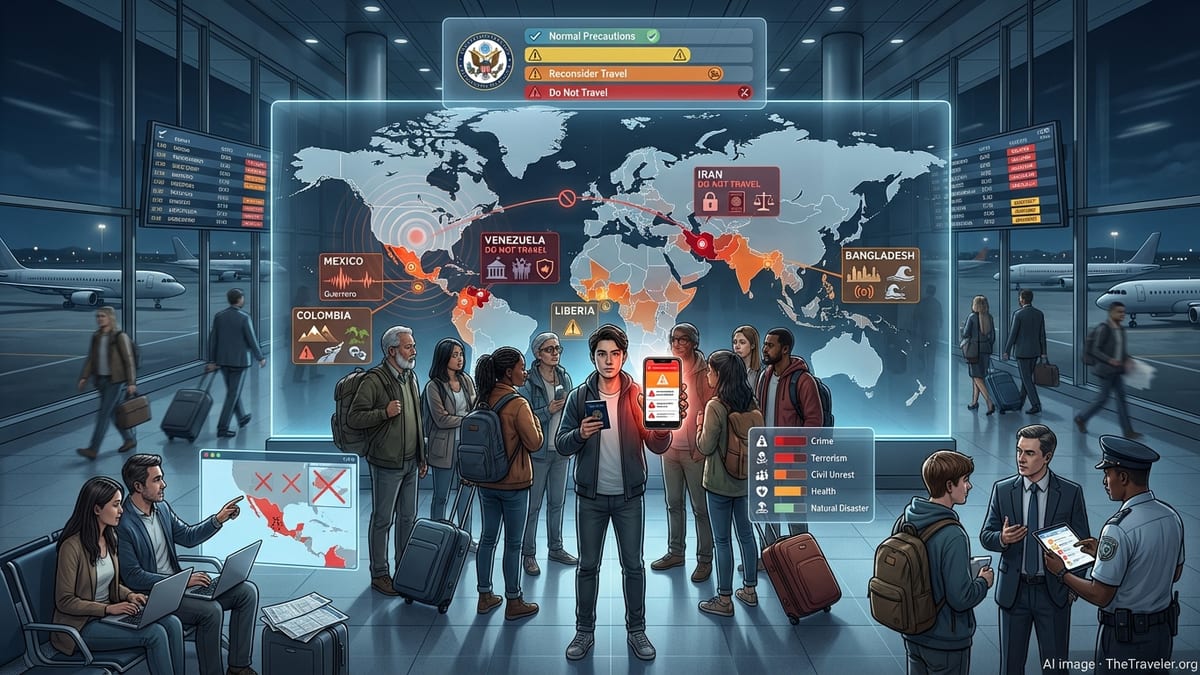
What the Level 4 “Do Not Travel” warning means
Publicly available guidance from the US State Department describes a Level 4 advisory as the strongest form of travel warning in its four-tier system, signaling that travelers should not visit a destination due to extreme risk. The department indicates that such designations usually stem from a combination of factors that can include ongoing armed conflict, terrorism, high levels of violent crime, civil unrest, kidnapping, or serious disruptions to essential services such as healthcare and transport.
Level 4 advisories are not legally binding bans, but they play a powerful role in shaping traveler decisions, insurance policies and corporate travel rules. Many travel insurers either exclude cover for destinations under a Level 4 warning or require additional clearances, and some multinational companies restrict staff movements based on the advisory level, particularly when kidnap or terrorism risks are cited.
The latest configuration of Level 4 destinations shows that risks are concentrated in parts of the Sahel, the Horn of Africa and several conflict zones in the Middle East and Eurasia, together with a small number of locations linked to organized crime or severe governance breakdown. Travel specialists note that, in practice, the warning often deters mass-market tourism even to areas of these countries that may remain relatively calm, as operators weigh liability and evacuation scenarios.
Eleven African countries among the 23 highest-risk destinations
According to recent State Department advisories and compiled coverage across major outlets, 11 of the 23 countries currently at Level 4 are in Africa. While specific names can shift slightly as alerts are revised, the African group is dominated by states facing active conflict or insurgency in parts of their territory, as well as those experiencing chronic instability and high levels of violent crime or kidnapping.
Reports indicate that several countries in the central Sahel and surrounding region appear on the strictest list primarily because of jihadist violence, banditry and the risk of roadside attacks or improvised explosive devices on key routes. Separately, parts of the Horn of Africa are categorized at Level 4 due to clashes between armed groups, cross-border tensions and sporadic attacks in major urban centers. In some coastal and hinterland states, piracy, armed robbery and kidnap-for-ransom affecting both locals and foreigners have also contributed to heightened risk levels.
Publicly available travel advisories emphasize that, across these African destinations, security conditions can change quickly, with sudden airport closures, checkpoints, curfews or internet shutdowns disrupting movement. Travelers who ignore the Level 4 guidance are warned that US government capacity to provide emergency assistance may be limited or nonexistent in some areas, especially where embassies have reduced staff or temporarily suspended operations.
Full list of the 23 countries under the highest US warning
Current advisory information shows 23 countries worldwide listed at Level 4 “Do Not Travel,” spanning Africa, the Middle East, Europe, Asia and the Americas. In addition to the 11 African states identified in recent reporting, the list includes countries that are focal points of ongoing wars or occupation, as well as destinations where large parts of the territory are under the control of non-state armed groups.
Among the non-African states, several are associated in public coverage with full-scale interstate conflicts, extensive missile and drone attacks, and shelling affecting civilian areas. Others are cited for pervasive gang violence, extremely high homicide rates and widespread kidnapping risks that have severely affected both local residents and visiting foreigners. There are also territories in which the breakdown of central authority, contested borders or foreign military interventions have together contributed to the Level 4 rating.
In many of these countries, only limited commercial flight options remain, and overland routes can be disrupted by frontlines, militia checkpoints or damaged infrastructure. Consular advisories stress that neighboring countries may at times close border crossings without notice, and that safe evacuation options for tourists and business travelers can be extremely constrained if security suddenly deteriorates.
Implications for African tourism and regional travel
Researchers tracking African tourism trends note that the concentration of Level 4 advisories in parts of the continent risks reinforcing perceptions of generalized insecurity, even though the vast majority of African destinations remain at Level 1 or Level 2, where travel is broadly considered safe with standard precautions. Industry analysis highlights that countries heavily dependent on safari, beach and heritage tourism can experience collateral reputational effects when nearby states are elevated to the highest warning level.
Regional airlines, tour operators and cross-border bus services are often the first to feel the impact when advisories tighten. Carriers may alter routes or cut frequencies where demand drops, while overland tour companies review itineraries to avoid transit through flagged territories. Insurance conditions can also change quickly, with some providers treating travel to border regions of Level 4 states as higher risk, even when the traveler’s primary destination carries a lower advisory level.
At the same time, tourism boards and private operators in unaffected African countries are working to distinguish their safety profile, emphasizing stable political conditions, upgraded airport and road infrastructure, and professionalized security in major tourist hubs. Analysts suggest that clear communication, transparent crime statistics and cooperation with international safety audits can help mitigate the reputational spillover from high-level warnings applied elsewhere on the continent.
How travelers and companies are adapting to the new risk map
The prominence of 11 African countries in the current roster of 23 Level 4 destinations is prompting many travelers and organizations to revisit how they assess and manage risk. Corporate travel managers increasingly combine official government advisories with private security intelligence, on-the-ground vendor input and real-time monitoring tools that track incidents in specific cities or regions rather than entire countries.
Independent travelers are likewise making greater use of layered information, cross-checking State Department advisories with guidance from other governments, airline updates and local news before deciding whether to proceed with trips. Travel medicine specialists recommend paying close attention not only to security risks but also to the resilience of healthcare systems in Level 4 countries, including the availability of emergency care and medical evacuation options.
Experts in risk management underline that the presence of a Level 4 warning does not necessarily mean every area within a country is equally dangerous, but it does signal that conditions are volatile enough to warrant extreme caution and contingency planning. For destinations under the highest alert, prospective visitors are advised to consider alternative locations, adjust itineraries to safer regions, or postpone travel until publicly available information indicates that conditions have improved and advisories have been lowered.