


More news on this day
Escalating confrontation between the United States and Iran is again rippling through Middle Eastern aviation, with missile and drone attacks on Kuwait and Jordan prompting fresh delays, targeted flight suspensions and new warnings over key Gulf airspace that links Dubai to the wider world.
Get the latest news straight to your inbox!
Missile strikes heighten risk across Kuwait and Jordan
Recent Iranian missile and drone attacks on locations in Kuwait and Jordan linked to United States military assets have sharpened concerns over the safety of regional skies. Publicly available information from regional media and government statements indicates that strikes and interceptions have taken place near major infrastructure and bases in both countries in the past week, as Tehran responds to a renewed American blockade on Iranian ports and expanded US airstrikes.
Reports from Kuwait describe explosions and fires around facilities at the Shuaiba area and Ali Al Salem Air Base, with images circulating on local and international outlets showing smoke rising close to industrial and logistics hubs. In Jordan, widely shared coverage points to attempted attacks on military installations, including Prince Hassan Air Base, with the country’s air defenses reportedly intercepting several ballistic missiles as they entered national airspace.
The evolving pattern of hostilities has turned Kuwait and Jordan into front-line states in the confrontation, raising the prospect of intermittent airspace restrictions whenever attacks or interceptions occur. Aviation analysts note that even when military activity targets specific bases, debris from intercepted missiles and drones can pose hazards to commercial aircraft, particularly during take-off and landing phases.
Travel advisories issued in recent months had already warned of possible disruptions to commercial flights serving Jordan due to the broader US-Iran conflict. The latest escalation is now bringing those risks into sharper relief, with operational decisions increasingly being taken on a day-by-day basis as new attacks and counterstrikes are reported.
Kuwait flight delays and rolling airspace closures
Kuwait International Airport is experiencing tangible knock-on effects from the tensions. Flight-status data compiled by regional travel outlets on July 16 shows a cluster of delayed arrivals from common connecting hubs such as Istanbul, Abu Dhabi and Hyderabad, affecting services operated by airlines including Turkish Airlines, Etihad Airways, Pegasus Airlines and IndiGo.
These delays coincide with intermittent restrictions on Kuwaiti airspace. Local carrier Jazeera Airways has publicly cautioned passengers that short-notice closures or capacity reductions may be required when military activity is detected in the region, warning that some services could be retimed, rerouted or cancelled at limited notice. Other airlines are understood to be making similar operational assessments, although most scheduled flights into and out of Kuwait continue to operate.
Industry specialists emphasize that the disruptions so far remain sporadic rather than systemic, with no prolonged shutdown of Kuwait International Airport reported in recent days. However, the pattern of repeated missile alerts and interceptions has created a more fragile operating environment. Each new round of attacks raises the likelihood of further temporary closures, diversions to alternative Gulf airports, or more conservative routing around suspected conflict zones.
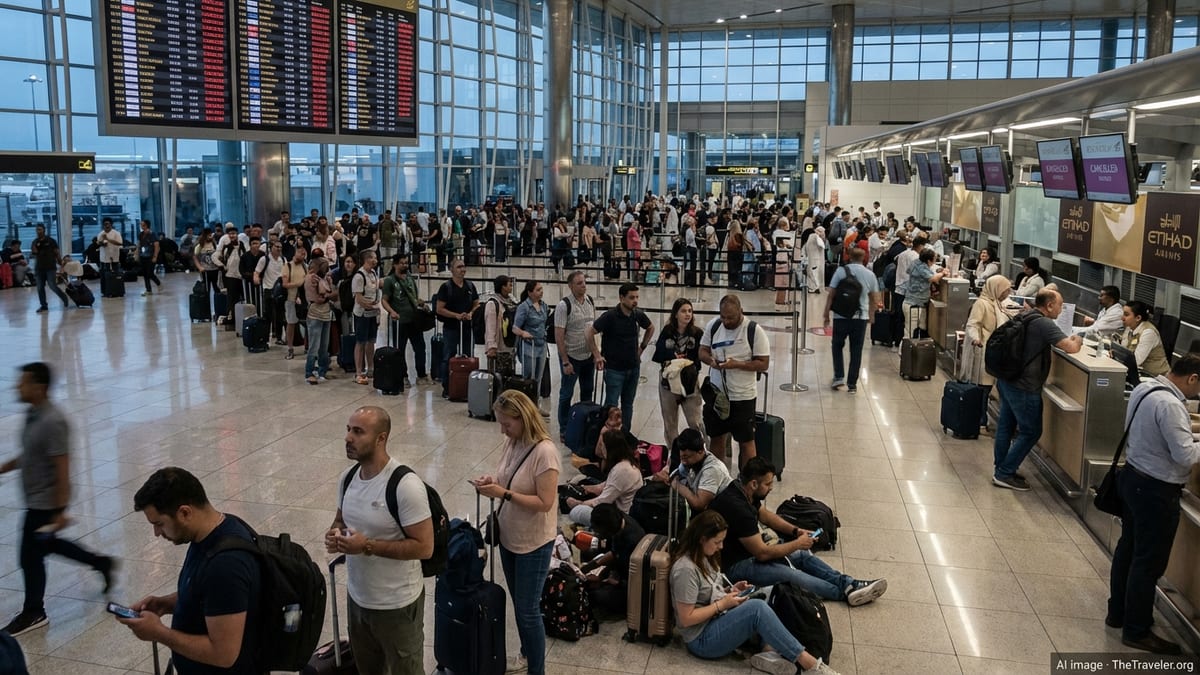
For travelers, the situation translates into a higher risk of day-of-travel changes and longer flight times. Advisories from carriers and travel agencies consistently encourage passengers bound for or transiting via Kuwait to monitor bookings closely, build in buffer time for connections and remain alert to schedule updates issued within hours of departure.
Dubai’s hub role under strain as airlines adjust routes
Dubai remains one of the world’s busiest long-haul hubs, and any turbulence in neighboring airspace quickly reverberates across its vast network. Despite the renewed conflict, Dubai’s airports are still open and handling heavy traffic, but airline operations are becoming more complex as carriers weigh how best to route flights around higher-risk areas linked to the US-Iran standoff.
Recent coverage from Gulf-based media indicates that flight disruption at Dubai and other United Arab Emirates airports currently remains limited in scale, with most services operating broadly to schedule. However, some international airlines have taken a more cautious stance. Singapore Airlines, for example, has extended the suspension of its daily Dubai service, which was initially halted earlier in the Iran war and has not yet been restored amid the latest escalation.
Other carriers are opting to trim frequencies, limit overnight operations or switch to alternative regional gateways where feasible. At the same time, some Gulf-based airlines, particularly low-cost operators, have emphasized that they are maintaining the majority of their schedules while making tactical routing adjustments where required. This mixed approach reflects varying risk appetites and fleet flexibility across the industry.
Dubai’s role as a key stopover point for Europe-to-Asia and Africa-to-Asia traffic means any sustained tightening of surrounding airspace could quickly impact global connectivity. Longer routings around restricted zones in the Gulf and the Strait of Hormuz would add flying time and fuel costs, and could reduce the number of daily rotations airlines can operate with a given aircraft, constraining capacity if the crisis persists.
Safety advisories and evolving airspace risk over the Gulf
The airspace picture over the broader Gulf has grown more complicated since the effective breakdown of a recent US-Iran ceasefire. European aviation regulators have issued detailed guidance describing a high level of risk to civil aviation in the skies above several Gulf states, including the United Arab Emirates, Bahrain, Qatar and Kuwait, as well as portions of the Gulf of Oman. The advisories highlight the possibility of missile and drone overflights, military interceptions and falling debris, all of which can intersect with civilian flight paths even when airports themselves remain open.
Specialist airspace-monitoring platforms tracking the situation in the Emirates report that the country’s airspace remains open but subject to routing constraints. Commercial traffic is being funneled along defined corridors that steer aircraft away from areas of heightened military activity and sensitive maritime zones near the Strait of Hormuz. For airlines, this often means additional coordination with air traffic control and potential reroutes at short notice as threat assessments evolve.
Some non-regional authorities have gone further by formally advising operators against using specified portions of Gulf airspace at any altitude. These notices are not outright bans in all cases, but they exert significant influence over how airlines plan long-haul routes to and from the Middle East. The result is a complex patchwork of national regulations, company safety policies and real-time military developments, all feeding into each carrier’s risk calculations.
Aviation experts point out that previous regional crises have shown how quickly risk assessments can shift. A single high-profile incident involving a civilian aircraft could trigger far more sweeping restrictions, so operators are closely monitoring both the trajectory of the US-Iran confrontation and any change in targeting patterns around airbases, ports and urban areas.
Travel outlook: heightened uncertainty but partial continuity
For passengers planning journeys to, from or through the Middle East in the coming days, the latest escalation presents a picture of heightened uncertainty layered over partial continuity. Airports in Dubai, Abu Dhabi, Doha and other major hubs remain operational, with the majority of scheduled flights still running, while Kuwait and Jordan continue to host regular commercial services despite periodic alerts and delays.
Nonetheless, the combination of missile and drone attacks on territories hosting US forces, shifting airspace advisories and the reimposition of a US naval blockade on Iran means that flight schedules are more vulnerable to sudden change. Individual airlines are updating their policies frequently, extending suspensions on some routes, announcing new diversions or reducing frequencies on others as they reassess the balance between demand, safety and operational complexity.
Industry observers suggest that, unless a new diplomatic framework takes hold, more conservative routings and selective service cuts are likely to persist across the region. Travelers are being encouraged by carriers and travel professionals to stay informed through official channels, confirm flight status shortly before departure and consider flexible booking options that allow for rebooking or refunds if the security situation deteriorates further.
As the confrontation between Washington and Tehran unfolds, the skies above the Gulf and the Levant remain both a lifeline for global commerce and a barometer of regional risk. Each new attack, interception or advisory has the potential to reshape flight paths and timetables, underscoring how tightly international aviation is intertwined with the shifting dynamics of Middle Eastern security.