

More news on this day
A fast-developing snowstorm slamming the northeastern United States has triggered widespread air travel disruption, forcing Emirates, Etihad Airways and Qatar Airways to cancel or reroute dozens of long-haul services to New York, Newark and Boston and leaving thousands of passengers across three continents scrambling to rebook.
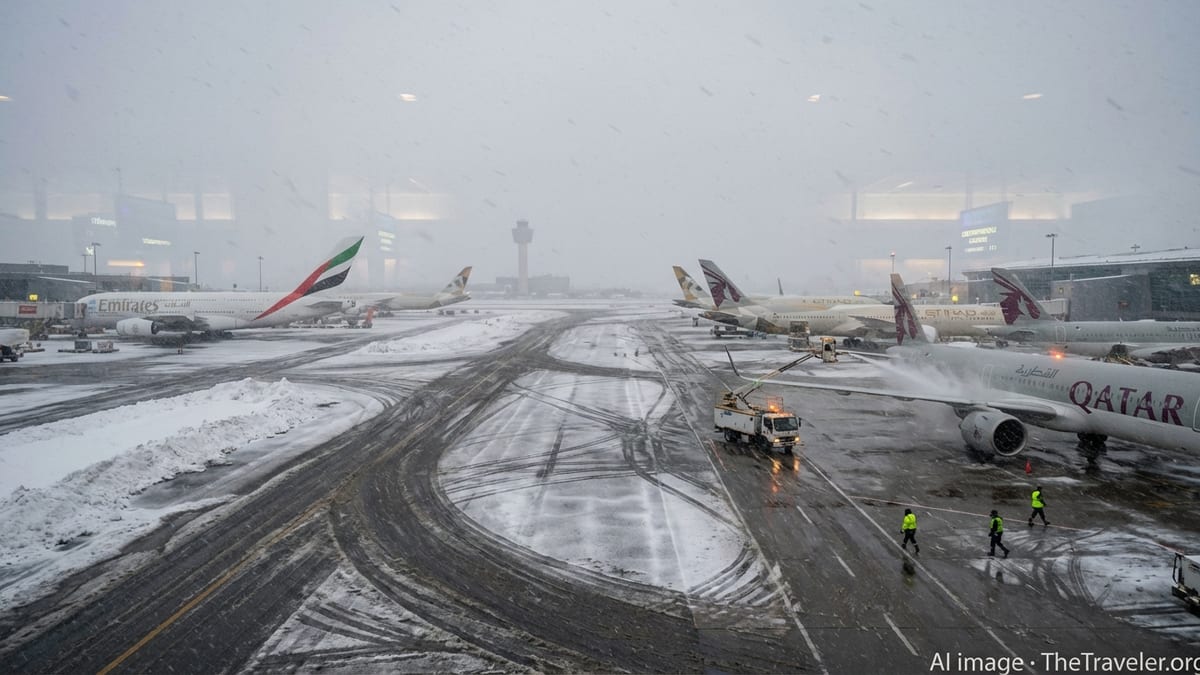
Nor’easter Bears Down on Key US Gateways
The latest powerful winter storm, tracking up the Eastern Seaboard across February 22 and 23, has pushed heavy snow, strong winds and poor visibility into some of the country’s busiest aviation hubs. New York’s John F. Kennedy and LaGuardia airports, Newark Liberty International and Boston Logan reported mounting cancellations and delays as the system intensified through Sunday into Monday.
Forecasters warned of snowfall rates of more than an inch an hour in parts of the Northeast, coupled with gusty winds and pockets of coastal flooding. Those conditions have severely restricted runway operations and ground handling windows, prompting airlines to preemptively pare schedules to avoid aircraft and crew being stranded in place.
The disruption comes as the region is still recovering from a punishing sequence of earlier winter storms that battered large swathes of the United States in late January and early February. Aviation authorities and airlines had hoped for a gradual return to normal operations, but the latest nor’easter has quickly reset the clock on recovery efforts along the East Coast.
With the storm’s track centered squarely over the densely populated Northeast corridor, air traffic control has also implemented flow restrictions and reduced arrival rates into New York and Boston. That has further compressed capacity for long-haul arrivals from Europe, the Middle East and Asia, forcing carriers to choose between diversion, delay or outright cancellation.
Emirates Slashes New York and Boston Services
Dubai-based Emirates, one of the largest foreign operators into the United States, has been among the hardest hit international carriers. The airline confirmed that multiple services between February 22 and 24 have been cancelled or rescheduled as conditions at New York, Newark and Boston deteriorate and airport operations scale back.
Flagship routes on the chopping block include its high-demand Dubai to New York JFK flights, historically among the busiest long-haul links between the Gulf and the US. Services that tag via European and Mediterranean gateways, such as Milan to New York and Athens to Newark, have also seen cancellations and significant schedule adjustments as the storm limits available slots.
Passengers booked on affected flights have been advised that they will not be accepted for travel if their itineraries terminate at or transit through New York, Newark or Boston on cancelled dates. Instead, the airline is directing customers to contact travel agents or Emirates directly to explore rebooking on later services once conditions improve and airports restore more normal operating levels.
Operationally, Emirates is repositioning aircraft where possible and working to protect onward connections for travelers continuing beyond Dubai to Asia, Africa and Australasia. However, tight aircraft utilization and crew duty limits on ultra-long-haul sectors mean some knock-on disruption is likely to persist even after storm conditions ease along the US East Coast.
Etihad Tightens Abu Dhabi–US Network Amid Storm Impacts
Abu Dhabi-based Etihad Airways has enacted similar measures, announcing cancellations and delays on key Abu Dhabi to New York and Newark routes. The carrier grounded selected services scheduled for February 22 and 23 as forecasts solidified around intense snowfall and potential whiteout conditions at New York area airports.
Among the most impacted flights are Etihad’s nonstop Abu Dhabi to New York JFK rotations, including services that typically act as critical connectors for passengers traveling between the Indian subcontinent, Southeast Asia and the eastern United States. With runway and taxiway conditions deteriorating through Sunday, the airline has opted to prioritize safety and operational predictability over maintaining full capacity.
Etihad has issued travel advisories urging passengers flying to or from the Northeast to closely monitor their flight status and to allow additional time for airport check-in and security when services do operate. Rebooking options, including the possibility of shifting to later dates or alternate US gateways once weather allows, are being handled on a case-by-case basis as the storm evolves.
The airline is also coordinating with airport authorities and ground service providers in the US and the UAE to manage aircraft turnarounds and crew rotations. With winter weather systems now affecting North America more frequently this season, Etihad’s operations teams are facing the challenge of maintaining schedule reliability across a global network that is tightly interconnected.
Qatar Airways Faces Knock-On Delays and Rerouting
Qatar Airways, which operates multiple daily services between its Doha hub and US East Coast cities, has also found its transatlantic and transpolar schedules snarled by the storm. While some flights have continued to operate with extended routings around the worst-affected airspace, others have faced lengthy ground delays, rolling departure pushes and last-minute equipment changes.
Services bound for New York and Boston have been particularly vulnerable, given the combination of strong crosswinds, low visibility and ground congestion at those airports. Qatar Airways has adjusted departure times out of Doha to align with revised arrival slots into the US, but the fast-changing nature of the storm and evolving air traffic control restrictions have made long-range planning difficult.
For passengers, the result has been a patchwork of disruption ranging from minor delays to full cancellations. Travelers connecting in Doha from Asia, Africa and the Indian Ocean region have been advised to verify their onward flights before boarding, as same-day connections may no longer be guaranteed when US-bound flights are held or rerouted.
Operationally, the airline is working to minimize crew duty time exceedances and avoid unscheduled overnight stops for aircraft diverted away from the storm zone. Nevertheless, aviation analysts expect Qatar Airways to feel the ripple effects of the Northeast disruption for several days, as aircraft and crew are gradually repositioned and backlogs of passengers are cleared.
US Airports and Airlines Struggle With Capacity Constraints
US carriers and airport operators across the Northeast are contending with a familiar but still formidable mix of challenges: snow and ice control on runways and taxiways, limited visibility for safe takeoffs and landings, and constrained ramp operations as winds and windchill worsen. These pressures have sharply reduced the number of movements per hour that airports can safely accommodate.
Domestic airlines have preemptively scrubbed hundreds of flights, clearing runway capacity for core operations while trying to protect morning and evening banks at major hubs. In New York, where three large airports sit within tightly controlled airspace, even minor shifts in weather and visibility can force controllers to reduce arrival rates, creating immediate bottlenecks for both domestic and international arrivals.
Ground handling has been further complicated by the need to de-ice aircraft repeatedly during periods of heavy snowfall, extending turnaround times and consuming de-icing fluid stocks. Baggage handling and catering operations have also slowed as staff contend with slippery ramp conditions and subfreezing temperatures.
These constraints have forced airport operations centers and airlines to collaborate on prioritizing which flights operate and when. In many cases, long-haul international arrivals and departures have been given precedence when conditions allow, in order to prevent aircraft from diverting to secondary airports or being stuck at outstations with limited support infrastructure.
Global Ripple Effects for Long-Haul Travelers
The storm’s impact reaches far beyond the Northeastern United States. For Emirates, Etihad and Qatar Airways, the sudden reduction in East Coast capacity has immediate consequences across their global networks, particularly in regions where passengers rely heavily on Gulf hubs to reach North America.
Travelers originating in India, Pakistan, Sri Lanka, Bangladesh and parts of Southeast Asia have been among the most affected, as many use one-stop itineraries via Dubai, Abu Dhabi or Doha to reach New York and Boston. With US-bound legs suddenly cancelled or rescheduled, some passengers have found themselves stuck mid-journey, while others have had to delay departures from their home airports altogether.
The disruption also reverberates into corporate and premium travel segments, as business travelers with tight schedules face missed meetings, events and connections. While airlines are generally issuing waivers for change fees on affected routes, rebooking into the limited number of available seats over the next several days remains a challenge, especially on already busy post-holiday and early-week services.
Beyond the Gulf, European and Asian carriers with code-share agreements and alliance partnerships with Emirates, Etihad and Qatar Airways are working to accommodate stranded passengers where possible. However, the simultaneous impact on multiple US hubs during a major storm limits the ability of any one airline or alliance to fully absorb the overflow.
Advice for Passengers Caught in the Disruption
Travel experts and consumer advocates are urging passengers scheduled to travel to or through the Northeast of the United States in the coming days to take a proactive approach. The first recommendation is to check flight status frequently, as schedules may change multiple times within a 24-hour window as airlines respond to updated weather and air traffic control guidance.
For those flying on Emirates, Etihad or Qatar Airways, using airline mobile apps and managing bookings online can provide quicker access to rebooking options than waiting on phone lines, which often become overloaded during major weather events. Passengers are also encouraged to ensure their contact details are up to date so they can receive real-time notifications about gate changes, delays or cancellations.
Travelers with flexible plans may wish to voluntarily push trips back by a day or two if their itineraries involve transiting through storm-affected airports. In many cases, airlines are issuing travel waivers that allow one-time changes without additional fees, though any fare differences may still apply during peak travel periods.
At airports, passengers are advised to pack extra patience along with essentials such as medications, chargers, warm clothing and snacks, in case of prolonged waits or unexpected overnight stays. With hotels near major hubs quickly filling up during large disruption events, some travelers may find themselves relying on in-terminal amenities and airline-provided accommodation only in limited cases where regulations or company policies require it.
Storm Highlights Vulnerability of Intercontinental Hubs
The latest snowstorm underscores how vulnerable global aviation networks remain to localized extreme weather events, particularly when they strike at critical nodes like New York and Boston. For Gulf carriers that have built their business models around seamless one-stop connectivity between East and West, the sudden removal of key US gateways exposes how tightly interwoven international schedules have become.
Aviation analysts note that while airlines have improved resilience through better forecasting, more robust de-icing capabilities and refined disruption playbooks, there are still hard limits when runways are snow-covered and visibility plunges. Safety-critical decisions to slow or halt operations inevitably cascade across time zones and continents, no matter how sophisticated the planning tools.
In the longer term, the growing frequency and intensity of winter weather events in parts of North America could prompt airlines and airports to revisit infrastructure investment, scheduling buffers and contingency hub strategies. For now, however, the priority for Emirates, Etihad, Qatar Airways and their American counterparts remains clear: safely ride out the storm, restore schedules as conditions allow, and move tens of thousands of displaced passengers to where they need to go.
With forecasts suggesting that snow and wind should gradually ease after February 23, airlines are tentatively planning for incremental schedule recovery midweek. Yet crews, aircraft rotations and passenger backlogs may take several more days to fully unwind, meaning travelers on transatlantic and transpacific routes could feel the knock-on effects well after the last flurries have melted along the US East Coast.