


Frequent Øresundståg trains connect Copenhagen Central Station with Malmö Central in approximately 35 minutes, while Copenhagen Airport is closer to Malmö at around 20 minutes by direct train. This makes Malmö one of the easiest international day trips from Copenhagen, and a very viable option for a relaxed weekend across the bridge in southern Sweden.
Get the latest updates straight to your inbox!
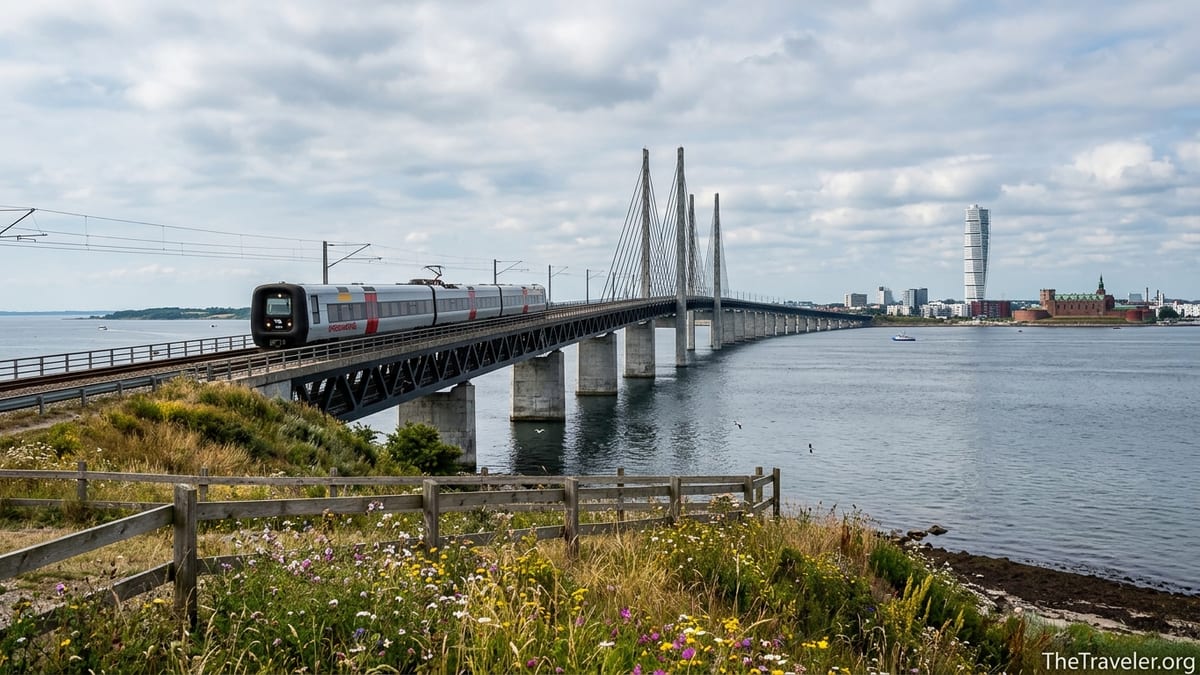
Getting from Copenhagen to Malmö by Train
The Copenhagen to Malmö journey runs along the Øresund Line, with trains marketed as Øresundståg on the Swedish side and usually shown as regional trains on Danish departure boards. Current timetables indicate up to six trains per hour at peak between Copenhagen and Malmö across the bridge, shared with other services on the corridor. In practice, visitors typically see a train at least every 20 minutes during daytime, slightly less frequently in late evenings or early mornings, so it is rarely necessary to reserve in advance for standard tickets.
The travel time between Copenhagen Central Station and Malmö Central is about 35 minutes, with intermediate stops at Ørestad, Copenhagen Airport (Kastrup), Hyllie and Triangeln. From Copenhagen Airport, the ride to Malmö Central is shorter at roughly 20 minutes. At the time of writing, the primary operators involved are Skånetrafiken on the Swedish side and DSB on the Danish side, while Øresundståg is the cross border brand and rolling stock. Schedules can change during track works, so checking Skånetrafiken or DSB journey planners close to your travel dates is important.
For most leisure travelers, the easiest solution is to buy a cross border ticket valid on Øresundståg between Denmark and Skåne. On the Danish side, DSB sells Øresund Tickets from station ticket machines and staffed points of sale, covering Copenhagen Central or Copenhagen Airport to Malmö and beyond. On the Swedish side, Skånetrafiken sells similar tickets via ticket machines, the Skånetrafiken app and some agents. These are distance based tickets rather than reservations for a specific train, which means you can usually board any suitable Øresundståg within the validity window.
When comparing options, Skånetrafiken single tickets in the app are often slightly cheaper in Swedish krona than buying equivalent tickets on international rail sites, and may include local buses and city transport on one or both sides of the bridge within selected zones. DSB Øresund Tickets are priced in Danish kroner and are convenient if you start your journey in Copenhagen and prefer card or contactless payment in a station machine or 7-Eleven kiosk.
Ticket Types, Validation and Border Requirements
Skånetrafiken’s mobile tickets are widely used by commuters and visitors. You download the app, create an account, choose a journey such as “CPH Airport Kastrup” to “Malmö C,” and purchase a single or 24 hour ticket. The ticket price is fixed for the distance and is not cheaper if you book far in advance. Tickets usually have a flexible time window and are activated either manually just before you board or automatically for a selected departure. Inspectors will scan the QR code or visually check the mobile ticket, so you need a charged phone and screen that can be read.
Paper tickets from DSB or Skånetrafiken machines are printed with a validity period and do not need to be stamped in a separate validator, since they are already time stamped. These can be checked on board by roving inspectors. Some cross border tickets cover both the train ride and local transport in Copenhagen zones 1 and 2, as well as Malmö city buses, which is useful if you plan to combine Malmö sightseeing with a Copenhagen evening.
Historically, border ID checks were introduced during migration surges, with controls at Hyllie on trains arriving from Denmark. At present, systematic passport checks are not the rule, but regulations can change quickly. Travelers should carry a valid passport or national ID card suitable for crossing the Denmark Sweden border within the Schengen area, since spot checks can occur and transport companies can refuse boarding if you lack proper identification. Third country nationals should also comply with Schengen entry rules and visa requirements.
For return journeys, day trip tickets and 24 hour products can represent good value if you expect to cross the bridge twice in a single day, while monthly commuter passes exist for regular cross border workers and students. In the event of disruptions, notification is usually pushed through the Skånetrafiken app, station departure boards and platform loudspeakers. Rail works on the Øresund Line are often scheduled in advance and can reduce frequency or require replacement buses, so it is wise to allow extra time for evening returns to Copenhagen, particularly in winter.
Where to Arrive: Malmö Central, Triangeln or Hyllie
From the viewpoint of most visitors, Malmö Central Station is the best general purpose arrival point. The underground platforms connect directly to the compact historic center. From here, it is a 5 to 10 minute walk to Stortorget, Lilla Torg, Gamla Väster and the main pedestrian streets. Many of the larger chain hotels are clustered immediately around the station, and the waterfront promenade, Malmö Saluhall food hall and the route toward Turning Torso and Västra Hamnen all start effectively from this node.
Triangeln is a central underground station on the southern edge of the inner city, close to the Triangeln shopping center and a short walk from the more bohemian Möllevången district. If you plan to stay near Sankt Johannes Church, along Södra Förstadsgatan shopping street, or want immediate access to Möllevångstorget with its dense cluster of ethnic eateries and bars, getting off at Triangeln saves some walking compared with Malmö Central. Hotels around Triangeln often appeal to travelers seeking a slightly quieter but still very urban base, with easy bus and bike connections.
Hyllie lies on the Swedish side of the bridge and is the first stop after crossing from Denmark. It serves Malmö Arena and the large Emporia shopping center. Hyllie can be the logical arrival station if your hotel is in that area, if you are attending a concert or match at the arena, or if you mainly want quick access to the motorway network and park and ride facilities. For short cultural sightseeing in Malmö’s historic core, however, continuing two more stops to Triangeln or Malmö Central is usually more convenient.
All three stations are integrated with local buses and cycling routes, so it is easy to adjust your arrival choice based on hotel location. Some visitors arriving late at night from Copenhagen Airport prefer Malmö Central for its wider range of visible services, while early morning commuters going to Malmö Arena offices may choose Hyllie for speed and simplicity.
Sightseeing on Foot: Historic Center, Parks and Waterfront
Malmö’s center is compact and lends itself well to walking. From Malmö Central, a natural first stop is Stortorget, the city’s large 16th century main square framed by the town hall and equestrian statue of King Karl X Gustav. Just behind Stortorget lies Lilla Torg, a smaller cobbled square ringed by colorful historic buildings and outdoor terraces. Cafes and bistros here are popular for coffee or an early evening drink rather than budget dining, but the atmosphere is a highlight in mild weather.
Gamla Väster, west of Lilla Torg, is one of Malmö’s most charming quarters, with narrow streets, low pastel houses and small design boutiques. This area is entirely free to explore on foot and is a good illustration of why Malmö is best appreciated at a strolling pace. From Gamla Väster, it is a short walk to Kungsparken and Slottsparken, the extensive green space that wraps around Malmöhus Castle and the old moat. The parks are free public areas and provide pleasant canalside paths, small bridges and shade in summer, with some sections wind exposed in autumn and winter.
Malmöhus Castle, dating originally from the 16th century, houses the Malmö Museum complex. The museum group, which may include exhibitions on local history, art and science, charges an admission fee that is typically set as a single combined ticket, often valid for more than one day. Children often benefit from reduced or free admission depending on age, but exact prices and included museums should be checked on arrival, as they are periodically adjusted. The castle courtyard and exterior are accessible without charge, so budget travelers can still appreciate the fortification and its setting even if they skip the paid galleries.
From the castle area, visitors often continue toward Malmö Saluhall, a modern food hall located in a former industrial setting near the docks. Entry to the hall is free and it provides a convenient lunch stop or coffee break. Beyond the food hall, promenades lead toward Västra Hamnen, the redeveloped Western Harbor district. Here, the Turning Torso residential skyscraper defines the skyline. There is no public viewing deck inside the building and entry is restricted, but the surrounding plazas and waterfront boardwalk are open public space, offering striking views across the Øresund toward Copenhagen and the bridge.
Ribersborg Beach, Cycling and Local Transport
Ribersborg beach stretches west of central Malmö and can be reached on foot from Västra Hamnen in around 20 to 30 minutes, or by bus or bicycle from other parts of the city. The sandy strand faces the bridge and Copenhagen skyline and remains a popular walking and jogging route in all seasons. In summer, locals swim along the shore and at the historic cold bathhouse, which charges a separate modest admission fee for saunas and jetties. Access to the general beach area and promenade is free year round.
Malmö is well known for its cycling infrastructure, with segregated bike lanes along most main arteries and marked crossings at junctions. Visitors can rent bicycles from private rental shops, hotels or app based schemes that operate in Swedish krona. Helmets are recommended, and riders are expected to follow local traffic rules, including signaling and respecting separate lanes for pedestrians and cyclists. The relatively flat topography makes two wheels a realistic way to connect Malmö Central with the castle, Västra Hamnen and Ribersborg in a single loop.
Local buses, branded under Skånetrafiken, link Hyllie, Triangeln, Malmö Central and outlying districts. Tickets are integrated with the wider regional system and can be bought in the Skånetrafiken app as city zone tickets, day passes or as part of cross border tickets that include Malmö city. Cash payment on board is uncommon; instead, riders use mobile tickets, prepaid cards or travelcards. For visitors staying in the central districts, walking is usually sufficient for the main sights, with occasional bus or bike use to reach more distant residential neighborhoods or for late night returns.
Cycling safety is generally good by international standards, with separated paths reducing conflicts. In winter, however, wind off the Øresund can be strong and surfaces occasionally icy. The municipality prioritizes snow clearing on key cycle corridors, but less experienced riders may feel more comfortable switching to buses or walking on very cold or wet days. Families with children will find that many parks and waterfront areas have playgrounds and open lawns, though parents should be mindful of open water edges near the harbor.
Food, Drink and Everyday Prices
Restaurant prices in Malmö reflect Swedish norms for a mid sized city. Surveys and local experience suggest that a typical weekday lunch dish, such as “dagens rätt” at a simple restaurant, often falls in the range of about 120 to 140 SEK, sometimes including coffee or salad. Pizza and kebab outlets in the city frequently price a large pizza around 100 to 130 SEK. More upscale lunch menus around Lilla Torg or in Västra Hamnen can cost more, especially if seafood or high quality meat is involved.
For dinner, many sit down restaurants start main courses at roughly 150 to 250 SEK, with higher prices for steaks or multi course menus. Dining in and around Lilla Torg and the historic center tends to command a location premium, while Möllevången offers a denser mix of budget friendly international choices, including Middle Eastern, East Asian and African cuisines. Around Malmö Saluhall, visitors find mid range street food counters, bakeries and specialty coffee bars, where a casual meal might sit in the 120 to 200 SEK bracket before drinks.
Breakfast costs vary widely depending on whether you eat at a hotel buffet, a chain bakery or a small café. Many hotels include breakfast in the room rate. Outside, a coffee and pastry from a bakery might run 40 to 70 SEK, whereas a more elaborate café brunch plate with eggs and bread could range upward from around 120 SEK. Compared with Danish prices in central Copenhagen, many travelers perceive Malmö’s food and drink to be slightly cheaper, particularly for casual meals and supermarket purchases, though alcohol remains comparatively expensive by international standards.
In everyday spending, visitors who self cater will notice that Swedish supermarket prices for staples such as bread, dairy and basic groceries often undercut those in central Copenhagen, especially if shopping at large supermarkets rather than convenience kiosks. This is one of the reasons some budget conscious travelers consider basing themselves in Malmö while exploring the wider Øresund region.
Where to Stay: Neighborhoods and Hotel Atmosphere
Hotels around Malmö Central Station are the most practical choice for short trips. Chain hotels and business oriented properties cluster immediately north and east of the station platforms, offering fast access to Øresundståg departures, airport buses and long distance trains. This area feels busy on weekdays and can be somewhat traffic heavy, but it delivers maximum convenience if you are catching early morning trains back to Copenhagen or beyond. Prices range from budget to four star levels, with room rates fluctuating according to conferences and events.
Staying near Gamla Väster and the pedestrian streets west of Stortorget provides a more atmospheric base, with cobbled streets and historic buildings just outside your door. Smaller boutique hotels and apartments here appeal to couples and design minded travelers who prioritize character and proximity to cafes over immediate station access. Noise levels vary; some cobbled lanes are quiet, while corners near busy bar streets can be livelier on weekend nights.
The Triangeln district offers modern hotels connected to the underground station and mall. This area feels less touristy than the central squares, with quick access to both the historic core and Möllevången’s nightlife and food scene. It suits visitors who want a contemporary environment, reliable public transport and a slightly less hectic feel than right at Malmö Central. Prices here are often similar to central station hotels, though occasional deals appear on weekends when business travel dips.
Västra Hamnen, including the area around the Turning Torso and waterfront boardwalk, hosts a smaller selection of hotels and serviced apartments. The atmosphere is residential and airy, with immediate access to the sea, bathing jetties and sunset views over the Øresund. Reaching the city center requires a bus or a 20 to 30 minute walk, and wind exposure can be strong outside summer. Accommodation prices here can be higher than average, reflecting the modern architecture and prime waterfront setting, which many couples and families find rewarding for a relaxed summer stay.
Sample Itineraries: One Day, Weekend and Lund Excursion
For a single day trip from Copenhagen, a realistic plan is to take a morning Øresundståg departing Copenhagen Central around 9:00, arriving at Malmö Central by about 9:35. Walk through Stortorget and Lilla Torg, then continue into Gamla Väster for mid morning photos and a coffee break. Around midday, make your way to Malmöhus Castle and the surrounding parks. If you are interested in museums, allow two hours for exhibits; otherwise, enjoy a shorter exterior visit and more time in Kungsparken and Slottsparken.
After lunch at Malmö Saluhall, spend the afternoon walking or cycling to Västra Hamnen and the Turning Torso surroundings, then follow the waterfront south toward Ribersborg. If the weather is calm, linger at the beach; in strong wind, the parks inland may feel more comfortable. Return to the center by bus or on foot in the late afternoon, take an early dinner in Möllevången or near Lilla Torg, and board an evening train back to Copenhagen, arriving before 22:00.
For a relaxed two day weekend, day one can follow the outline above but at a gentler pace, with more time for museum visits and lingering in cafés. Spend the night at a hotel in Gamla Väster or near Malmö Central. On day two, explore Möllevången’s market square, independent shops and eateries, then consider optional activities such as visiting additional galleries, strolling local residential streets or simply enjoying parks and playgrounds if you are traveling as a family. Evening trains back to Copenhagen are frequent enough that you can depart after dinner and still reach the Danish capital at a reasonable hour.
An optional third day is ideal for a short excursion to Lund, the medieval university town only one station or about 10 to 15 minutes north of Malmö by regional train. Trains on the Malmö Lund section are very frequent during the day. In Lund, the Romanesque cathedral, university buildings and botanical garden are all within walking distance of the station. Adding Lund to your plan means an extra local train fare if you hold only a basic cross border ticket, but some regional tickets and day passes sold by Skånetrafiken include both cities within their validity.
Costs: Day Trip vs Weekend Stay and Commuting Calculations
Exact ticket prices across the Øresund can shift with periodic fare changes, so the following should be treated as broad indications rather than fixed offers. A standard adult single ticket between Copenhagen and Malmö purchased through DSB has recently been listed around 96 DKK from Copenhagen or Kastrup to Malmö in second class. Converted to Swedish krona at recent exchange rates, this corresponds to several hundred SEK for a round trip. Skånetrafiken app tickets for the same journey are typically priced in SEK and can be somewhat more advantageous, especially if you benefit from youth or student discounts.
For a Copenhagen based traveler doing a one day trip to Malmö, a realistic budget might allocate the cross border return fare, local city transport if needed, one café breakfast or coffee, a casual lunch in the 120 to 150 SEK range, an afternoon coffee and a mid range dinner around 180 to 250 SEK. Adding a paid museum visit, such as Malmöhus Castle and its associated museums, may increase the total by another few hundred SEK. Altogether, it is reasonable to anticipate spending the equivalent of several hundred Danish kroner for the full day including train, food and one paid attraction, depending on your restaurant choices.
For a two night weekend stay based in Malmö, you would add two hotel nights to this picture. Mid range centrally located hotels often price rooms somewhere between budget and premium segments, with seasonal peaks when events occur. If you assume a moderate nightly rate rather than a luxury property, then two nights, cross border return tickets and meals for two and a half days in Sweden will usually exceed a simple day trip’s cost, but each individual restaurant meal and supermarket visit on the Swedish side may feel slightly lighter on the wallet than in Copenhagen. Families and couples who share a room can spread the accommodation cost, which improves the value proposition compared with solo travelers.
As for the idea of staying in Malmö while commuting repeatedly to Copenhagen to save money, local discussions suggest that some cross border commuters choose Malmö for lower housing and daily expenses, even though they incur regular train costs. Monthly commuter tickets sold by Skånetrafiken and DSB for the bridge crossing, sometimes in combination with Copenhagen city zones, can amount to several thousand DKK per month. Whether this is worthwhile depends on your rental savings, travel frequency and eligibility for student or youth discounts. For a short leisure stay of a few days, the train costs accumulate quickly if you shuttle back and forth every day, so the advantage of sleeping in Malmö to visit Copenhagen repeatedly is less clear than for long term residents.
Weather, Seasons and Practical Suitability
Malmö shares a coastal North European climate with relatively mild but windy winters and pleasant, often breezy summers. In winter months, daylight can be short, with early sunsets that compress outdoor sightseeing time. The waterfront in Västra Hamnen and Ribersborg is particularly exposed to wind and chill, making parks and indoor attractions more attractive in January and February. In summer, long evenings and cooler sea air compared with inland areas invite extended walks and waterfront dining.
Snowfall in Malmö is typically lighter than in more northerly Swedish cities, but icy patches do occur on pavements and cycle tracks. The municipality prioritizes clearing key paths, yet visitors unaccustomed to wintry surfaces should invest in good footwear and avoid cycling during the worst conditions. Rain showers can be frequent in shoulder seasons, so carrying a light waterproof jacket is practical even in late spring and early autumn.
For families, Malmö’s combination of short walking distances, numerous playgrounds, open lawns and accessible waterfront spaces makes it an appealing destination in good weather. Many buses and trains are low floor with dedicated stroller spaces, and step free access exists at major stations such as Malmö Central, Triangeln and Hyllie, though specific elevators and ramps should be checked on site. Wheelchair users and travelers with limited mobility benefit from the generally level cityscape and modern transport infrastructure, but should still allow extra time for transfers and be mindful that some historic buildings have stair dependent access.
Couples often appreciate Gamla Väster’s intimate streets and Västra Hamnen’s sunsets, while solo travelers enjoy the ease of navigation and the availability of cafés for lingering with a book. Budget travelers can cut costs by using supermarkets, bakeries and casual lunch deals, and by focusing on free attractions such as parks, waterfronts and historic streets, paying only for select museums that match their interests.
Who Should Visit Malmö and How Long to Stay
For couples visiting Copenhagen, Malmö makes an excellent one day or overnight extension. The ease of the Øresundståg connection, the compact old town and the romantic appeal of Gamla Väster and the waterfront mean that a single full day can deliver a strong impression of the city. An overnight stay allows for unhurried dinners and sunset walks without watching the train timetable too closely, particularly during summer when late evening light bathes the harbor.
Solo travelers who enjoy urban wandering may find that a day trip already covers the main highlights, from Stortorget and Lilla Torg to the castle, parks and Västra Hamnen. Those interested in contemporary Nordic city planning and design could justify a weekend to explore Västra Hamnen, university life in nearby Lund and different Malmö neighborhoods at a more analytical pace.
Budget travelers deciding between spending all their time in Copenhagen or allocating a night or two in Malmö should weigh train costs against lower everyday prices in Sweden. For a quick one off experience of another country and currency, a day trip is straightforward and cost contained. For longer itineraries with several days to spare, a weekend based in Malmö with a single round trip across the bridge can allow you to experience two Scandinavian cultures while moderating restaurant and accommodation expenses.
In practice, Malmö comfortably fills a well planned day, particularly for first time visitors. A full weekend reveals more of the city’s neighborhoods, local dining scenes and relaxation possibilities, and makes room for an excursion to Lund. Travelers with only a tight Copenhagen schedule might choose the day trip, while those who enjoy slower urban exploration, waterfront walks and a slightly calmer, more lived in atmosphere than Copenhagen’s central streets will find that Malmö rewards a two night stay.