

More news on this day
Fresh conflict in West Asia has rapidly spiralled into a full-blown aviation crisis, with the United Arab Emirates, Saudi Arabia, Qatar, Kuwait, Bahrain, Lebanon and other states at the centre of unprecedented airspace closures, mass flight cancellations and sweeping last-minute changes to global travel plans.
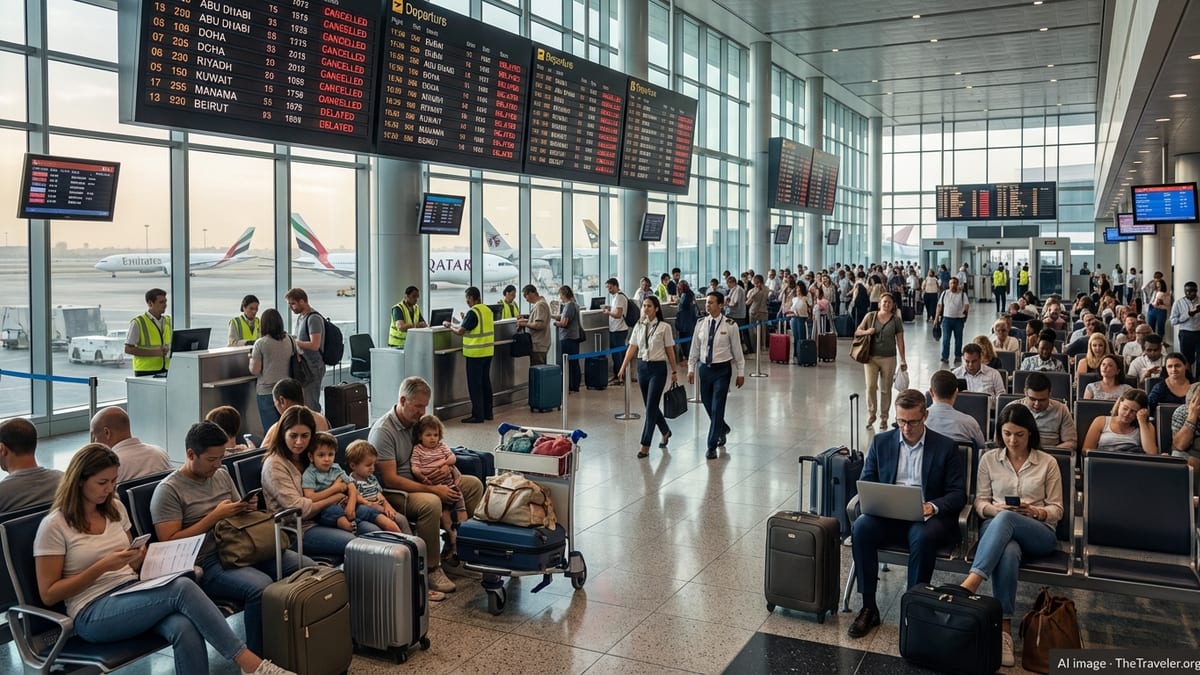
Airspace Closures Hit the Gulf’s Biggest Hubs
The latest wave of US and Israeli airstrikes on Iran, followed by retaliatory attacks, has prompted a string of airspace shutdowns across the Gulf and wider West Asia since late February 2026. Authorities in the UAE, Qatar, Kuwait and Bahrain have all imposed severe restrictions, disrupting traffic through some of the world’s busiest aviation corridors.
Dubai International, routinely the top global hub for international passengers, has seen operations temporarily halted amid reports of drone debris falling in the city and heightened air defence activity. Abu Dhabi, Doha and key airports in Kuwait and Bahrain have also faced suspensions, with airport operators warning that schedules remain highly volatile and subject to rapid change.
The closures are not limited to the Gulf. Lebanon’s Beirut, long a crucial gateway for the Levant, has been affected by regional overflight bans and airline safety assessments, further tightening options for travellers bound for or transiting through West Asia.
Aviation analysts note that the affected airspace effectively sits on the main bridge between Europe, Asia, Africa and Australasia, so even travellers whose tickets do not list Middle Eastern destinations are finding their flights diverted around the region, with stretched routings and extended flying times.
Wave of Cancellations, Rerouting and Longer Journeys
In the hours after the latest strikes, global carriers began cancelling and rerouting services that rely on Gulf and Levantine hubs. Emirates, Etihad, Qatar Airways, Gulf Air and Air Arabia have all announced temporary suspensions or severe reductions across parts of their networks, while foreign airlines including Air France, Lufthansa, Finnair and several Indian and Australian carriers have halted or diverted flights to Dubai, Doha, Riyadh, Beirut and other cities.
Preliminary aviation data suggests that roughly a quarter of scheduled flights into the broader Middle East were cancelled on peak days of the crisis, with even higher cancellation rates on routes into Israel and certain Gulf destinations. Airports in India, such as Delhi, Mumbai and Bengaluru, have reported dozens of cancellations on West Asia routes in a single day, underscoring how deeply the disruption is being felt on key India–Gulf and India–Europe corridors.
For travellers still flying, rerouted journeys are significantly longer. Airlines avoiding Iranian, Iraqi and adjacent conflict-zone airspace are adding several hours to long-haul trips between Europe and Asia or Australia, often with additional fuel stops and tighter connection windows. Schedules are being redrawn day by day as carriers wait for updated safety guidance from regulators and defence authorities.
At the same time, aircraft and crew are out of position, triggering knock-on delays and cancellations well beyond the immediate region. Travellers departing from North America or Europe have reported last-minute aircraft swaps, overnight layovers and missed onward connections, even when their itineraries only nominally touched the Gulf via a single transit stop.
Tour Operators Report Surge in Cancellations and Date Changes
Tour operators and online travel agencies from Asia to Europe say they are now handling a surge in booking cancellations, rebookings and date changes tied directly to the West Asia crisis. Large platforms in India have issued alerts warning that airspace closures over the Gulf are affecting a wide range of itineraries, from leisure holidays in Dubai and Doha to complex multi-stop trips connecting Europe, Southeast Asia and Australia.
Many travellers with imminent departures to the UAE, Saudi Arabia, Qatar, Kuwait, Bahrain or Lebanon are opting to postpone or cancel outright, citing safety concerns and uncertainty about how long airspace restrictions will last. Corporate travel managers are also pulling staff from nonessential trips through the region, redirecting meetings online or shifting them to alternative hubs in Europe or East Asia.
Operators that specialise in winter sun breaks and stopover packages through Dubai, Abu Dhabi and Doha report particularly sharp pain. Packages built around Gulf cruises, beach stays and onward itineraries to Africa or the Indian Ocean are being restructured on the fly, with some customers accepting reroutes via Istanbul, Singapore or European gateways and others seeking full refunds.
The disruption comes at a time when outbound tourism from key markets such as India, Europe and North America had been rebounding strongly, making the sudden pullback especially challenging for hotels, attractions and small travel businesses in West Asia that rely heavily on peak-season demand.
What Travellers Need to Know Right Now
For anyone with upcoming travel touching the UAE, Saudi Arabia, Qatar, Kuwait, Bahrain, Lebanon or neighbouring states, the single most important step is to treat all bookings as fluid. Airlines are adjusting schedules hour by hour in response to evolving military activity and regulatory guidance, and many are issuing broad waivers allowing free date changes, rerouting or refunds for tickets issued before the latest escalation.
Passengers should monitor their airline’s app or notification channels closely, as automated rebooking often happens only once a flight is formally cancelled. In many cases, travellers are being shifted to alternative routings that bypass the Gulf entirely, at the cost of longer journey times and different connection points. Those with tight onward connections or critical events at their destination may want to proactively request more generous layover windows.
Travel insurers are urging customers to check the fine print of their policies. Some comprehensive plans may cover additional accommodation, meals and rebooking fees caused by route changes and delays, while others exclude war and conflict-related disruptions. Travellers who booked via tour operators or online agencies may have different rights and processes for refunds than those who bought direct from airlines.
Officials and aviation bodies in Europe and elsewhere have published conflict-zone bulletins for Persian Gulf and Middle Eastern airspace, signalling that risk assessments will remain conservative for at least the coming days. That means travellers should prepare for the possibility that today’s emergency measures could evolve into a longer period of adjusted routings, reduced capacity and higher fares on alternative corridors.
Planning Ahead as the Situation Remains Fluid
With no clear timeline for the reopening of all affected airspace, industry insiders say flexibility is now the key currency in travel planning. Travellers booking new trips for March and April 2026 that might normally transit the Gulf are being advised to consider routings through alternative hubs, even if they appear slightly more expensive or indirect at first glance.
Airlines, meanwhile, are trying to protect core long-haul networks while trimming frequencies on secondary routes. This could mean fewer daily options, busier remaining flights and reduced award-seat availability for frequent flyers on sought-after corridors such as Europe–Southeast Asia and Australia–Europe. Some carriers are already signalling that capacity constraints and higher fuel burn on longer routings may translate into firmer pricing over the short term.
For the tourism industries of the UAE, Saudi Arabia, Qatar, Kuwait, Bahrain, Lebanon and their neighbours, the hope is that confidence will return once skies reopen and air defences stand down. Until then, hotels and destination marketing bodies are working with airlines and trade partners to reassure future visitors and emphasise flexible booking policies, while accepting that near-term occupancy and arrival figures are likely to dip.
For now, the key message from tour operators and airlines across the globe is simple: stay informed, stay flexible and be prepared for changes. In a region where aviation is the lifeblood of tourism and commerce, the latest West Asia crisis is a stark reminder of how quickly geopolitical tensions can redraw the map of global travel.