


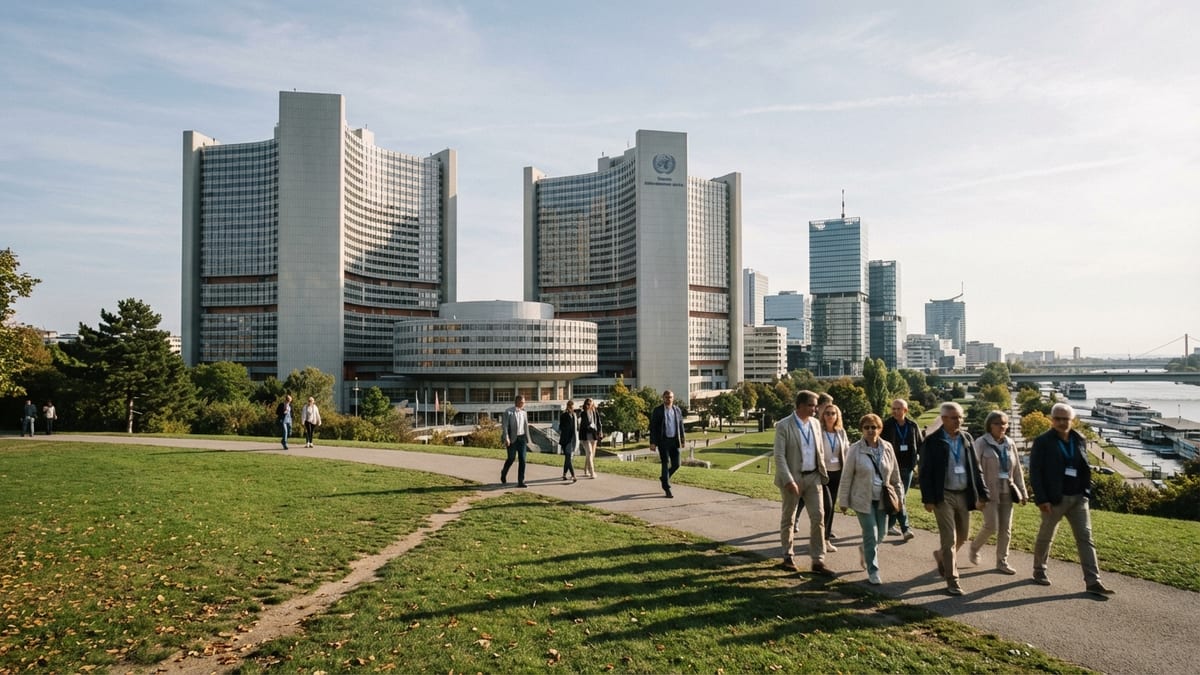
Just across the Danube from Vienna’s historic center lies a very different kind of landmark. Locals call it UNO City, but its official title is the Vienna International Centre.
With its silver Y shaped towers and circular conference building, this self contained campus is one of only four main United Nations headquarters worldwide and has helped turn Vienna into a global crossroads for diplomacy. For travelers, it offers a rare chance to walk onto international territory, peek behind the scenes of multilateral negotiations and see a radically modern side of the Austrian capital.
What Exactly Is UNO City Vienna?
UNO City is the informal name for the complex that includes the Vienna International Centre and the neighboring Austria Center Vienna, a large congress and exhibition venue. When people talk about visiting UNO City, they are usually referring to the Vienna International Centre itself, which hosts the United Nations Office at Vienna and a cluster of other international organizations. It looks and feels like a compact, purpose built city: offices, conference halls, banks, canteens and services that support thousands of staff and delegates every working day.
The Vienna International Centre is one of the UN’s four principal duty stations, alongside New York, Geneva and Nairobi. It is the only one situated within the European Union. Inside its perimeter you will find the International Atomic Energy Agency, the United Nations Industrial Development Organization and the United Nations Office on Drugs and Crime among others. Around 5,000 staff members from some 125 countries work here on issues that range from nuclear safety and outer space to crime prevention, trade law and sustainable industrial development.
Legally, the Vienna International Centre enjoys extraterritorial status. Although it stands on Austrian soil, the site is considered international territory belonging collectively to all UN member states, and it is governed by special agreements between Austria, the United Nations and the International Atomic Energy Agency. Walking through security at Gate 1, you technically step outside Austrian jurisdiction into a neutral enclave dedicated to international cooperation.
From Danube Meadow to UN Headquarters: A Brief History
The story of UNO City is rooted in Austria’s postwar foreign policy. Determined to underline the country’s neutrality and role as a bridge between East and West during the Cold War, the Austrian government and the City of Vienna jointly designated a site on the left bank of the Danube for a future international center in 1967. At that time this area was only beginning to transform from floodplain and landfill into Donaupark and the surrounding new districts.
An international architectural competition launched in 1968 drew hundreds of designs from around the world. The winning proposal came from Austrian architect Johann Staber, whose bold composition of six Y shaped towers around a central rotunda promised generous light, clear separation between office and conference functions and a strong visual identity on Vienna’s skyline. Construction began in 1972 under a dedicated public authority that oversaw the project on behalf of the Austrian state and the city.
The financial arrangement reflected Austria’s ambition to host the UN. The federal government covered roughly two thirds of the construction costs and the City of Vienna the remaining third. In return, once the complex was finished, Austria handed it over to the United Nations and the International Atomic Energy Agency in 1979 for a purely symbolic rent of one Austrian schilling per year for 99 years. The official inauguration of the Vienna International Centre took place in August 1979, marking Vienna’s arrival as a full UN headquarters city.
Architecture and Layout: Inside the Vienna International Centre
The Vienna International Centre occupies around 180,000 square meters between the Danube and Donaupark and is immediately recognizable from a distance. Six high rise office towers stand in three pairs around a round conference building, creating a kind of open hexagon in plan. Their sweeping concave facades and silver cladding give the complex a distinctly 1970s futuristic character that still feels striking today, especially when contrasted with the glass towers of neighboring Donau City.
Each office tower follows a Y shaped footprint that maximizes natural light by reducing the amount of building mass blocking direct sun to other towers. The highest tower, known as Building A, rises to about 127 meters and contains 28 floors. Altogether the complex houses around 4,500 offices and 19 formal conference rooms, using a mix of tower floors and the central cylindrical block. The arrangement is compact but carefully planned, with internal plazas and circulation routes designed to move delegates efficiently between meeting rooms and workplaces.
Over time the campus has been adapted to changing needs. In the 2000s, large scale refurbishment works removed asbestos from the original structures and improved building systems. A new conference facility, first called C2 and now known as the M Building, was constructed over an existing parking deck near the southern edge of the compound and came into service in 2009. This addition gave Vienna greater capacity to host major multilateral conferences and review meetings, reinforcing its status as a neutral meeting ground.
Behind the unmistakable skyline lies a city like infrastructure that most visitors never see in full. The Vienna International Centre contains restaurants and cafeterias, a post office with its own specific Vienna 1400 postal code, banking services, a commissary that sells international groceries to staff and mission personnel, travel agencies, medical services and even some small retail outlets. United Nations security officers are responsible for protecting the entire site, operating under UN regulations while cooperating closely with Austrian authorities.
Who Works at UNO City and What Do They Do?
Although the Vienna International Centre is a single campus, it houses a family of different organizations and secretariats. The best known is the International Atomic Energy Agency, whose inspectors and technical experts support countries in using nuclear technology safely and monitor compliance with non proliferation commitments. The IAEA’s scientific laboratories and Vienna based staff play a central role in everything from nuclear safety standards to peaceful applications of nuclear medicine and energy.
The United Nations Office at Vienna provides administrative and conference support for the UN entities based in the city and also hosts the United Nations Office on Drugs and Crime. UNODC works globally to combat illicit drugs, organized crime, corruption and terrorism, with policy analysts, lawyers and program managers at UNO City coordinating field operations and negotiations with member states. The United Nations Office for Outer Space Affairs is likewise headquartered here, overseeing international cooperation on the peaceful uses of outer space and maintaining the register of objects launched into space.
Another major tenant is the United Nations Industrial Development Organization, which focuses on inclusive and sustainable industrialization, helping developing and emerging economies design industrial policies, adopt cleaner technologies and integrate into global value chains. Vienna is also home to the UN Commission on International Trade Law, which drafts model laws and conventions that underpin cross border commercial transactions. In addition, the Vienna International Centre serves as the base for the Preparatory Commission for the Comprehensive Nuclear Test Ban Treaty Organization, which runs a global verification system to detect nuclear test explosions.
On a typical weekday the campus receives not only its 5,000 or so staff members but also delegations from UN member states, expert groups, civil society representatives and academic visitors. Conferences, negotiations and training sessions follow one another in tight succession. The Vienna International Centre is also a major employer and economic factor for the city, supporting jobs in hospitality, transport and services while reinforcing Vienna’s reputation as a hub for international organizations alongside the separate headquarters of bodies such as the Organization for Security and Co operation in Europe and the Organization of the Petroleum Exporting Countries elsewhere in town.
Planning Your Visit: Tours, Security and Practicalities
The Vienna International Centre is a working UN campus with controlled access, but it welcomes visitors on guided tours that provide an introduction to the organization’s work and the architecture of UNO City. Individual travelers and small groups of up to ten people can usually join scheduled public tours from Monday to Friday. At the time of writing, regular tours are offered several times a day in German and English, with additional languages available depending on staff capacity and demand.
Advance booking is strongly recommended. The UN Visitors Service in Vienna operates a dedicated reservation system and publishes up to date information on tour times, languages and any temporary restrictions or closures. The visitors service does not operate on weekends or official UN holidays, and there are additional closure periods during the year when tours are suspended, so it is essential to check current details before planning your trip. Access is only granted to visitors who have a confirmed tour and pass the necessary security checks at the main gate.
Security procedures are similar to those at an airport or other high profile international buildings. You will need an official photo ID, such as a passport or national identity card, to receive a visitor badge. Bags are screened, and all guests pass through metal detectors. Once inside, visitors are usually accompanied by a guide at all times and may only move within designated routes of the complex. Photography is allowed in certain exterior and interior areas, but there can be restrictions in sensitive zones, so always follow your guide’s instructions.
Ticket prices for public tours are moderate by European capital standards, and reductions may be available through local tourism passes such as the Vienna City Card. For school groups, universities and other institutions, the Visitors Service offers tailored programs in more than a dozen languages focusing on different aspects of UN work, from human rights and sustainable development to disarmament and outer space. Specialized art tours highlight the public artworks and gifts from member states that decorate the campus, including sculptures and murals in the conference areas.
What to Expect on a Tour of the Vienna International Centre
A standard tour of UNO City typically starts at Gate 1, where visitors pass through security and receive an overview of the UN presence in Vienna. Guides introduce the main organizations based on site and explain why the city became a UN headquarters in the late 20th century. From there, the route usually leads into the inner courtyards and public areas between the towers, offering a close up look at the dramatic Y shaped facades and the circular conference building that anchors the composition.
Depending on the daily schedule of meetings, many tours include a visit to at least one conference room where delegates negotiate treaties, review implementation of conventions or attend briefings. Guide commentary often touches on recent or historic events connected to Vienna, such as nuclear non proliferation efforts, crime prevention conventions or space law discussions. When no sessions are taking place, guests may be able to sit briefly in the rows of country nameplates to get a sense of what formal UN debates feel like.
Exhibition spaces within the Vienna International Centre host rotating and permanent displays about the work of the UN family in Vienna and beyond. Topics can range from sustainable development goals and anti corruption efforts to scientific uses of nuclear technology and responses to drug trafficking. Many exhibitions are designed to be accessible to general audiences with strong visual elements and multilingual descriptions. On some days, special talks, film screenings or events for visiting school classes complement the standard tour narrative.
Every tour also offers a more personal glimpse into life inside this self contained international enclave. You might pass the postal counter that uses the distinctive 1400 Vienna code, look through the glass at one of the staff cafeterias serving an eclectic mix of cuisines, or spot delegates chatting in multiple languages under the flags of different countries. The atmosphere is at once highly professional and pleasantly cosmopolitan, a reminder that this corner of Vienna operates on a truly global timetable.
UNO City in its Urban Context: Donaupark and Donau City
One of the appealing aspects of visiting the Vienna International Centre is its setting on the banks of the Danube, surrounded by large green and waterfront spaces. Immediately north of the complex lies Donaupark, a vast park that began life as a rehabilitated landfill and hosted the Vienna International Garden Show in 1964. Today it is a beloved recreational area with walking paths, lawns, playgrounds and a miniature railway that loops through the grounds in warmer months.
The park’s most visible landmark is the Danube Tower, a 252 meter observation tower dating from the 1960s, which offers panoramic views of UNO City, the Old and New Danube and Vienna’s historic center beyond. Around the park and along the Danube Island across the river, residents enjoy cycling routes, riverside promenades, outdoor sports facilities and picnic spots. This mix of high level diplomacy and everyday leisure activities gives the area a distinctive character that contrasts with Vienna’s baroque palaces and coffeehouse lined streets.
South and east of the Vienna International Centre lies Donau City, a contemporary business and residential district that grew up from the 1990s onward. Here, glass and steel skyscrapers, including some of Austria’s tallest towers, form a new skyline that visually echoes but also updates the 1970s silhouette of UNO City. Pedestrian bridges and the nearby Reichsbrücke road bridge connect this cluster of modern architecture with the rest of Vienna, underlining the city’s evolution from imperial capital to a global service and conference hub.
For travelers, combining a guided visit to the Vienna International Centre with time in Donaupark and a trip up the Danube Tower makes for a varied day on the city’s north eastern edge. The neighborhood is also within easy reach of the Old Danube, a former branch of the river that now serves as a calm lake with swimming spots, boat rentals and lakeside restaurants. It is entirely possible to move from UN conference halls to waterside relaxation within a short walk or metro ride.
How to Get to UNO City and When to Go
Reaching the Vienna International Centre from the city center is straightforward thanks to Vienna’s efficient public transport system. The most convenient connection is the U1 metro line, which runs in a straight axis from the southern district of Favoriten through the main transport nodes in the historic core to the northeastern suburbs. The station you need is called Kaisermühlen Vienna International Centre. From there it is a short signed walk to Gate 1, the usual entrance for visitors and tour participants.
Travel time from central stops such as Stephansplatz or Karlsplatz to Kaisermühlen is typically under 15 minutes. Trains run frequently during the day and early evening. Several bus routes also serve the area around Wagramer Straße, and cyclists can reach UNO City via riverside paths or designated bike lanes from the city center. There is limited parking in the immediate vicinity, and given Vienna’s environmental policies and congestion, using public transport is by far the most practical option.
Guided tours of the Vienna International Centre run only on weekdays, so plan accordingly if you have a strict itinerary. Mornings and early afternoons are usually the most popular slots, especially during the school year when student groups visit. To avoid crowding, consider booking a tour outside the peak summer holiday period or choosing an off peak time if available. Keep in mind that the Visitors Service closes on all official UN holidays, which do not always match Austrian public holidays, and that additional closure periods can be announced for the end of year season or special events.
Weather can influence how you experience UNO City and its surroundings. The tours themselves take place mostly indoors, but much of the architectural impression comes from walking between the towers and seeing the complex from different outdoor vantage points. Spring and early autumn often offer the most pleasant combination of mild temperatures and clear visibility. In high summer the exposed plazas can be hot, while in winter the wind across the Danube plain can feel sharp, though Vienna’s transport links and indoor attractions ensure the trip is still manageable in all seasons.
The Takeaway
UNO City Vienna is one of those places where the global and the local intersect in a very tangible way. It is a working headquarters where complex negotiations on nuclear safety, crime, industry and space policy take place daily, yet it is also accessible enough for curious travelers and students to step inside and see how multilateral diplomacy functions in practice. The Vienna International Centre’s distinctive architecture and extraterritorial status make it unlike any other site in the city.
Beyond its symbolism, UNO City anchors a broader landscape of modern Vienna. Its presence spurred the development of Donaupark as a generous green buffer, inspired the rise of nearby Donau City’s skyline and helped solidify Vienna’s role as a leading international congress destination. A visit here complements walks through the historic center with a clear view of how the city has reinvented itself as a platform for global dialogue while preserving its high quality of life.
For travelers who want more than postcard Vienna, spending time at the Vienna International Centre offers context, curiosity and a rare kind of behind the scenes access. Whether you come for the guided tour, the skyline views from the Danube Tower or a day spent between riverside paths and UN conference halls, UNO City opens a different chapter of the Austrian capital’s story, one written not just in German but in the many languages of its 193 UN member states.
FAQ
Q1: What is UNO City in Vienna?
UNO City is the informal name for the area that includes the Vienna International Centre, a major United Nations headquarters complex on the left bank of the Danube, together with the adjacent Austria Center Vienna conference center.
Q2: Which organizations are based at the Vienna International Centre?
The Vienna International Centre hosts the United Nations Office at Vienna, the International Atomic Energy Agency, the United Nations Office on Drugs and Crime, the United Nations Industrial Development Organization, the United Nations Office for Outer Space Affairs, the UN Commission on International Trade Law and the Preparatory Commission for the Comprehensive Nuclear Test Ban Treaty Organization, among others.
Q3: Can tourists visit UNO City?
Yes. The United Nations in Vienna operates a Visitors Service that offers guided tours of the Vienna International Centre on weekdays for individuals, small groups and larger organized groups, subject to advance booking and security clearance.
Q4: How do I book a tour of the Vienna International Centre?
You need to make a reservation through the official UN Visitors Service in Vienna, which publishes current tour times, languages and booking procedures. Because places are limited and schedules can change, you should always check the latest information before your visit.
Q5: What security requirements should visitors expect?
Visitors must pass through security screening at the main gate, including metal detectors and bag checks, and must present a valid photo ID such as a passport or national identity card to receive a visitor badge. Access is only permitted as part of an approved tour or event.
Q6: How do I get to UNO City using public transport?
The easiest way is to take Vienna’s U1 metro line to Kaisermühlen Vienna International Centre station. From there, clear signs guide you on a short walk to Gate 1 at the Vienna International Centre.
Q7: Is the Vienna International Centre part of Austrian territory?
Physically it is in Vienna, but legally it enjoys extraterritorial status under agreements between Austria, the United Nations and the International Atomic Energy Agency. This means it is considered international territory used by the UN and related organizations.
Q8: Are there special tours or programs for schools and groups?
Yes. The Visitors Service offers tailored guided tours for school classes, universities and other groups in multiple languages, often focusing on specific themes such as human rights, sustainable development, nuclear issues or crime prevention.
Q9: What else can I see near UNO City?
Nearby attractions include Donaupark, a large urban park ideal for walking and cycling, the Danube Tower with its viewing platform and rotating restaurant, the New and Old Danube waterfronts and the modern high rise district of Donau City.
Q10: When is the best time of year to visit UNO City?
The Vienna International Centre can be visited year round on weekdays when tours operate, but spring and autumn often provide the most comfortable weather for combining an interior tour with time spent exploring Donaupark and the surrounding riverside areas.