


Italy is spoiled for spectacular shorelines, from the pastel villages of the Cinque Terre to the polished drama of the Amalfi Coast. Yet the Bay of Naples feels different from any of them. Here, a working, often chaotic metropolis faces a near-perfect arc of sea dotted with islands, fishing villages, Roman ruins and a very present volcano. For travelers who want more than just pretty views, the gulf offers a rare combination of raw urban life, deep history and easy access to some of Italy’s most famous sights.
Get the latest updates straight to your inbox!
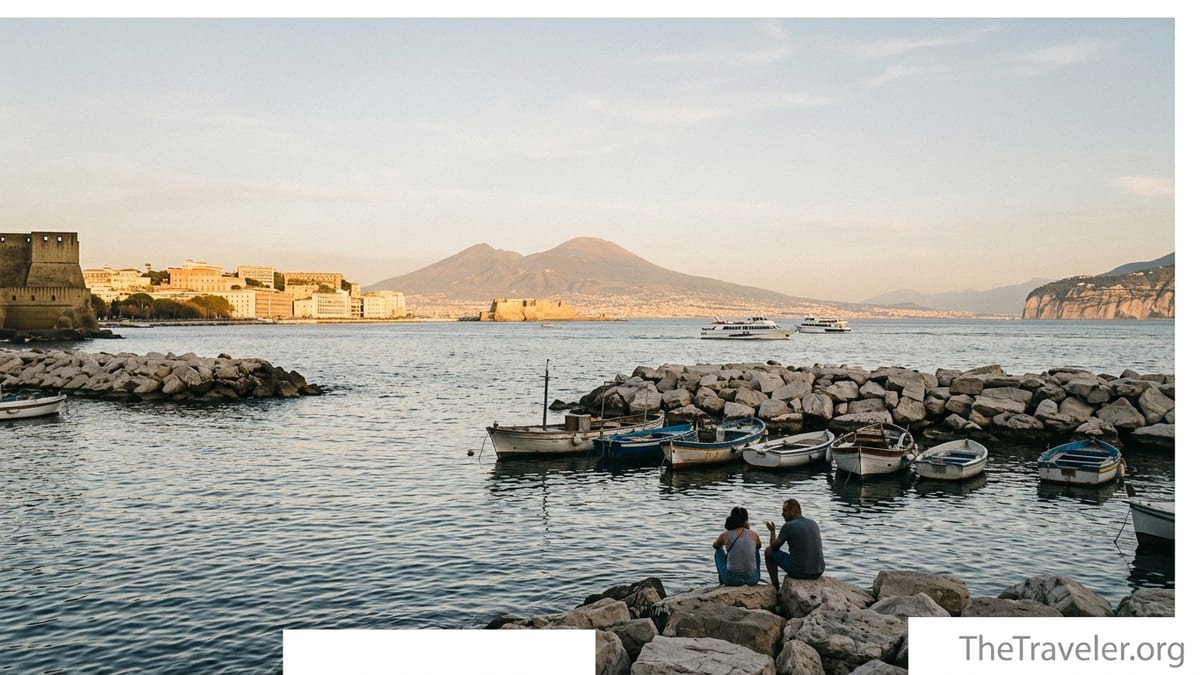
A Natural Amphitheater of Sea and Volcano
Geographically, the Bay of Naples is a compact natural amphitheater. The roughly 15‑kilometer‑wide gulf curves between Cape Miseno in the north and the Sorrento Peninsula in the south, with Naples spread along the inner shore and Mount Vesuvius rising immediately behind it. Across the water sit the islands of Capri, Ischia and Procida, each with its own character. Unlike the linear, cliff-bound Amalfi Coast or the rugged Cinque Terre, the bay feels enclosed, almost like a vast harbor with a different story at every point on the compass.
Vesuvius is what truly sets this coastline apart. On a clear day you might be eating a sfogliatella in a café on Via Partenope and see a wisp of steam curling from the volcano’s summit, a reminder that the same force that buried Pompeii and Herculaneum still shapes this landscape. Few major coastal cities in Europe live with an active volcano in such close proximity, and that constant presence lends the bay a dramatic, slightly precarious energy that you will not find in Portofino or Taormina.
The sea itself also feels different here. Ferries, hydrofoils and fishing boats crisscross the water from dawn to late evening, linking Naples to the islands and to Sorrento. In summer, departures to Capri can be as frequent as every 30 to 60 minutes from Molo Beverello, with crossings of about 50 to 60 minutes on large high-speed boats. Travelers quickly realize that the bay is not just a scenic backdrop but the main highway of the region, used daily by commuters, schoolchildren and market vendors as much as by tourists.
Urban Energy on the Water’s Edge
Most of Italy’s famous coasts are anchored by small or mid-sized towns that swell in summer and quiet in winter. The Bay of Naples is different because it is first and foremost the coastline of a major southern Italian city. Naples is one of Italy’s largest urban centers, and in recent years it has seen a strong rise in visitor numbers, with millions of travelers using it as a base for wider exploration. That scale changes everything. On the waterfront, joggers share space with street vendors, fishermen and cruise ship passengers spilling out for a few hurried hours in the centro storico.
Staying in a seafront neighborhood like Santa Lucia or Chiaia, you can walk from 18th-century palazzi to a working harbor where you might see a fisherman repairing nets next to a sleek yacht heading to Capri. At sunset, locals gather along the Caracciolo promenade to eat paper cones of fried seafood, listen to buskers and watch the sky turn pink behind Vesuvius. It feels more like a lived-in seaside boulevard in a Latin American or Mediterranean metropolis than a carefully manicured resort strip.
Compared with the Amalfi Coast, which is mostly about holidaymaking, the Bay of Naples waterfront is where everyday life plays out. You are never far from laundry lines, scooter traffic and shouting fruit sellers. For some travelers, especially those used to the more polished Tyrrhenian destinations, that grit can be a surprise. Yet it is exactly this mix of urban intensity and seaside light that makes the bay memorable. Rather than stepping into a postcard, you are dropped into a functioning city that just happens to overlook one of the most storied gulfs in Europe.
World-Class Archaeology at the Water’s Edge
Another key difference is how tightly ancient history is woven into the coastline. Within an hour of central Naples you can stand in the ghost streets of Pompeii, wander frescoed villas in Herculaneum, and even snorkel above submerged Roman ruins at Baia, where luxurious seaside resorts slid under the water because of volcanic activity and gradual ground subsidence. Few other coastal regions in Italy combine this level of archaeological richness with easy beach and island access.
In practical terms, you can sleep in a budget guesthouse near Piazza Garibaldi, take a morning Circumvesuviana train to Pompeii, spend several hours exploring its forum and bathhouses, then be back on the waterfront in time for a late-afternoon espresso overlooking Castel dell’Ovo. The journey costs only a handful of euros each way, far less than typical organized excursions along more remote coasts. The ability to independently reach world-famous ruins by commuter train is unique to the Bay of Naples.
Further west, the Phlegraean Fields area around Pozzuoli and Baia feels almost surreal. Steam rises from Solfatara’s vents, Roman markets stand near modern apartment blocks, and boat tours glide over mosaicked floors now a few meters underwater. While the Amalfi Coast has impressive cathedrals and medieval alleys, the Bay of Naples is the rare shoreline where you can pair a swim with a same-day visit to sites that defined Roman ideas of seaside leisure two thousand years ago.
Islands with Distinct Personalities, Minutes Apart
Islands dot many Italian coasts, but the Bay of Naples offers an unusually dense cluster with very different personalities, all linked by short ferry rides. Capri is the star: a compact limestone island known for its Blue Grotto, designer boutiques and dramatic cliffs. A mid-morning hydrofoil from Naples or Sorrento delivers you to Marina Grande in under an hour, where you can take the funicular up to the Piazzetta, walk to the Augustus Gardens for views of the Faraglioni sea stacks, then circle the island by small boat before heading back to the mainland at sunset.
Ischia, by contrast, draws Italians seeking longer, more relaxed stays. It is greener and larger than Capri, with thermal spas, vineyards and low-key towns like Forio and Sant’Angelo. Typical high-season hydrofoils from Naples reach Ischia Porto in about an hour, and prices are often similar to or slightly lower than Capri crossings. Procida, the smallest of the three, offers pastel harborscapes like Marina Corricella and simple fishermen’s houses that feel far removed from Capri’s luxury hotels, even though the crossing from Naples can be as short as 40 minutes on fast boats.
What sets the bay apart is how easy island-hopping is as an everyday activity rather than a once-per-trip expedition. During the main season, it is entirely feasible to base in a Sorrento guesthouse and take one day trip to Capri, another to Ischia, then a third along the Sorrentine or Amalfi coasts, all using regular ferries and hydrofoils. On other Italian shorelines, islands can feel like a separate journey; here they are tightly woven into local commuting patterns and weekend plans.
Accessibility and Price: A Different Kind of “Famous Coast”
For many travelers, the Bay of Naples is also notably more accessible and, in parts, more affordable than Italy’s other marquee coasts. Naples International Airport sits only a short taxi or bus ride from the central station and port, meaning you can step off a plane in the morning and be on a hydrofoil to Ischia or Capri by lunchtime without needing an additional regional train. This easy gateway contrasts with the Amalfi Coast, where reaching Positano or Amalfi typically involves a combination of long-distance train, local train or ferry, and often a winding bus ride.
Accommodation prices also differ significantly. While a sea-view room in Positano or Ravello in July can run into several hundred euros per night, it is still possible to find respectable mid-range hotels in central Naples in the 120 to 180 euro range in shoulder seasons, with simple guesthouses and B&Bs coming in lower. Neighborhoods like the Spanish Quarter, Vomero and Chiaia offer different balances of atmosphere and cost. Many visitors choose to sleep in the city, enjoy its food culture and museums, and use comparatively inexpensive public transport to reach beaches and islands.
Transport within the bay reflects this practical, everyday character. The Circumvesuviana rail line links Naples with Pompeii, Herculaneum and Sorrento for a modest fare, while regular ferries connect the mainland ports to the islands. Dedicated ferry apps aggregate timetables from multiple companies, making it easier to compare departure times and prices. In contrast, the Amalfi Coast relies heavily on buses that must negotiate narrow, frequently congested cliff roads, and many other Italian coasts have fewer year-round sea connections.
Culinary Culture Rooted in a Working Port City
Italian coastal food is generally excellent, but the Bay of Naples stands out for the intensity and variety of its everyday culinary scene. As a major port city, Naples has long absorbed influences from across the Mediterranean, and that heritage is on display everywhere from century-old pizzerias to humble fry shops tucked into alleyways near the harbor. You can eat a slice of classic margherita for only a few euros at iconic pizzerias, then walk a few meters to try cuoppi, paper cones filled with fried anchovies, calamari and vegetables ordered from a street window.
Compared with polished resort towns where many menus cater primarily to visitors, Naples remains resolutely local in its tastes. Morning bars along the seafront serve dense espresso and sfogliatelle to office workers and dockhands as much as to tourists. Markets in neighborhoods like Pignasecca or Porta Nolana overload the senses with crates of just-landed fish, piles of clams destined for spaghetti alle vongole and plastic tubs of deep-fried baccalà. It is one of the few famous Italian coastlines where budget-minded travelers can eat exceptionally well without seeking out fine dining venues or hotels.
Beyond the city, each island and coastal town adds its own twist. Ischia’s taverns might serve coniglio all’ischitana, a rabbit stew from the island’s interior hills, alongside simple grilled catch of the day. Procida is known for lemon and seafood dishes that reflect its fishing heritage. Capri, even at its most glamorous, still offers small family-run trattorias in Anacapri where homemade ravioli capresi, filled with caciotta and parmigiano, cost far less than a cocktail on the Piazzetta. This culinary diversity, rooted in a working-class city but spread across islands and villages, gives the bay a food culture that is both democratic and deeply regional.
A Mood Between Grit and Glamour
Perhaps the hardest thing to convey, yet the clearest difference from other coasts, is the Bay of Naples’ mood. In a single day you might sip an espresso in a chipped ceramic cup at a standing bar, pick your way around overflowing trash bags in a back alley, then an hour later find yourself on the terrace of a chic Capri hotel, looking out at luxury yachts. The transition from grit to glamour is incredibly short in distance and time, and locals move between these worlds more fluidly than visitors expect.
By contrast, places like the Amalfi Coast or the Costa Smeralda in Sardinia tend to keep their luxury and everyday life more neatly separated. Touristic centers there often feel curated; even when they are crowded, the impression is of an environment designed around visitors. In Naples and its bay, the tourism boom is more layered on top of existing neighborhoods and social realities. You may see a 19th-century building with faded grandeur next to a trendy wine bar, a street shrine festooned with football scarves opposite a contemporary art gallery, or teenagers diving off a crumbling pier next to a moored cruise ship.
For some travelers, especially those seeking an entirely serene escape, that intensity can be overwhelming. Yet for others it is precisely what makes the Bay of Naples unforgettable. The coast here is not a separate, polished stage set but an extension of a city that is creative, contradictory, occasionally chaotic and endlessly alive. Even a short trip often leaves visitors with stronger, more complex memories than an equivalent stay in more orderly resorts.
The Takeaway
The Bay of Naples differs from other famous Italian coastlines in almost every meaningful way. Geographically, it is a compact, volcanic amphitheater rather than a simple stretch of cliffs or beaches. Culturally, it is anchored by a large, historic city whose daily life spills directly onto the waterfront. Practically, it offers uniquely convenient access to world-class archaeological sites like Pompeii, affordable transport by train and ferry, and three very different islands all within easy reach.
For travelers, the question is less whether the bay is “better” than the Amalfi Coast or Cinque Terre, and more whether you are curious about a coastline where beauty and roughness coexist. If you are willing to trade a little polish for a great deal of personality, the Bay of Naples rewards you with views of Vesuvius at dusk, alleyway pizzerias that cost less than a beach umbrella elsewhere, and the chance to ferry-hop between glamorous Capri and unpretentious Procida in a single weekend. It is a landscape that feels lived-in rather than staged, and that is exactly what makes it stand apart in a country full of celebrated shores.
FAQ
Q1. Is the Bay of Naples the same as the Amalfi Coast?
The Bay of Naples and the Amalfi Coast are neighboring but distinct areas. The bay includes Naples, the islands of Capri, Ischia and Procida, and towns like Sorrento. The Amalfi Coast lies just beyond the Sorrento Peninsula on the Gulf of Salerno and includes towns such as Positano, Amalfi and Ravello.
Q2. Is Naples safe to use as a base for exploring the bay?
Naples can feel intense and busy, but most visitors who take normal big-city precautions have a trouble-free stay. Petty theft exists, especially around crowded stations and tourist areas, so keeping valuables secure and avoiding obvious displays of wealth is sensible. In return, you gain excellent connections to the islands, ruins and nearby coasts.
Q3. How long does it take to reach Capri, Ischia or Procida from Naples?
High-speed ferries from Naples to Capri and Ischia usually take around 50 to 60 minutes, while some services to Procida can be slightly shorter. Exact times depend on the route and vessel, but all three islands are realistic day trips, especially in the main season when departures are frequent.
Q4. Is the Bay of Naples cheaper than the Amalfi Coast?
Generally, yes. Accommodation and everyday food in Naples and on some of the islands can be significantly more affordable than in marquee Amalfi Coast towns, especially in shoulder seasons. You can still find high-end options, but there is a wider range of mid-range and budget choices alongside excellent inexpensive street food.
Q5. Can I visit Pompeii and still enjoy the coast on the same day?
Yes. Many travelers take a morning train from Naples or Sorrento to Pompeii, spend several hours at the site, then return to the coast for a late-afternoon stroll or dinner by the sea. Good rail links make this an easy and cost-effective combination.
Q6. When is the best time to visit the Bay of Naples?
Late spring and early autumn are ideal, typically from May to early June and late September to early October. Temperatures are comfortable, sea conditions are usually good for ferries, and crowds are thinner than in peak summer. July and August are hot, busy and more expensive, especially on Capri.
Q7. Do I need a car to explore the Bay of Naples?
A car is not necessary and can be more of a burden than a help. The area is well served by local trains, metro lines, buses and ferries. Parking in central Naples and on the islands is expensive and limited, and driving in city traffic can be stressful for visitors.
Q8. How does the Bay of Naples compare to Cinque Terre?
Cinque Terre is a smaller, tightly protected stretch of villages with cliffside trails and no large city attached. The Bay of Naples, by contrast, combines a big urban center with islands, archaeological sites and a wider variety of landscapes. It is less orderly and more chaotic than Cinque Terre, but also offers more cultural depth and diversity in experiences.
Q9. Are beaches in the Bay of Naples as scenic as those on the Amalfi Coast?
The bay offers a mix of small urban beaches, rocky coves and lidos on the islands, but its shoreline is not as uniformly dramatic as the vertical cliffs of the Amalfi Coast. Travelers often choose the bay more for views, islands, food and history than for long sandy beaches, though you can still find inviting swimming spots, especially on Ischia and Procida.
Q10. Is the presence of Vesuvius a real risk for visitors?
Vesuvius is an active volcano monitored closely by Italian authorities. There is no indication of an imminent major eruption, and millions of people live and travel in the area each year. For most visitors, the volcano is more of a fascinating backdrop and excursion destination than a practical concern, though it is wise to follow any local guidance if conditions change.