


Super Paradise Beach is marketed as Mykonos at full volume: daybeds packed like dominoes, champagne buckets in the sand, and DJs pushing the south-coast soundtrack well into the afternoon. Yet step a few meters away from the speakers, or arrive just an hour earlier than everyone else, and a different place appears. Behind the famous beach clubs is a surprisingly nuanced cove with quiet corners, small local rituals, and ways to enjoy it that most visitors never discover. This guide looks at what sits just beyond the obvious party, and how to actually find it.
Get the latest updates straight to your inbox!
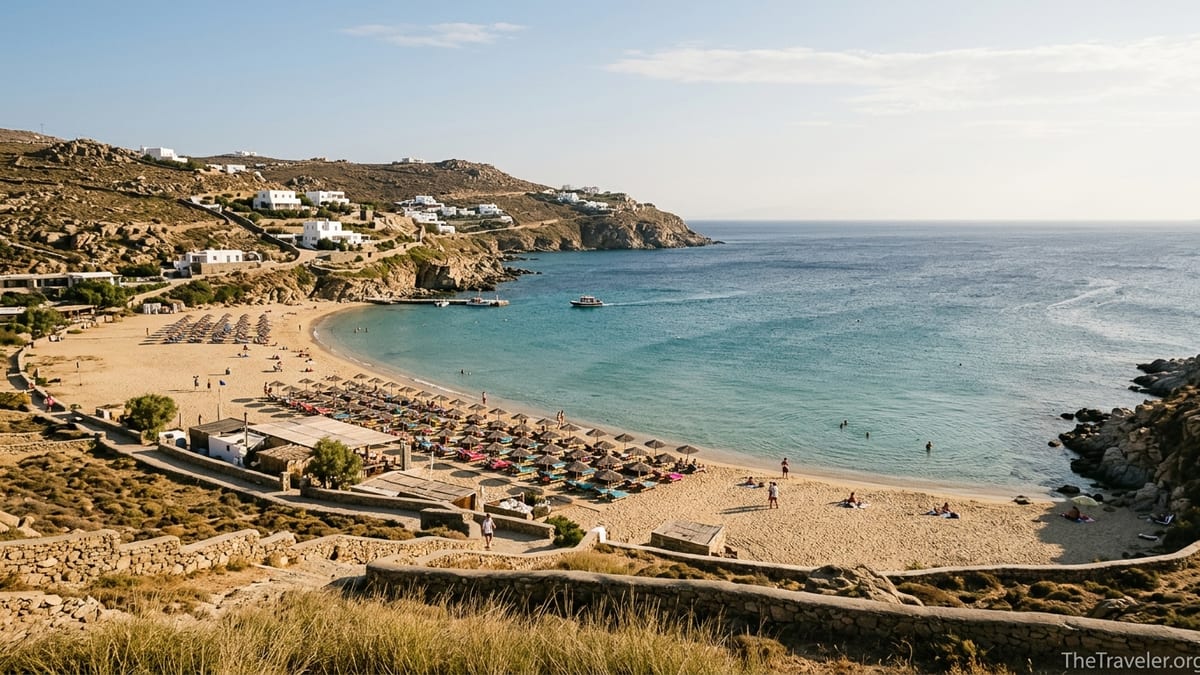
The Side of the Cove Where the Music Fades
Many people arrive at Super Paradise Beach by shuttle or water taxi, walk straight down the central path, and stop the moment a host offers them a sunbed. The result is a crowd crushed in front of the main sound system, while the edges of the bay stay almost empty. Super Paradise occupies a deep, curved cove on the south coast, so the shoreline bends gently out of sight at both ends. Walk five minutes toward either rocky side, and the music quickly drops from headline act to background hum.
At the eastern end of the beach, past the last organized rows of loungers, the sand narrows and blends into low rocks. This is where you see couples spreading out simple towels instead of paid daybeds and small groups slipping into the water without selfie sticks or bottle service. Swimmers favor this stretch because the cove is slightly deeper here and the water stays clearer when the central zone is busy. It feels much closer to a classic Cycladic beach than to a party set.
The western edge has a similar feel but a slightly different crowd. Thanks to the way the hills shelter the bay, this side often catches a touch more afternoon sun and a little less wind. It is where you might spot solo travelers with a paperback, or locals who duck out of the club scene on their break. You may still hear the bass line, but the rhythm belongs more to the waves and the ongoing shuttle of water taxis nosing in and out of the jetty.
What most visitors miss is that you do not have to choose between party and peace. You can claim one of these quieter edges in the morning, then wander back toward the club zone as the energy picks up after 4 pm. For many, the best days at Super Paradise are built on that shift: a swim when the water is empty, a late lunch when the grills first fire up, and only then a slow drift into the dance crowd.
Morning Super Paradise: The Beach Before the Party
Super Paradise has a split personality that depends almost entirely on the clock. Most travelers arrive from Mykonos Town around midday, either on the KTEL bus, on prebooked shuttles bundled with sunbeds, or via the south-coast water taxi that links Platis Gialos, Paraga, Paradise, and Super Paradise. Those who show up at 10 am instead of 1 pm often feel like they have stumbled into a different island.
Before lunchtime, the sand is only lightly dotted with towels, staff are still aligning umbrellas, and the water is practically empty. Guides that track the beach describe it as two distinct beaches: a tranquil, postcard-perfect bay until mid-afternoon, and only then a full-blown party. In practice that means you can swim long laps across the cove without weaving between inflatable unicorns, and the sea is still glass-clear before sunscreen and sand get churned up by the crowds.
Prices do not change with the hour, but the experience does. A front-row pair of sunbeds with umbrella at one of the main beach clubs can easily run to around 100 euros per couple in high season for the day, rising for premium rows near the water. Arrive early and you get far more value out of that fee: one long, slow day that starts cool enough for a walk and ends with you watching the choreography of staff carrying out sparklers at sunset.
Practically speaking, an early arrival also solves two headaches that many visitors do not anticipate: parking and table waits. The steep access road into the bay has limited car space, which often fills before noon in July and August, forcing latecomers to park higher up the hill and walk down the last stretch. The public buses and boats also become standing-room-only by mid-afternoon. Those who come for a morning swim walk off the beach just as the buses unload, or stay and enjoy the feeling of having seen the place change shape around them.
Hidden Viewpoints Above the Bay
Most phones at Super Paradise point in the same direction: toward the water, with the club facade behind. Yet some of the best views of the bay actually sit above and behind the beach, where the granite slopes climb up in terraces dotted with villas and small chapels. Guests heading directly to their reserved loungers usually skip them, but a short detour rewards anyone willing to break from the flow.
At the upper edge of the cove, a narrow road winds toward hillside villas that advertise “Super Paradise” in their names. From several informal lay-bys along this road, you can look straight down onto the curve of sand, the turquoise ring of shallow water, and the darker blue where the seabed drops off. In late afternoon, as the sun slides toward the western headland, the waves catch strips of light that do not reach the beach itself. This is where many local drivers pause for a quick photo between transfers, leaving you with a viewpoint most visitors only see on postcards.
Small whitewashed chapels hidden behind stone walls also add quiet punctuation to the scene. While not formally promoted as attractions, they speak to the older life of the island before the beach clubs arrived: fishing families, shepherds moving across the hills, and occasional religious gatherings looking down at what was once just another remote cove. Spend ten minutes wandering the lanes behind the beach clubs and you are likely to pass at least one such chapel, its blue door half-open, its courtyard scented with wild thyme and hot dust.
If you are arriving by ATV or scooter rather than shuttle, you have more freedom to explore these upper roads. Park in one of the higher pull-offs instead of forcing your vehicle down the steepest section, then walk the last part while stopping at viewpoints. In high season the hillside often feels calmer than the sand, with only the distant echo of the DJ rolling up the slopes.
The Local Side of Food and Drink
Super Paradise’s main clubs are known for polished menus, bottle presentations, and prices that remind visitors they are on one of the most expensive islands in the Aegean. Cocktail lists lean heavily into champagne, signature spritzes, and large-format drinks meant for sharing and for social media. Many visitors stop here and assume this is the only way to eat and drink on the beach.
Step back from the front-row daybeds, however, and you find a more varied landscape. Behind the central strip there are smaller kiosks and snack bars selling basics at more grounded prices: cold Mythos or Fix beer in cans, simple souvlaki skewers, gyros wrapped to go, and thick Greek yogurt topped with honey. A takeaway pita from a back-row counter can cost roughly what a single garnish-heavy cocktail runs at the main bar, and you can eat it on the public sand with your feet in the water.
Some independent operators just off the sand offer the kind of quick, practical options that long days at the beach demand: large bottles of water, packets of nuts, fresh fruit, and simple salads prepared to order. While club staff may discourage outside food and drink within their designated sunbed zones, the edges of the bay remain public. Seasoned visitors often buy one round at the bar to enjoy the service and atmosphere, then switch to occasional snacks from these smaller vendors as the day goes on.
For those looking for a more traditionally Greek meal, it can pay to eat either earlier or later than the standard lunch rush. Arrive at a taverna-style venue just after opening, or linger until the first wave of day-trippers heads back toward the buses, and you are more likely to get unhurried service and a table with a glimpse of the sea. Grilled octopus, fried courgette chips, and village salads with thick slabs of feta taste different when you are not shouting your order over a build-up mix.
Finding Space Without Spending a Fortune
One of the biggest surprises for first-time visitors is how little obviously “free” space there seems to be at Super Paradise. Organized sunbeds and umbrellas march across much of the beach in neat rows, each linked to a club or bar. For those on a tighter budget, it can feel as if they must either pay high-season prices per lounger or leave the cove entirely.
In reality, Greek law maintains that the shoreline itself remains public, and there are always wedges of sand between the organized sections that cannot be permanently claimed. At Super Paradise these tend to be at the extreme edges of the bay and in a few narrow strips between different club concessions. They are not signed and can be easy to miss if you are not looking for them, but regulars know to walk the length of the beach once before committing to any offer.
Travelers who bring their own lightweight towels, foldable mats, or even compact umbrellas can set up in these free sections for the cost of whatever snacks and drinks they choose to buy. This approach works particularly well earlier in the day and outside the absolute peaks of July and August. It also changes the feel of the visit: you are no longer locked into a minimum spend or a single venue’s soundtrack, and can wander the bay, swim where the water looks clearest, and choose when to dip into the higher-energy zones.
Another tactic that many people miss is combining transport and beach access. Some tour operators and hotel concierges bundle round-trip transfers from Mykonos Town with pre-reserved loungers at negotiated prices, which can undercut walk-up rates at the front desk. Others coordinate with less high-profile sections at the ends of the beach where prices are lower and the vibe is more relaxed. Asking your accommodation about their preferred partner at Super Paradise before you arrive can save money and resolve logistics in one step.
LGBTQ+ Culture Beyond the Stereotypes
Super Paradise has a long-standing reputation as one of the island’s most open and LGBTQ+ friendly beaches. For some travelers that reputation is the main draw; for others it comes as a surprise when they realize the most vibrant, mixed crowd on the island is not in the main town but on this south-coast cove. What often gets missed is how layered and welcoming that culture can be beyond the clichés.
The western side of the bay hosts one of the island’s most distinctive beach clubs, known both for its afternoon drag and cabaret shows and for its poolside terrace overlooking the water. Performances usually take place around sunset, with hosts and dancers weaving through the crowd in between choreographed sets. For many visitors, this becomes the single most memorable evening of their Mykonos stay, a blend of humor, choreography, and shared celebration that feels more like a festival than a typical club night.
Around the edges of the official shows, though, there is a quieter form of community. Groups of friends gather on the rocks above the club to watch the colors shift over the water, couples slip away for a sunset swim at the softest part of the light, and strangers share sunscreen, cigarettes, or restaurant tips with the disarming ease that beach life can foster. The crowd spans ages, body types, and backgrounds in a way that stands out even on an island already known for its cosmopolitan mix.
It is worth noting that, while the beach has historically had areas where nude sunbathing is informally tolerated, particularly toward the less organized ends, this is a matter of local custom rather than official policy. Anyone curious about these zones should gauge the atmosphere respectfully on the day, give others space, and remain aware that norms can shift season by season.
Water Taxis, Coastal Walks, and Crowd Dodging
Most guides describe Super Paradise as a destination, a place you aim for and then stay all day. In practice it works just as well as a waypoint on a south-coast circuit if you use the island’s boats and paths to your advantage. This is another aspect many visitors miss when they come on a direct bus transfer and feel committed to staying until the return departure.
The Mykonos water taxi is the key. Operating most days of the season, it links Platis Gialos, Paraga, Paradise, Super Paradise, and onward beaches along the south shore. A day pass costs roughly what two bus tickets and a short taxi would, and gives you the freedom to step off when a cove looks appealing, and move on again when the mood shifts. Arriving at Super Paradise by boat has its own subtle thrill: as the captain noses the bow toward the jetty, the full bowl of the cove opens ahead of you, music rising over the water.
Those who prefer to walk can combine short coastal paths with boat legs. For example, you might start with breakfast at Platis Gialos, follow the well-trodden footpath to Paraga and Paradise, then board the water taxi for the final hop to Super Paradise during the quieter late morning. After a few hours on the sand and perhaps a cabaret performance, you can ride the last boat back toward Elia or return to Platis Gialos and catch the bus to Mykonos Town.
This flexible approach has two main benefits. First, it lets you dodge the worst of the crowd cycles by arriving and leaving on your own schedule rather than being tied to bus timetables. Second, it turns a single beach visit into a wider tour of the coastline, with each stop offering its own balance of party energy, family-friendly space, and scenery. Super Paradise becomes the high-energy chapter in a day that also includes quieter bays and different styles of music and food.
The Takeaway
Super Paradise Beach is famous for a reason. Its central strip of loungers and speakers delivers the high-gloss, high-energy image that fills summer playlists and social feeds. Yet the same cove also contains rocky corners where you can hear mostly waves, hillside chapels that remember a pre-club landscape, and snack bars that still serve unfussy, affordable food to those willing to step away from the champagne buckets.
The visitors who enjoy Super Paradise most tend to be the ones who arrive early, walk the full length of the sand at least once, and look up at the hills as well as out to sea. They use the water taxi instead of only the bus, keep a towel in their bag to claim public sand when they feel like it, and treat the club scene as an optional highlight rather than an all-or-nothing commitment. Approach the beach this way and you discover that “Super” does not only describe the party, but also the setting that quietly holds it all together.
FAQ
Q1. Is Super Paradise Beach only for party-goers?
Super Paradise is strongly associated with daytime parties, but in the morning it feels more like a classic Cycladic beach, with calm water, light crowds, and space to relax or swim before the music turns up in mid-afternoon.
Q2. What is the best time of day to visit if I want a quieter experience?
For a calmer visit, aim to arrive between 9 am and 11 am. You will find easier parking, quieter buses and boats, and a cove that still feels tranquil before the DJ sets and crowds build later on.
Q3. Do I have to rent a sunbed, or can I stay on the beach for free?
You do not have to rent a sunbed. While much of the sand is organized by clubs, there are public strips at both ends of the bay and between some concession zones where you can lay down a towel at no charge.
Q4. How expensive are sunbeds and drinks at Super Paradise?
Prices change by season and position, but in peak summer expect to pay in the region of 100 euros per couple for a pair of loungers with umbrella in a central area, with cocktails and champagne priced to match the island’s upscale reputation.
Q5. What is the easiest way to get to Super Paradise from Mykonos Town?
Most visitors either take the public bus toward the south-coast beaches and walk or boat from there, join a dedicated shuttle linked to a beach club reservation, or use the water taxi service that runs between Platis Gialos, Paradise, and Super Paradise.
Q6. Is Super Paradise Beach suitable for LGBTQ+ travelers?
Yes. Super Paradise has long been one of the island’s most LGBTQ+ friendly beaches, with a mixed, welcoming crowd and a well-known beach club that hosts drag and cabaret shows popular with queer travelers and allies.
Q7. Can I combine Super Paradise with other beaches in one day?
It is easy to combine Super Paradise with nearby beaches by using the south-coast water taxi or short coastal walks. Many visitors spend the morning at a quieter bay and then move to Super Paradise for the afternoon party and sunset.
Q8. Are there food options that are not linked to expensive beach clubs?
Yes. Behind the front rows of loungers you will find smaller snack bars and casual spots selling gyros, salads, and drinks at more modest prices, and you can enjoy them on the public parts of the sand.
Q9. Is nudity allowed at Super Paradise Beach?
Nude sunbathing has traditionally been tolerated in some of the quieter sections toward the ends of the bay, but it is based on local custom rather than formal rules, so you should always be discreet and respectful of others.
Q10. When does the party usually start, and how late does it go?
On most summer days the atmosphere begins to shift after about 4 pm when DJs start playing louder sets. The energy builds toward sunset and early evening, after which many people head back to Mykonos Town for the late-night bar scene.