


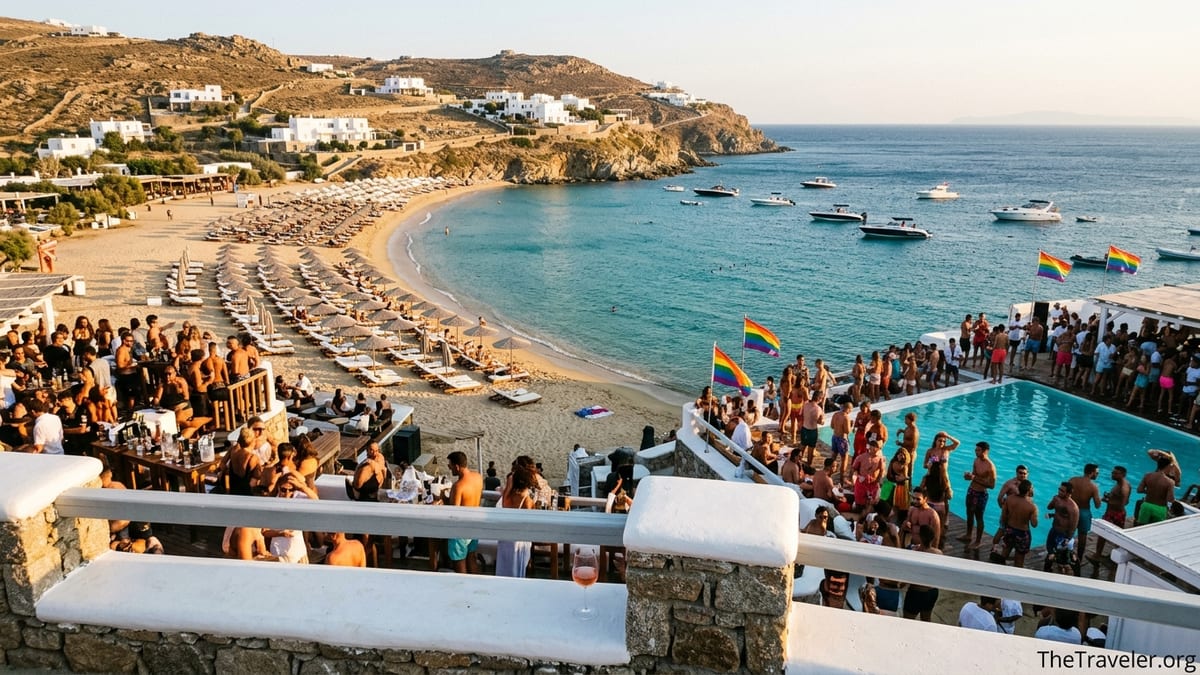
On an island packed with legendary shorelines, Super Paradise Beach still manages to stand out. Tucked into a deep, golden cove on the south coast of Mykonos, this once-remote bay has turned into one of Greece’s most famous party beaches, drawing DJs, jet-setters, LGBTQ+ travelers and sun-seekers who want their Aegean swim with a side of serious nightlife energy.
Get the latest updates straight to your inbox!
From Remote Cove to Party Legend
Super Paradise did not start life as a polished beach club strip. In the early 1970s, when most visitors still stuck to Mykonos Town or nearby Paradise Beach, this smaller bay at Plintri was little more than a rugged, hard-to-reach cove. It quickly earned a following among free spirits, artists and gay travelers who were happy to hike over the hill for a quieter, more liberal scene on the sand.
By the mid-1970s Super Paradise had become synonymous with all-day parties and a live-and-let-live attitude. Local accounts describe impromptu beach gatherings with simple bars wired to powerful speakers, people dancing barefoot in the sand, and nudists sharing space with tanned fashion insiders on summer escape. The idea that the “real” fun on Mykonos happened on a remote beach rather than in town cemented its reputation early.
As Mykonos itself morphed from bohemian hideout to global luxury destination, Super Paradise evolved with it. Party infrastructure grew more sophisticated, DJs came in from Athens and later from European club capitals, and the bay’s name began appearing in glossy travel magazines and on international party calendars. What never changed was the core formula: clear, swimmable water by day, and a beach that shifts into a high-octane party venue by late afternoon.
Today, many repeat visitors still talk about their first day at Super Paradise as the moment “Mykonos clicked.” They might arrive to what seems like a fairly typical organized beach, then watch as the music rises, people start dancing on the sand and tabletops, and the quiet cove transforms into something closer to an outdoor club, all framed by that unmistakable Cycladic landscape.
Daytime: A Classic Cycladic Beach With an Edge
For much of the day, Super Paradise looks like a textbook Greek island beach, only more organized. The bay is small but deep, with steep golden slopes on both sides, a strip of pale sand and turquoise water that stays calm thanks to its sheltered position on the south coast. Even families with younger children use the gentle shallows in the morning, especially on the left-hand side where the atmosphere starts more relaxed.
Rows of sunbeds and umbrellas cover most of the sand in peak season. A typical set for two people at one of the main venues can easily run around 80 to 120 euros in July and August, and prime front-row loungers at the most fashionable clubs often cost more, especially on weekends or during festival weeks. Prices usually include towels and at-seat service, but not food and drinks, which means a couple spending all day on the beach can easily reach 200 euros or more once cocktails and snacks are factored in.
Despite the prices, many visitors treat a Super Paradise day as a “splurge experience.” A couple might book a pair of loungers at a well-known beach club, order a late breakfast of yogurt, fruit and espresso on the sand, then spend the late morning rotating between swims, naps, and people-watching. You will see everything from minimalist Greek swimwear brands to designer kaftans, and the crowd tends to skew late twenties and above, compared with the younger backpacker scene at nearby Paradise Beach.
Crucially, there is still a small section of “free” public beach where you can spread a towel without paying for a lounger. Budget-minded travelers often stop in Mykonos Town or at a supermarket near Platis Gialos to buy water and snacks, then head straight to that unreserved strip early enough to claim a spot. They might still wander up to the beach bars for a drink later, but they avoid the steep per-sunbed fees that can surprise first-timers.
When the Music Rises: Why the Parties Are Famous
The reason Super Paradise is on the global party map is what happens after the lazy midday lull wears off. By mid to late afternoon, usually around 4 or 5 pm in high season, the music volume climbs, the DJ shifts from chill tracks to dance and house anthems, and staff start coaxing people off their beds and onto the sand or platforms to dance.
On a typical August afternoon, the transformation can feel instant. A cruise ship group arrives by water taxi, a group of Italians or Spaniards starts a spontaneous singalong to a summer hit, and soon half the beach is on its feet. Servers carry trays of cocktails through a maze of dancing bodies; inflatable pool toys end up on the sand; and it is not unusual to see someone who was reading a book an hour earlier suddenly leading a line of dancers in the shallows.
International guest DJs appear frequently during peak weeks, particularly at the flagship Super Paradise Beach Club and at JackieO’ Beach Club, which is perched slightly above the sand with its pool and terrace. While you will not always find the superstar names that headline massive nightclubs on Ibiza, the sets are often by respected Greek or European DJs, and the sound systems are powerful enough that the entire bay feels like a single, shared party.
Part of the appeal is that these are day-into-night events rather than all-night marathons. Many travelers say they prefer starting the party in the afternoon, leaving the beach around sunset or early evening to shower and change, and then continuing the night back in Mykonos Town. It creates a rhythm where the beach is both a destination and the opening act for a full island night out.
LGBTQ+ Heritage and Inclusive Vibe
Super Paradise’s party reputation cannot be separated from its long-standing role in LGBTQ+ travel. Decades before rainbow flags became common on European beaches, this cove was known informally as Mykonos’s gay beach. For years it was one of the world’s best-known gay shorelines, a place where same-sex couples could kiss in the surf or dance together at the bar when that still felt daring elsewhere in the Mediterranean.
Although the crowd today is mixed, that heritage is still visible. The right-hand side of the beach when facing the water remains particularly popular with gay men, and JackieO’ Beach Club, set above that section, has built an international following with its drag shows, upbeat playlists and unselfconscious atmosphere. On many afternoons you will spot rainbow fans, swim briefs in bold prints and groups of friends greeting each other like a reunion.
At the same time, Super Paradise is not an exclusively LGBTQ+ space. Straight couples book the same sunbeds, groups of friends in their thirties plan birthday celebrations here, and you will occasionally see multi-generation families anchoring the quieter sections in the morning. What defines the beach is less who you are and more the expectation that everyone is welcome as long as they are comfortable with open affection, skimpy swimwear and a playful, body-positive environment.
This inclusive energy is what makes many travelers describe Super Paradise as “freeing.” A solo visitor might arrive from a more conservative background and find, within an hour, that they feel comfortable sunbathing in a way they never would at home. Others appreciate that the staff at the major venues are used to international guests and do not blink at mixed groups, non-binary fashion or same-sex couples booking cabanas.
Beach Clubs, Food and What It Really Costs
The beach clubs lining Super Paradise are central to its fame. The original Super Paradise Beach Club, right on the sand, combines restaurant, bar and party space, with sunbeds in front and a large central bar area that becomes the focal point once the music starts. A few steps away, JackieO’ Beach Club sits slightly elevated, with an infinity pool, restaurant terrace and its own stretch of loungers, often attracting a stylish, LGBTQ+-leaning crowd.
Between and around these anchors are smaller venues and beach bars, some with more laid-back vibes. One might focus on Mediterranean lunches and rosé served to the loungers, another on shisha and chilled beats earlier in the day. This clustering means that even if you pick one venue as your base, you can wander a few meters along the sand and find a different soundtrack or crowd.
Prices, however, are firmly in line with Mykonos’s reputation as one of Greece’s most expensive islands. A pair of loungers with umbrella in a prime front row at a headline club can cost well over 150 euros in August, and second or third rows run cheaper but still substantial. Cocktails frequently start from around 15 to 20 euros, with signature creations, magnum bottles or premium spirits much higher. A simple lunch of a shared salad, two mains and a carafe of wine for two people can easily reach 70 to 100 euros at a fashionable spot.
Travelers looking to control costs often mix and match. One common strategy is to reserve standard sunbeds at a mid-range section of the beach, then order soft drinks and coffees during the day and save cocktails for the late afternoon happy-hour deals. Another is to bring your own water and snacks in a small cooler, then splurge only on one sit-down meal at a club restaurant, perhaps timing it around sunset when the light over the bay is at its best.
Getting There and Practical Tips
Part of Super Paradise’s allure is that it still feels slightly tucked away despite its fame. The beach sits about seven kilometers from Mykonos Town along a hilly, winding road. Many visitors arrive by taxi or pre-booked transfer, especially if they are staying in town and plan on drinking. During peak season, shared minivans offered by the larger beach clubs shuttle guests directly from central pick-up points like Fabrika Square for a set fee per person.
Budget-conscious travelers often combine the public bus and a short onward hop. A common route is to take the bus from Mykonos Town to Paradise Beach, a journey of around 15 to 20 minutes, and then either walk the rugged footpath over the headland for about 15 minutes or take a small local boat or minivan from Paradise to Super Paradise for an additional fee. In high season, water taxis also link beaches along the south coast, so a visitor might start the day at Platis Gialos, hop off at Super Paradise for the afternoon party, then continue on to another bay.
If you are arriving by rental car or quad, be mindful of the road’s steep last section and the limited parking near the beach, especially in July and August. Parking lots fill quickly by late morning, and leaving at sunset can mean a slow crawl up the hill behind other vehicles. Many repeat visitors prefer to arrive before 11 am to secure parking and a good lounger location, then leave either earlier in the evening or later at night once the main exodus has passed.
Practical details matter on a party beach. Sand temperatures can be intense in mid-afternoon, so sandals or flip flops you do not mind losing temporarily in the crowd are a smart choice. A lightweight cover-up is useful both for sun protection and for the often air-conditioned transfers back to town. Most beach clubs accept card payments, but it is wise to carry some cash for tips, small kiosks or unexpected transport options.
How Super Paradise Compares to Other Mykonos Beaches
Super Paradise is only one of several famous Mykonos beaches, but its particular mix of size, setting and party tone helps explain why it has become a reference point. Compared with Paradise Beach next door, which tends to attract a younger, often student-heavy crowd and hosts huge late-night events at clubs like Tropicana and Cavo Paradiso, Super Paradise feels slightly more grown-up and compact. The party is intense, but the scale is smaller and the bay’s shape gives it a cozy, amphitheater-like feel.
Against ultra-luxury options like Psarou, where front-row sunbeds at marquee venues can reach several hundred euros and designer boutiques line the back of the sand, Super Paradise often comes across as more approachable. You will still see high-end swimwear and champagne buckets, but the vibe is looser, and the focus is on shared dancing rather than fashion photography. Many travelers split their time, doing a “see and be seen” day at Psarou and a higher-energy, dance-focused afternoon at Super Paradise.
For visitors who would rather keep the volume lower, beaches like Ornos, Agios Ioannis or Elia offer extensive lounger setups and excellent swimming with far less party emphasis. Elia in particular has long been a favorite among LGBTQ+ travelers who prefer a more relaxed, spread-out beach with a nudist-friendly section and modest music levels. In that sense, Super Paradise sits in the middle of the Mykonos spectrum: not the wildest all-night club, not the quietest family cove, but the archetypal “party beach” where sun, sea and sound system share equal billing.
What connects all these shorelines is the island’s infrastructure and style. Buses, water taxis and taxis make it relatively easy to hop between them, and many visitors build a beach itinerary that might include a party day at Super Paradise, a quieter swim elsewhere, and an evening stroll through Little Venice or the old port. Super Paradise’s fame simply ensures that, for many, it is the beach they feel they “have to” experience at least once.
The Takeaway
Super Paradise Beach has earned its place among Greece’s most famous party beaches by combining a naturally beautiful cove with a distinctly Mykonian approach to fun. Its history as a haven for free spirits and LGBTQ+ travelers, its reliable day-to-night transformation from sleepy shoreline to dancing-in-the-sand party, and its tight cluster of beach clubs have all fed into a reputation that now spans generations.
At the same time, it is not a place for everyone, every day. Prices are high, the music gets loud, and by late afternoon in high season the scene can feel overwhelming if you are hoping for a quiet read under an umbrella. The travelers who leave with the best memories tend to be those who arrive knowing what they want: a big daytime celebration with friends, a glamorous afternoon of people-watching and dancing, or simply a once-in-a-trip experience of the Mykonos beach party myth.
Approached with realistic expectations, a bit of planning around transport and budget, and a willingness to lean into the beach’s open, inclusive spirit, Super Paradise can be a highlight of a Greek island itinerary. Whether you stay for a single sunset or make it your base for several afternoons, it offers a concentrated taste of why Mykonos has become shorthand worldwide for sun-drenched, sea-front partying.
FAQ
Q1. Is Super Paradise Beach suitable if I am not a big partier?
Yes, especially earlier in the day. Mornings and early afternoons are relatively calm, with people swimming, sunbathing and having lunch. The intense party atmosphere usually builds later in the afternoon, so if you visit before around 3 pm you can enjoy the scenery and facilities without feeling immersed in a full club environment.
Q2. How expensive is a day at Super Paradise compared to other Greek beaches?
It is significantly more expensive than the average Greek beach. Sunbed sets for two at popular beach clubs can run to dozens or over a hundred euros in peak season, and cocktails are typically priced at big-city European levels. There is a small free-sand area where you can lay your own towel, but food and drink at the main venues remains premium-priced.
Q3. Do I have to book sunbeds in advance?
In July and August, and on weekends or during festival weeks, advance reservations are strongly recommended, especially for front rows or at headline venues. Many visitors reserve online or through their hotel concierge a few days ahead. Outside peak periods or if you are flexible about location, you can sometimes walk in earlier in the day and still find a spot.
Q4. Is Super Paradise Beach safe for solo travelers?
Super Paradise is generally considered safe for solo travelers, including solo women and LGBTQ+ visitors, especially during daylight hours when the beach is busy and staff are present. As with any crowded party environment, it is wise to keep an eye on your belongings, pace your drinking, and have a clear plan for how you will get back to your accommodation.
Q5. What is the dress code at the beach clubs?
There is no formal dress code during the day beyond standard beachwear, but the crowd tends to be stylish. Expect everything from simple bikinis and trunks to designer swimwear, lightweight shirts and resort-style cover-ups. In the afternoon, people might add accessories like sunglasses, hats and jewelry, and some visitors change into more statement outfits if they plan to stay into the evening.
Q6. Is Super Paradise still considered an LGBTQ+ beach?
Super Paradise today draws a mixed crowd of all orientations, but it retains a strong LGBTQ+ presence and heritage, particularly on the right-hand side of the beach and at venues like JackieO’ Beach Club. It is widely seen as an inclusive, gay-friendly environment rather than an exclusively gay beach.
Q7. Can families visit Super Paradise Beach?
Families do visit, especially in the morning when the beach is quieter, the music is softer and the shallow water is ideal for children. However, parents should be aware that the atmosphere becomes adult-focused later in the day, with louder music, drinking, revealing swimwear and dancing. Many families choose to leave by mid-afternoon or visit on shoulder-season days when the party intensity is lower.
Q8. How do I get back to Mykonos Town after the party?
Most visitors return by pre-booked transfer, taxi, or club-arranged minivan shuttles that run back to central drop-off points in town. During peak hours around sunset you may face queues and higher demand. It is sensible to confirm return options and approximate times when you arrive at the beach, particularly if you are relying on a specific shuttle service.
Q9. What should I bring for a day at Super Paradise?
Beyond standard beach essentials like swimwear, sunscreen and sandals, it is useful to bring a light cover-up, some cash alongside your cards, and perhaps a small bag for valuables that you can keep close when swimming. If you do not plan to rent a lounger, a beach towel or mat is important, and many budget travelers also bring bottled water and snacks to avoid relying entirely on club menus.
Q10. When is the best time of year to experience the Super Paradise party scene?
The core party season runs from roughly late June through early September, with July and August offering the most intense atmosphere, international DJs and packed dance floors. If you prefer a bit more space but still want lively afternoons, consider visiting in late June or early September, when the weather is warm, the music is on, and prices and crowds are slightly more manageable than in peak August.