


Many travelers planning trips to Europe in 2027 have the same question: will I need the new ETIAS travel authorization, and if so, how will it actually work in practice? The European Travel Information and Authorisation System (ETIAS) has been in development for years, and while it is not yet operating, it will eventually become a standard pre-travel requirement for millions of visitors from visa-exempt countries such as the United States, Canada, the United Kingdom, Australia and Japan. Understanding what is known now about timing, costs and rules can help you plan trips for late 2026, 2027 and beyond with fewer surprises at the border.
Get the latest updates straight to your inbox!
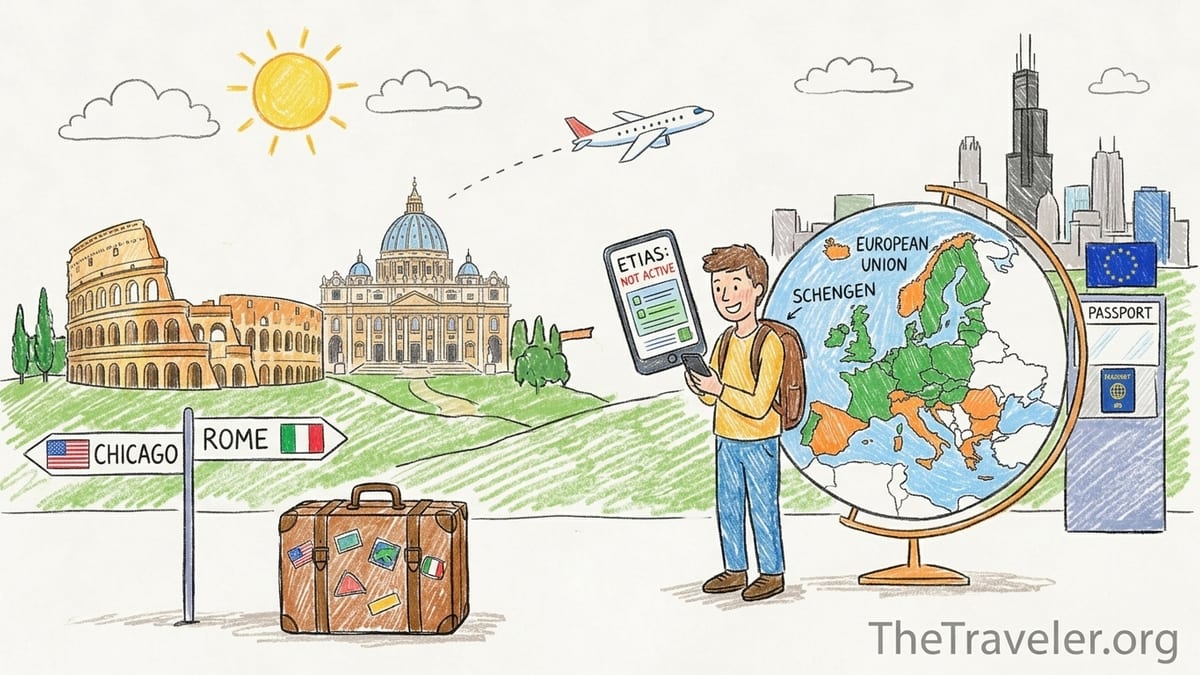
Official launch status as of late 2026
As of November 2026, ETIAS is not yet in force. The European Union has confirmed that no ETIAS applications are being accepted, and no approvals are required to board flights or cross external Schengen borders at this time. Travelers from visa-exempt countries are still following the long-standing rules: they can usually enter the Schengen area for up to 90 days in any 180-day period without a visa, provided they meet standard entry conditions such as holding a valid passport and proof of onward travel.
Earlier official communications from the European Commission and associated agencies referred to an expected launch of ETIAS by the end of 2026, following the roll-out of the new Entry/Exit System (EES). Those indicative dates have been withdrawn. Recent advisory updates from both EU-related bodies and private immigration law firms note that technical and operational issues with the border IT systems have made the timeline uncertain, and the most realistic scenario discussed publicly is a launch sometime in 2027 rather than 2026.
For travelers, the key point is that at the time of writing there is no confirmed, legally fixed start date for ETIAS. When the system is ready, the European Union has said it will provide several months of advance notice before the requirement becomes mandatory. That means that somebody booking a family vacation from Chicago to Rome for spring 2027 should check the official ETIAS information site and their national foreign ministry advisories regularly, but cannot yet submit an application or receive an authorization.
In addition, European and national authorities have indicated that there will be a transition period when ETIAS first goes live. During that initial phase, border guards and airline staff will be adjusting to new procedures and systems. Travelers planning trips that straddle the anticipated introduction date, such as a late-2026 departure with a return in early 2027, will need to pay particular attention to any announcements that specify from which date ETIAS becomes obligatory for boarding a flight or crossing a land or sea border.
Where ETIAS will apply and who will need it
ETIAS is designed for short-term visitors who are currently allowed to enter certain European countries without a visa. It will apply to around 30 European states that either belong to the Schengen area or closely cooperate with it on border policy. This group includes popular destinations such as France, Italy, Spain, Greece, Germany and the Netherlands, as well as less frequently visited countries like Latvia, Slovakia or Slovenia. It also covers non-EU Schengen countries such as Iceland, Norway and Switzerland, and is planned to include Bulgaria, Romania and Cyprus as they align with the common border regime.
The travelers targeted by ETIAS are non-EU, non-EFTA nationals who are visa-exempt for short stays. That means citizens of countries such as the United States, Canada, the United Kingdom, Australia, New Zealand, Japan, South Korea, Singapore and many Latin American countries, among others. For example, an American tourist flying from New York to Paris for a two-week vacation, a British business traveler heading from London to Frankfurt for meetings, or a Canadian backpacker planning a rail trip across Italy and Austria are all the kind of visitors who will in future need to apply for ETIAS before departure.
By contrast, people who already need a short-stay Schengen visa today will not suddenly replace that visa with ETIAS. A traveler from India visiting relatives in Madrid, or from South Africa attending a conference in Vienna, will still need to go through the usual visa application at a consulate if they intend to enter countries in the Schengen area. Similarly, ETIAS will not apply to long stays. A Brazilian student admitted to a two-year degree program in Berlin, or an Australian software engineer relocating to Amsterdam for a work contract, will continue to require the appropriate national long-stay visa or residence permit rather than ETIAS.
Dual nationals also need to pay attention to which passport they use. Someone who holds both Italian and Canadian citizenship, for example, would not need ETIAS if they enter Europe using their Italian passport, because they are an EU citizen in that case. However, if they chose to travel on their Canadian passport only, they would be treated as a visa-exempt third-country national and would fall under the ETIAS rules once they take effect. Using the “stronger” European passport for entry can therefore avoid unnecessary paperwork.
Expected fees, validity and what travelers can anticipate paying
When ETIAS enters into operation, travelers will pay a modest fee for each application. Official EU communications and supporting documents have consistently referred to a charge of 7 euros for most adult applicants. For a family of four from Los Angeles flying to Barcelona for a summer holiday, that would mean a total ETIAS cost of approximately 28 euros, paid online by credit or debit card at the time of application. This fee is comparable to similar systems in other regions, such as the United States ESTA or Canada’s eTA, and is a one-off payment for the validity period of the authorization, not for each individual trip.
The authorization itself is expected to be valid for several years, as long as the traveler’s passport remains valid. Current EU regulations indicate that ETIAS approvals will last for up to three years or until the passport used in the application expires, whichever comes first. In practice, that means a 35-year-old Japanese traveler who renews her passport in 2028, applies for ETIAS once and receives a three-year authorization, could use that single approval for multiple trips to Paris, Prague and Lisbon during that time, provided she always travels with the same passport.
There will be categories of travelers who are exempt from paying the fee, although they may still have to complete an application. Draft and supporting documents indicate that children under a certain age, older travelers and some family members of EU or EFTA citizens will not be charged. For example, a retired 72-year-old British national visiting grandchildren in Copenhagen and an 11-year-old American child on a school trip to Rome may be exempt from the 7-euro payment, while their accompanying 45-year-old parents and teachers will pay.
Travelers should also budget for indirect costs. While the ETIAS fee itself is small, applicants might face currency conversion charges from their bank if they pay in euros using a non-euro credit card. A Canadian traveler who pays 7 euros with a Canadian-issued card might see a final charge on their statement slightly higher than the real-time exchange rate would suggest, due to foreign transaction fees of 2 to 3 percent. Those planning multi-country itineraries should factor in ETIAS as part of their overall trip planning, just as they do with travel insurance or seat selection fees.
Key exemptions and who will not need ETIAS
Even after ETIAS is launched, not every visitor crossing a European border will need this authorization. The regulations and official explanatory notes describe several important exemptions. First, people who hold a valid Schengen short-stay visa will not require ETIAS on top of that visa. For instance, a Chinese tourist with a French-issued Schengen visa for a three-week coach tour from Paris to Milan and Vienna would show their visa and passport at the border as usual and would not complete ETIAS.
Second, holders of long-stay visas or residence permits issued by Schengen countries or Cyprus are outside the scope of ETIAS for travel related to those permissions. A Moroccan engineer living in Lyon on a French residence permit, or a Colombian researcher working in Helsinki with a Finnish residence card, will continue to use those documents plus their passport for travel between their home country and Europe without an ETIAS requirement for that specific status.
Third, close family members of EU or EFTA citizens who hold specific residence cards or travel documents may either be fully exempt from ETIAS or exempt from the fee, depending on the exact circumstances and national implementation. An example would be the American spouse of a Spanish citizen who lives with their partner in Madrid and holds a residence card as a family member of an EU citizen. When that couple takes a weekend trip from Madrid to Vienna, the American spouse would use the residence card rather than an ETIAS authorization.
Finally, certain specialized categories such as holders of local border traffic permits or refugee travel documents issued by Schengen states are treated separately. A Ukrainian resident living near the Polish border who holds a local border traffic permit for short visits into Poland, for example, will generally fall under that regime for those specific cross-border movements. These edge cases are highly technical, and affected individuals should check directly with the issuing authority or an official EU information channel to confirm whether ETIAS applies to their situation once the system is operational.
How the ETIAS application process will work in practice
When ETIAS finally goes live, applications are expected to be submitted exclusively through an official online portal or mobile app operated by the European Union. There will be no requirement to visit an embassy or consulate, and no need to give fingerprints or other biometric data for ETIAS itself. A typical traveler, such as a Canadian tourist planning a May city break in Paris and Amsterdam, will sit down at a laptop or use a smartphone several days or weeks before departure, complete the form in one session and pay the fee electronically.
The application will request basic personal and travel information. Based on current regulations and public guidance, applicants can expect to provide details such as their full name, date and place of birth, passport number and expiry date, contact information, intended first country of entry, and answers to a series of security and public health questions. For example, a 29-year-old American applying to visit Berlin for a music festival in June might indicate Germany as the first point of entry, list the approximate dates of travel, and answer whether they have any serious criminal convictions or have been previously refused entry to Schengen countries.
Most applications are expected to be processed automatically within minutes by checking the submitted data against various security and migration databases. For the majority of straightforward cases with no matches to concern lists and no inconsistencies, the traveler should receive an approval email shortly after submitting the form. In practical terms, that means a family in Sydney booking a last-minute ski trip to the Austrian Alps in January could apply on a Friday afternoon and, in most cases, receive their authorizations the same day.
A small percentage of applications may require manual review by national authorities, which could extend processing times to several days or longer. If, for example, a traveler’s name is similar to someone on a security watchlist, or their answers about previous immigration refusals raise questions, their file might be flagged. In that case, the person might be asked to provide additional documentation or clarification. For this reason, frequent travelers such as business executives flying monthly between Toronto and Brussels, or long-term digital nomads shuttling between Lisbon and Tallinn, are well advised to apply well in advance of major trips once ETIAS becomes available, rather than waiting until the day before departure.
Using ETIAS at the airport, land borders and ports
Once ETIAS is operational, airlines, ferry operators and coach companies will have a responsibility to check that passengers who need an authorization have one before transporting them to the external border of the European countries that require ETIAS. In practice, this will look similar to the way carriers already verify visas and passports. When an American traveler checks in for a Delta flight from Atlanta to Amsterdam, for instance, the airline’s system will query ETIAS in the background using the passport details. If a valid authorization is on file, boarding passes can be issued as normal.
At the border itself, ETIAS does not replace a passport. Border guards will still scan passports at e-gates or kiosks and may ask questions about the purpose of the trip, proof of accommodation and onward travel. However, they will also see in their system whether there is a valid ETIAS linked to the passport. A traveler driving from Zurich to Milan or taking a ferry from Tunis to Marseille will experience a similar check on arrival. If ETIAS is missing, invalid or has been revoked, the traveler could be refused boarding by the carrier or denied entry at the border, even if they previously traveled visa-free without problems.
Travelers making complex itineraries that combine Schengen and non-Schengen destinations will need to think carefully about the first point of entry listed on the ETIAS form. For example, a British traveler might book an itinerary that starts with three days in Athens, followed by a cruise through the Greek islands and then onward flights to Prague and Copenhagen. In that case, Greece would be the first country of entry for ETIAS purposes. Changing plans at the last minute, such as deciding to fly into Rome instead, would not automatically invalidate an existing ETIAS, but travelers should be prepared to explain any discrepancies if questioned.
Land borders are also relevant, especially for visitors touring Europe by car or bus. A Canadian family renting a car in Munich and planning to drive through Austria and Slovenia to Croatia will likely cross several internal Schengen borders without routine checks, but their initial entry into the Schengen area, perhaps at Munich Airport, is where ETIAS status will matter most. Similarly, intercity bus operators running routes from non-Schengen countries such as Serbia or Albania into Hungary or Greece will be required to check that visa-exempt passengers hold valid ETIAS authorizations before reaching the border.
Planning Europe trips around an uncertain 2027 timeline
Because ETIAS does not yet have a fixed start date, travelers planning journeys for 2027 need to prepare for different scenarios. Someone arranging a multi-country rail trip from Boston to Lisbon, Madrid, Paris, Brussels and Amsterdam in June 2027 may find that ETIAS has entered into force by then, or that introduction has been postponed again. The safest approach is to follow official updates during the months before departure, subscribe to travel alerts from your home country’s foreign ministry, and build ETIAS checks into your trip planning in the same way you monitor airline schedule changes.
Travelers booking expensive, once-in-a-lifetime trips should also consider timing their reservations thoughtfully. For example, a retired couple from Toronto booking a luxury river cruise from Budapest to Amsterdam in late 2027 might opt for flexible or refundable flight tickets so that if ETIAS introduction dates shift and cause airline check-in issues during the initial rollout period, they have more room to adjust plans. Tour operators and cruise lines are increasingly including ETIAS information in their pre-departure materials, but the ultimate responsibility to hold the correct authorization will rest with the traveler.
It is wise to avoid relying on outdated blog posts or social media threads that quote earlier target dates as if they were confirmed. Because ETIAS has already seen multiple delays, any article that states a precise start date without referring to a recent official announcement should be treated with caution. Instead, focus on sources that clearly state that ETIAS is not yet operational and that any specific activation date will be communicated publicly and in advance by the European Union.
For travelers who visit Europe regularly, it may be useful to think of ETIAS as just one more standard pre-travel task, similar to checking passport validity or arranging health insurance. A freelance photographer from Sydney who covers fashion shows in Paris twice a year, or a tech consultant from San Francisco who attends annual conferences in Berlin and Stockholm, will likely integrate ETIAS renewal into their routine once the system has stabilized. In the meantime, keeping digital copies of passports, maintaining up-to-date contact details and tracking previous stays in the Schengen area will make future ETIAS applications smoother.
What to do now: practical steps before ETIAS goes live
Until ETIAS formally launches, the most important step for travelers is to stay informed and avoid unofficial imitator sites that already claim to process ETIAS applications for a fee. European Union communications stress that any genuine ETIAS portal will be hosted on an official EU domain, and that applications cannot be submitted before the system is declared operational. If a website today invites you to pay for a guaranteed ETIAS approval for a 2027 trip, that is a clear sign to close the page and look instead at your government’s travel advice or the EU’s official information pages.
Travelers should also review the validity of their passports well ahead of planned trips. Because ETIAS approvals are tied to a specific passport, renewing your passport shortly after obtaining an authorization could mean applying again with the new passport number. A British traveler whose passport expires in mid-2028, for example, might decide to renew before ETIAS starts, so that when they eventually apply they can hold a long-lasting passport and make full use of a multi-year authorization.
Another sensible step is to understand your current legal status and rights in Europe, especially for people with complex backgrounds. Dual nationals, long-term residents, cross-border workers and family members of EU citizens may find that ETIAS either does not apply to them or affects them differently. For instance, an Argentine national living in Madrid with a Spanish residence card will not be in the same position as an Argentine tourist flying from Buenos Aires to Rome for a 10-day holiday. Clarifying which category you fall into now can avoid confusion when ETIAS goes live.
Finally, consider building ETIAS into your broader risk management for international travel. Alongside checking health requirements, such as whether proof of vaccination or specific insurance is needed, and monitoring security conditions in destination countries, add a recurring reminder a few months before each European trip to review the current ETIAS status. That way, whether the system finally launches in 2027 or later, you will be ready to apply promptly, pay the modest fee and continue enjoying relatively simple access to many of Europe’s most popular destinations.