


On 2 August 2027, a total solar eclipse will sweep from the Atlantic across southern Spain, northern Morocco and into Egypt, offering one of the longest and most spectacular eclipses of the 21st century. With totality lasting over four minutes in parts of Spain and Morocco and more than six minutes along the Nile in Egypt, this event is already reshaping travel plans around the Mediterranean. Here is how to choose the right country and location, and what to expect on the ground when the Moon’s shadow finally arrives.
Get the latest updates straight to your inbox!
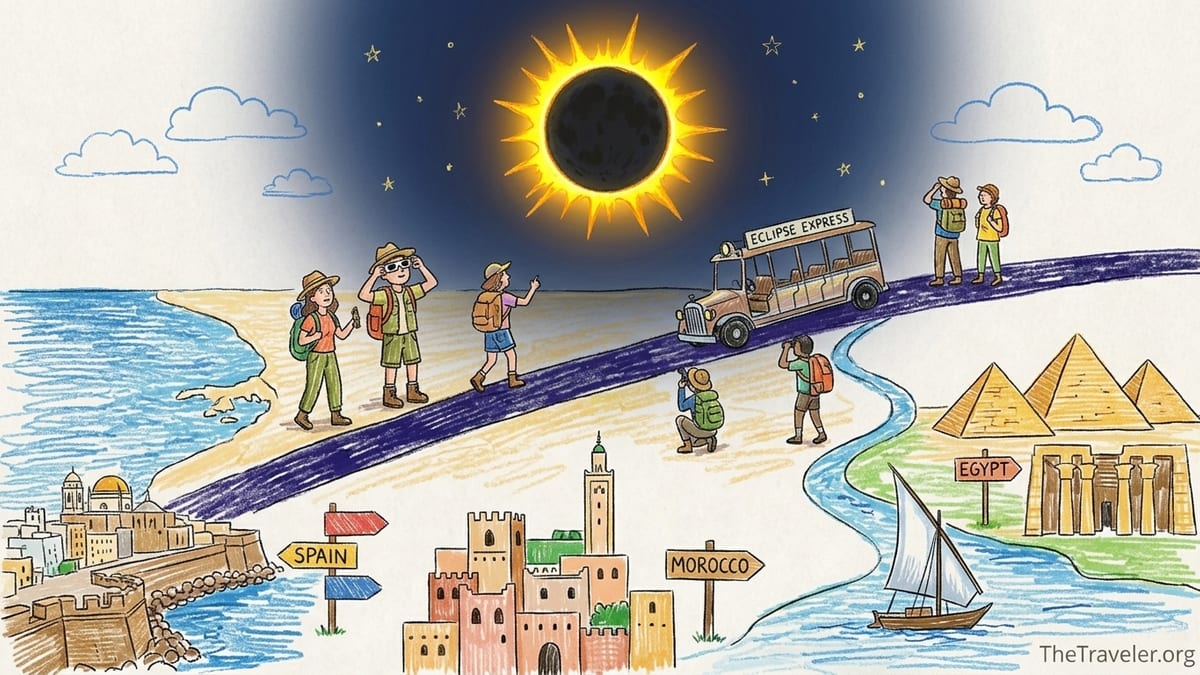
Understanding the 2 August 2027 Total Solar Eclipse
The total solar eclipse of 2 August 2027 will begin over the eastern Atlantic, cross the Strait of Gibraltar, slice through southern Spain, sweep across northern Morocco and then traverse North Africa to Egypt before continuing over the Red Sea and into the Arabian Peninsula. Astronomers describe the narrow track where day turns briefly to night as the “path of totality,” roughly 250 to 260 kilometers wide for this eclipse according to official national and international maps. Outside that path, observers will see only a partial eclipse, even if most of the Sun is covered.
This particular eclipse stands out for its duration. Near the point of greatest eclipse in southern Egypt, just east of Luxor and close to the Nile, totality will last about 6 minutes 20 seconds, one of the longest intervals of complete darkness anywhere on Earth in the first half of the century. Travel and eclipse-planning portals give durations of around 6 minutes 21 seconds to 6 minutes 24 seconds for locations on or near the central line in this region, compared with the two to three minutes that many modern eclipse chasers are used to.
Timing also matters when you plan your day. In Spain, mid-eclipse comes late in the morning, around 10:40 to 10:50 local time in many coastal locations in Andalusia, while in Morocco totality tends to occur close to local midday. In Egypt, totality will fall around early afternoon, roughly 13:00 local time in the Luxor area according to eclipse calculators derived from NASA data. These broad windows help you plan whether to travel the same morning or stay overnight near your viewing point, a key logistics decision in regions that will attract tens or hundreds of thousands of visitors.
The eclipse also has historical significance. Spanish astronomical agencies note that this will be the second total solar eclipse to cross Spain within a year, following the August 2026 event, and that no other total eclipse will be visible from Spain again until the 2050s. Egyptian scientific institutions have dubbed the 2027 event the “eclipse of the century” for the country, highlighting both the exceptional duration and the rare combination of astronomical spectacle with world-class archaeological sites.
Spain: Atlantic Light over Cádiz and Andalusia
In Spain, the path of totality clips the far south, offering a mix of coastal and urban viewing locations. Maps from national observatories and specialist eclipse sites show the shadow coming ashore near the province of Cádiz, crossing parts of Andalusia and touching the Spanish enclaves of Ceuta and Melilla on the North African coast. Cities such as Cádiz and Jerez sit close to or just within the path, while popular destinations like Seville, Málaga and Granada experience a very deep partial eclipse if not full totality in the city center. Further north, Madrid and Barcelona will only see the Sun partially covered, albeit impressively so.
Cádiz stands out as one of the most atmospheric Spanish bases. A compact historic city on a peninsula in the Atlantic, it combines broad horizons over the ocean with open plazas and historic ramparts that double as viewing platforms. On a clear morning in early August, observers spread along city beaches like Playa de la Victoria or head to the seafront promenades around the old town in time for totality just before 11:00. Local accommodation in high summer ranges from modest pensions charging the equivalent of around 80 to 120 euros per night to upscale boutique hotels that can easily exceed 200 euros per night for eclipse week, according to current listings for comparable August dates.
Logistics in Andalusia are comparatively straightforward for visitors. High-speed rail and long-distance buses link Madrid and Barcelona with Seville, Córdoba and Málaga, and from there regional trains and buses continue to Cádiz, Algeciras and smaller coastal communities in the shadow’s path. For example, fast trains from Madrid to Seville in recent summers have often started in the 60 to 100 euro range one way if booked early, while advance intercity bus tickets from Seville to Cádiz have been available for roughly 10 to 20 euros depending on operator and time of day. Rental cars from major brands at airports like Málaga or Seville commonly start at around 40 to 60 euros per day in peak season for basic models before insurance and extras, though eclipse demand may push prices higher.
Weather is the main uncertainty. Climatological summaries suggest that early August weather in southern Spain typically brings hot, dry conditions with many clear mornings, but coastal marine layers and heat haze are possible. Serious eclipse travelers may want to base themselves in a hub such as Cádiz, Algeciras or inland Jerez, then be prepared to drive an hour or two along the coast or inland before sunrise if short-term forecasts suggest cloud. Even modest flexibility can make the difference between an obstructed and a crystal-clear view.
Morocco: Long Totality between Tangier and Tetouan
Across the Strait of Gibraltar, northern Morocco sits squarely inside the path of totality, making it one of the most attractive and accessible regions to witness the 2027 eclipse. Maps from astronomical organizations and national tourism content indicate that cities such as Tangier, Tetouan and Chechaouen are near the central track, offering around four to five minutes of darkness in some locations, combined with views of mountains, Mediterranean coastline and historic medinas. Some eclipse enthusiasts have already identified the area east of Tangier and around Tetouan as offering an appealing balance of duration, scenery and infrastructure.
Tangier will likely emerge as a major hub. With an international airport served by European carriers, a fast rail link to Casablanca and an established hotel scene, it can absorb significant visitor numbers while keeping logistics manageable. In recent high summer seasons, mid-range hotels in central Tangier have often been bookable in the range of 70 to 150 euros per night, with international chains and waterfront properties typically commanding higher rates. Boutique riads inside the medina can offer characterful stays at similar or slightly lower price points if booked far in advance. By contrast, smaller towns near the centerline may have only a limited number of guesthouses, meaning eclipse groups could quickly saturate local capacity.
Travelers may also consider inland or hillside locations to balance cloud risk and crowding. Northern Morocco in August is hot but can see coastal humidity and some haze, so locations slightly inland, such as the hills south of Tetouan or near Chefchaouen, may provide cleaner skies. Reaching these areas usually involves road travel. As a reference, intercity buses between Tangier and Tetouan commonly take about 1.5 hours and cost the equivalent of 5 to 10 euros, while shared taxis operate on flexible schedules at comparable or slightly higher prices per seat. Renting a car from Tangier or Tetouan has recently been advertised from roughly 30 to 50 euros per day for compact models, though careful checking of insurance terms and vehicle condition is recommended.
Morocco’s tourism industry is already signaling interest in the eclipse. International and local operators are beginning to promote 2027 eclipse itineraries that combine a few days on the northern coast with journeys to classic destinations such as Fes, Marrakech or the Sahara dunes near Merzouga. Sample packages for earlier seasons that combine several nights in riads, guided city tours and overnight desert camps often start around 800 to 1,500 euros per person for a week, excluding international flights, and it is reasonable to expect dedicated eclipse programs in 2027 to be priced at the higher end of that range or above. Independent travelers hoping to keep costs down will want to monitor booking windows closely and secure key reservations at least a year or more ahead.
Egypt: The Longest Darkness over Luxor and the Nile
Egypt offers the longest and arguably most dramatic experience of totality in 2027. Eclipse maps from research institutions show the path crossing the country from the western desert through oases like Siwa, then following the Nile corridor near cities such as Sohag and Luxor before turning toward the Red Sea coast. Near Luxor, where the central line intersects the river and the surrounding archaeological zone, totality reaches its maximum duration of roughly 6 minutes 20 seconds, an exceptionally long interval that will allow observers to fully absorb the changing sky, solar corona and the eerie lighting over temples and cliffs.
Luxor is already one of Egypt’s most visited destinations, home to the temples of Karnak and Luxor on the east bank and the Valleys of the Kings and Queens on the west bank. Scientific and tourism authorities have started referring to 2027 as an “eclipse of the century” opportunity for Egypt, and there are indications that conferences on solar physics and special observation programs will be organized around the event. International travel companies are also advertising sample itineraries like week-long Nile cruises timed to arrive in Luxor for eclipse day, with promotional materials highlighting on-deck viewing shows, expert lectures and guided visits to sites that will momentarily plunge into darkness.
Pricing for Egypt in late July and early August already reflects strong demand even before final eclipse offerings are set. For a rough sense, recent five to seven night Nile cruise packages between Aswan and Luxor that include accommodation, meals and standard sightseeing have often been advertised from around 900 to 1,500 euros per person in double cabins outside peak holiday weeks, with higher-end vessels charging from roughly 2,000 euros and upward. Mid-range hotels in Luxor have commonly been available from about 40 to 100 euros per night, while international chain properties and luxury riverfront hotels often start around 150 to 250 euros per night for high-season dates. In 2027, eclipse week pricing is likely to sit at or above these upper bands, especially for rooms and cabins with good sky views.
On the ground, getting to Luxor usually involves a domestic flight from Cairo or Hurghada, or an overnight train along the Nile valley. Recent sample prices from Egyptian and foreign carriers suggest one-way fares between Cairo and Luxor in the 60 to 150 euro range depending on booking class and season, while night trains with air-conditioned sleeping berths have been advertised from roughly 50 to 100 euros per person in double cabins. Road transfers from nearby Red Sea resorts such as Hurghada generally take about 4 hours by private car or organized bus. Given the potential for crowding around the narrow path of totality, travelers will want to arrive in Luxor at least a full day, and ideally several days, before eclipse day to avoid disruptions.
Comparing Spain, Morocco and Egypt for Eclipse Travelers
Choosing between Spain, Morocco and Egypt for the 2027 eclipse involves weighing totality duration, weather prospects, ease of access and the broader travel experience you seek. Spain offers relatively short totality near Cádiz compared with North Africa, but combines that with easy access from elsewhere in Europe, familiar infrastructure and the chance to pair eclipse viewing with beach holidays in Andalusia, cultural visits to Seville or Córdoba, or road trips across southern Spain. For many first-time eclipse travelers from Europe or North America, the combination of simplicity and safety nets makes Spain an appealing entry point.
Morocco sits in the middle in several senses. It promises longer totality than most Spanish locations, with four minutes or more possible near the central path, and a sense of adventure without straying too far from major air hubs. Its historic medinas, Rif and Atlas mountain landscapes and desert excursions give the trip a strong sense of place beyond the astronomical event. At the same time, language differences, driving conditions and variable service standards can introduce more complexity than in Spain, although many visitors find that planning with reputable local partners or established guesthouses mitigates these concerns.
Egypt is the clear winner on duration and drama. Observing over six minutes of totality above the Nile valley with a backdrop of temples and desert cliffs is a once-in-a-lifetime proposition even for veteran eclipse chasers. However, it also involves a longer journey for most visitors, hot conditions in early August and the need to navigate domestic transport and security procedures. Package tours and cruise-based programs can simplify many of these logistics but often at higher cost. Travelers should also be prepared for intense sunlight and temperatures outside the brief window of darkness, making hydration, sun protection and sensible scheduling of sightseeing particularly important.
Budget plays a role across all three destinations. As of late 2026, typical summer airfares from major European gateways to Andalusian airports have often started around 150 to 300 euros return if booked early, while flights to Morocco have been available from roughly 200 to 400 euros and to Egypt from around 350 to 700 euros, depending on origin and season. Accommodation and food costs tend to be highest in Spain, moderate in Morocco and comparatively lower in Egypt for equivalent comfort levels, although eclipse-driven demand could compress those differences. Travelers with flexible dates can potentially save by arriving before or staying after the peak eclipse window rather than focusing all nights on the immediate days around 2 August.
Weather, Safety and Practical Viewing Tips
Weather is the critical variable all eclipse travelers must accept and manage. Historical climate data indicate that many regions along the 2027 path, especially in North Africa and Egypt, enjoy high probabilities of clear skies in early August, but local and short-term conditions can still bring clouds, dust or haze. Inland desert and semi-desert locations often have better odds of cloud-free conditions than coastal areas influenced by marine layers, which is part of the reason why many eclipse specialists favor sites along the Nile or inland Morocco over strictly seaside locations. Checking cloud-cover statistics and monitoring forecasts from about a week out will help inform any last-minute relocations.
Safety considerations differ by destination but share common themes. Authorities in Spain, Morocco and Egypt are aware that the eclipse will attract visitors, and previous events in other countries suggest that police, civil protection and health services will issue special advisories covering crowd management, road closures and heat risks as the date approaches. Travelers should watch for official guidance on where large-scale public viewing zones will be set up, such as city stadiums, seaside promenades or open fields near major roads, and consider using these instead of isolated off-road spots that could be difficult for emergency services to reach.
Proper eye protection is non-negotiable. Only during the brief phase of totality, when the Sun is completely covered, is it safe to look directly at the sky without filters. At all other times, including partial phases before and after totality, observers must use eclipse glasses or handheld viewers that meet international safety standards. In recent eclipses, certified glasses sold through astronomy organizations, science museums and reputable retailers have often cost between the equivalent of 2 and 10 euros per pair, depending on quantity and branding. Travelers should purchase and test their glasses well before departure, as counterfeit or substandard products sometimes appear in tourist markets around major events.
Planning your viewing setup can also enhance the experience. In built-up cities like Cádiz or Tangier, rooftops, seafront promenades and elevated parks with good horizons make excellent vantage points but may become crowded early in the day. In Luxor and along the Nile, many tours are expected to arrange private terraces, riverbanks or even stationary boats as observation platforms. Whatever the location, bring water, sun protection, a hat, backup viewing glasses and, if photographing, appropriate filters for cameras and binoculars. The temperature drop and changing light during totality can be surprisingly emotional, so it is wise to spend at least part of the event simply looking and listening rather than focusing entirely on equipment.
Booking Strategies and Crowd Expectations
The 2027 eclipse is already affecting travel patterns. Reports from tour operators and travel forums indicate that some Nile cruises, specialist astronomy tours and premium hotels in Luxor are releasing eclipse-week allocations years in advance, with certain categories already selling briskly. In Spain, cities within the path of totality, including Cádiz and the autonomous cities on the North African coast, can expect a surge of domestic visitors similar to or greater than that seen during the 2026 eclipse. Moroccan tourism professionals in the north report rising inquiries for August 2027 stays around Tangier and Tetouan, even from travelers who have not previously visited the country.
For independent travelers, a staged booking strategy can help balance certainty and flexibility. The first priority is usually accommodation inside or very near the path of totality for at least two nights around 2 August. Securing fully refundable or flexible-rate rooms a year or more ahead in a town with good road connections gives you a base while preserving the option to relocate closer to the central line if better opportunities arise closer to the date. The second step is to lock in international flights once airline schedules open, typically 10 to 12 months out for many carriers. Finally, as forecasts sharpen, you can refine internal transport and local excursions in the last few months.
Crowd levels will likely vary considerably along the path. High-profile sites like Luxor, central Tangier and Spain’s larger coastal cities could draw large numbers of organized tour groups, making central squares, waterfronts and iconic viewpoints very busy. By contrast, smaller inland towns, rural areas or lesser-known stretches of coastline within the path may offer more relaxed experiences, provided they are safely accessible and have at least some basic services. Travelers who prioritize a quiet, contemplative totality might consider renting simple accommodation in outlying villages, arranging private transportation and bringing necessary food and water.
Cancellation and contingency planning deserve special attention. Heat waves, regional disturbances or airline disruptions could intersect with eclipse travel in unpredictable ways. Wherever you book, check refund policies carefully, consider travel insurance that covers significant delays or cancellations and think through backup plans such as alternative viewing sites reachable by car or train if your first-choice location becomes impractical. Being mentally prepared to adapt, rather than holding rigidly to a single perfect plan, increases the odds that you will still come away with meaningful memories even if some details change.
Making the Eclipse Part of a Wider Journey
While the few minutes of totality on 2 August 2027 will be the headline moment, many travelers will use the event as an anchor for broader itineraries. In Spain, it is easy to combine eclipse viewing in Andalusia with time in cities like Seville, Córdoba or Granada, visiting landmarks such as the Alcázar, the Mezquita or the Alhambra before or after the event. Road trips from Cádiz along the Costa de la Luz or into the white villages of the Sierra de Grazalema can round out a week-long holiday, and some travelers may even link the 2027 event with a return visit for the annular eclipse that will cross parts of Spain in 2028.
In Morocco, an eclipse-focused trip might begin in Tangier before heading to Chefchaouen in the Rif mountains, Fes with its ancient medina, and later south to Marrakech or the Sahara. Overnight stays in traditional riads, visits to historic madrassas and time in desert camps under dark skies can give the journey a sense of coherence that extends beyond the single astronomical event. Travelers with more time might even cross by ferry between Spain and Morocco before or after the eclipse, experiencing two countries under the same shadow on a single itinerary.
Egypt lends itself especially well to themed journeys around the eclipse. A typical route might start in Cairo, with visits to the Pyramids of Giza and the Egyptian Museum, before a flight or train to Luxor for several days of temple visits and eclipse preparations. After the event, travelers could continue by cruise or road to Aswan, explore Philae Temple and the High Dam, or venture further south to Abu Simbel if conditions and security guidance allow. Alternatively, some may pair a few days in Luxor with relaxation on the Red Sea coast at resorts near Hurghada or Marsa Alam, taking advantage of coral reefs and beaches after the intensity of eclipse day.
In all three countries, the eclipse is likely to spark local cultural programming, from astronomy talks in museums to special evening light shows at monuments and community events in town squares. Keeping an eye on local tourism board announcements and cultural calendars in the year leading up to August 2027 will help you weave these opportunities into your plans. The more you integrate the eclipse into a broader narrative of place, history and personal exploration, the more resonant your memories of those few minutes of midday darkness are likely to be.
Conclusion: Choosing Your Moment in the Shadow
The total solar eclipse of 2 August 2027 is more than a celestial curiosity. It is a rare alignment of astronomy, geography and culture that places Spain, Morocco and Egypt on a shared stage for a few fleeting minutes. From the Atlantic horizons of Cádiz to the hills of northern Morocco and the temple-lined banks of the Nile in Luxor, the path of totality offers very different backdrops for essentially the same cosmic drama.
Where you choose to stand when the Moon covers the Sun will depend on your appetite for adventure, your tolerance for heat and crowds, your budget and the kind of stories you hope to tell afterward. Spain may be the simplest and most familiar option for many, Morocco a compelling bridge between Europe and Africa, and Egypt the ultimate choice for those seeking maximum totality and ancient landscapes under an otherworldly twilight.
Whatever you decide, planning early, staying flexible and grounding your trip in reliable information from scientific and tourism authorities will be crucial. Secure a safe place to watch, protect your eyes, build time around the event to explore and be ready to adapt to weather and logistics. If all goes well, for a few unforgettable minutes in August 2027, the world around you will fall silent, the sky will darken and you will share in a spectacle that has fascinated human societies for millennia.