


Flight disruptions are stressful, but for many travelers the real headache starts afterward, when they try to claim compensation they are legally owed. Services like AirHelp promise to turn canceled flights, long delays, and missed connections into cash in your bank account, without you having to fight the airline yourself. Yet not every traveler gets the same value from using AirHelp. Some passengers stand to benefit far more than others, depending on where they fly, how complex their trips are, and how much time and energy they can spare to chase a claim.
Get the latest updates straight to your inbox!
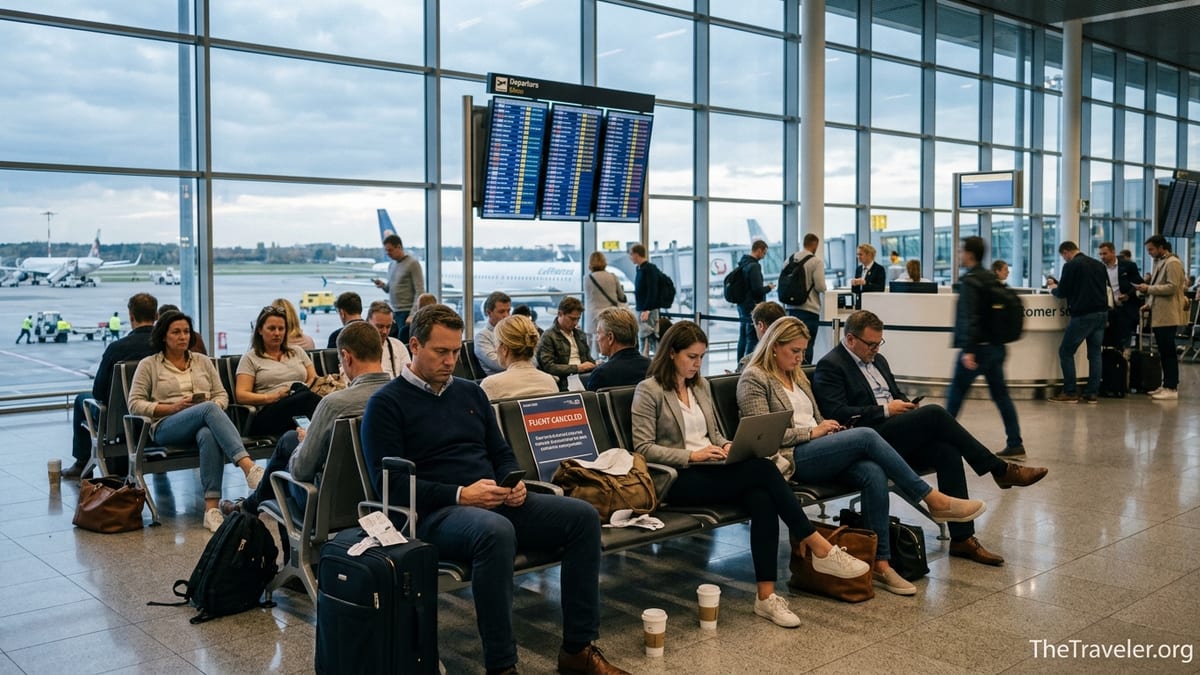
How AirHelp Works in Practice
AirHelp is a claims management company that helps passengers pursue compensation for flight disruptions under air passenger rights laws such as the European Union’s EC 261 regulation, the United Kingdom’s UK 261 rules, Brazil’s ANAC 400, and others. In simple terms, you submit your disrupted flight details to AirHelp, they check whether your case is likely eligible, then they pursue the claim with the airline on your behalf. If they win, you receive a payout and AirHelp takes a percentage as a success-based fee. If they lose, you pay nothing for their efforts or for any legal action they tried.
In real-world terms, that could mean turning a badly delayed Lisbon to New York flight into several hundred euros in compensation, or claiming money after an airline cancels your Amsterdam to Rome trip the night before departure. Under EC 261, compensation on eligible flights typically ranges from about 250 to 600 euros per passenger depending on distance and delay length, so a family of four on a disrupted transatlantic route could be looking at a total claim in the four-figure range.
AirHelp’s value lies in handling the tedious parts that often discourage travelers from claiming anything at all: identifying which law applies, drafting formal complaints, arguing back when an airline refuses, and, in some cases, filing suit in a foreign court. The company has handled millions of passenger claims worldwide, and its process is largely digital: you upload your boarding pass or confirmation, sign an authorization, then wait for updates rather than spending hours chasing customer service.
Because AirHelp works mainly with fixed, law-based compensation rather than discretionary vouchers, the outcomes are usually either a legally defined cash amount or no compensation at all. That clear framework is one reason it is especially attractive to certain types of travelers, particularly on European and long-haul itineraries where consumer protections are strongest.
Travelers on Flights Covered by Strong Passenger Rights Laws
The group that gets the highest potential monetary value from AirHelp is passengers flying on routes with strong, established legal protections. The standout example is EC 261 in Europe, which applies to all flights departing the European Union (and a few associated countries) on any airline, as well as flights arriving in the EU when operated by an EU carrier. UK 261 offers near-identical protections for flights under UK jurisdiction. Under these rules, a delayed or canceled flight can lead to compensation of roughly 250, 400, or 600 euros per person depending on distance and arrival delay, provided the disruption was not caused by extraordinary circumstances such as severe storms or air traffic control strikes.
Take a common scenario: a traveler flying New York to Madrid on Iberia, or Miami to Lisbon on TAP Air Portugal, arrives more than three hours late due to an airline-controlled technical issue. Even if the ticket was bought through a US travel agency, the departure from the EU (in the eastbound direction) or the EU carrier on the westbound leg can trigger European protections. In practice, that could be a 600-euro claim per passenger on a long-haul route. For a couple on holiday, AirHelp’s involvement could transform a frustrating overnight delay into more than 1,000 euros in recovered funds.
Passengers on European low-cost carriers also benefit significantly when they know to check their rights. A budget traveler on a 60-euro Ryanair or easyJet ticket from Berlin to Barcelona might think a delay is just bad luck and never bother complaining. Under EC 261, however, a three-hour arrival delay for a flight of this distance could still be worth around 250 euros in compensation, several times the ticket price. AirHelp’s online tools can flag this automatically, making it particularly valuable for cost-conscious travelers who fly cheap but have limited awareness of passenger rights.
Beyond Europe, AirHelp also works under national laws like Brazil’s ANAC 400 and the Canadian Air Passenger Protection Regulations. The payouts are often lower or more conditional than in Europe, but they can still add up. For instance, a domestic flight in Brazil with a long delay and poor rebooking options can generate a right to compensation or refunds that many foreign visitors would struggle to enforce without help, given language barriers and unfamiliar procedures. On such routes, AirHelp effectively translates local regulations into plain language and a simple claims flow.
Occasional Travelers Who Lack Time or Legal Knowledge
Occasional flyers, such as families taking one big international vacation a year, often stand to gain disproportionately from using AirHelp. They are the least likely to know detailed rules like EC 261, and they rarely have experience drafting formal complaints or threatening legal action. When something goes wrong, they may accept meal vouchers or a partial refund and assume that is all they can hope for.
Imagine a family from Chicago flying to Paris for a summer holiday. Their outbound flight from Chicago to London on a European carrier encounters a last-minute aircraft swap that leads to a long mechanical delay, and they arrive in Paris six hours late after a missed connection at Heathrow. At the airport, they receive a hotel room and meal vouchers but no clear explanation of their compensation rights. Once home, the parents discover AirHelp, enter their booking number, and learn that under EC 261 they may each be entitled to a fixed cash payment because their journey involved an EU airline and a qualifying delay.
For this family, the alternative to AirHelp would be contacting the airline through web forms, possibly receiving a template denial referencing “extraordinary circumstances,” and then deciding whether to argue further or drop the matter. Most occasional travelers simply let it go at that point. AirHelp’s offer to handle all correspondence and, when necessary, escalate to legal action is precisely what turns an almost-abandoned claim into money they would otherwise leave uncollected.
Older travelers and those who are less comfortable with bureaucracy or foreign languages also fit into this high-benefit group. A retired couple whose Rome to Munich flight was canceled the morning of departure might not feel confident navigating airline terms or European law. A service that compresses their role to “upload your documents and wait” can convert what feels like an intimidating legal fight into a passive, low-effort process with a chance of a meaningful payout.
Frequent Flyers and Complex, Multi-Leg Itineraries
AirHelp can also deliver especially strong value for frequent travelers who book complex itineraries, particularly when multiple airlines and connections are involved. The more moving parts a trip has, the easier it is to miss a connection or fall into a grey area where nobody wants to accept responsibility. Knowing which carrier is liable under the relevant law, and whether a delay on an early leg qualifies for compensation based on the final arrival time, can be surprisingly technical.
Consider a business traveler booked on a single ticket from Warsaw to San Francisco via Frankfurt with a European carrier. A runway issue at the first airport leads to a missed connection in Frankfurt, and the traveler eventually lands in California more than four hours later than scheduled. The flight disruption itself occurred in Europe and the itinerary is operated by an EU airline, so EC 261 may apply to the entire trip, not just the first leg. A busy professional might not realize that the missed connection, rather than only the initial delay, is the key to their compensation eligibility. AirHelp’s systems are designed to analyze such cases based on departure, arrival, operating carrier, and actual delay at final destination.
Another example is code-share flights, where a ticket is marketed by one airline but operated by another. A traveler might purchase a ticket on a US airline from Toronto to Rome, with the long transatlantic leg operated by a European partner. If the Rome leg is severely delayed or canceled and the traveler reaches their destination far behind schedule, EC 261 might still be triggered because an EU carrier operated part of the journey into Europe. In these tangled scenarios, determining who owes what is often more effort than a frequent flyer cares to expend; handing the paperwork to AirHelp can be a rational trade of a percentage fee for saved time and hassle.
For digital nomads or consultants who travel often between Europe, North America, and South America, AirHelp can function as a persistent safety net. Each time a disruption occurs, they simply upload the details and let the service determine eligibility. Over a year of frequent flying, a pattern of occasional three-hour delays and missed connections can add up to a surprising amount of recovered money, even after AirHelp’s fee.
Non-Residents and Travelers Dealing With Foreign Airlines
Another group that often gets outsized value from AirHelp is non-resident travelers facing an airline based in a foreign country. Suing an airline or even filing a formal complaint can be daunting when you do not speak the language, have no local address, and are unfamiliar with the court system. This is especially true for visitors who experience disruptions while traveling in Europe, Brazil, or Canada and then return home to a country with weaker passenger protections.
Take a traveler from the United States who flies Berlin to Lisbon to Rio de Janeiro on a mix of European and Brazilian airlines, all on a single ticket. If the Berlin to Lisbon leg is canceled for an aircraft maintenance issue and the traveler arrives in Rio an entire day late, they might have rights under both EC 261 and Brazilian regulations. Trying to parse two legal systems and negotiate with two foreign airlines from another continent is not something most travelers are prepared to do. AirHelp’s role is to focus on whichever law offers the clearest, most enforceable path to compensation and handle the full cross-border process.
Similarly, a Canadian visiting London who is bumped from an overbooked London to Dublin flight on an Irish carrier might not even realize that denied boarding, when it is involuntary and the airline’s responsibility, can trigger specific cash payments under European rules. They may accept a travel voucher or seat on a later flight but leave statutory compensation unclaimed. By contrast, entering their flight details into AirHelp after the trip can reveal a straightforward case where the airline is obliged to pay a fixed sum.
Tourists on package holidays booked through foreign tour operators, and students on study abroad programs flying with unfamiliar carriers, also fit this pattern. They are often far from home, with limited time and no appetite for legal wrangling. For them, the true value of AirHelp is not just the money recovered but the avoidance of navigating foreign-language websites, national enforcement bodies, or small-claims courts abroad.
When AirHelp Is Less Valuable or Not Necessary
While many travelers benefit from AirHelp, there are also scenarios where its value is limited. The most obvious is when the disruption is clearly outside the airline’s control, such as closures caused by extreme weather, air traffic control outages, or security incidents. In these situations, most passenger-rights laws do not grant cash compensation even if airlines must provide meals, hotels, or rerouting. If your London to Madrid flight was grounded due to a massive snowstorm that shut down the airport, no service can create a compensation right that the law does not provide.
Another case where AirHelp may be less essential is when the traveler is already comfortable asserting their rights directly. Some frequent flyers, especially those based in Europe, know EC 261 well enough to write their own complaints and, if necessary, escalate to a national enforcement body. For them, going straight to the airline can preserve 100 percent of any payout, as long as they are willing to manage the back-and-forth correspondence and potential delays. AirHelp’s benefit in this context is reduced to saving time rather than unlocking compensation that would otherwise be lost.
Domestic flights in countries without robust compensation schemes also limit what AirHelp can achieve. For instance, a purely domestic itinerary within the United States, operated by US carriers and not linked to an international EC 261 or similar route, generally offers few legal rights to fixed-sum compensation for delays or cancellations unless you are involuntarily denied boarding due to overbooking. If your Dallas to Denver flight is delayed by four hours due to a crew scheduling issue, the airline may offer meal vouchers or a partial refund, but there may be no law-based cash amount for AirHelp to enforce. In these circumstances, managing the issue directly with the airline is usually just as effective.
Finally, some travelers prefer to avoid sharing their personal data or claim a percentage-based fee out of principle. For them, the calculus may be that any compensation is worth pursuing only if they can keep it all. AirHelp’s model is built on the trade-off between a reduced share of the payout and the convenience of outsourcing the entire claims process. Travelers who enjoy handling such disputes themselves, or who are motivated by the idea of confronting the airline directly, are less likely to see the service as worthwhile.
The Takeaway
AirHelp fills a very specific gap in modern air travel: the space between what passengers are legally entitled to and what they actually receive in practice. The travelers who get the most value from the service are those flying routes protected by strong passenger-rights laws, particularly in and out of Europe, and those who lack the time, confidence, or legal knowledge to fight with airlines on their own. For a family delayed overnight on a transatlantic vacation, or a digital nomad regularly missing connections in European hubs, the ability to turn a disrupted journey into hundreds or even thousands of euros in compensation, without handling any paperwork, can be compelling.
On the other hand, AirHelp is not a magic solution for every disruption. When weather or air traffic control is clearly to blame, or when flights are entirely domestic in jurisdictions with weak compensation rules, the service cannot create rights that do not exist. And confident, well-informed travelers might prefer to claim directly and keep 100 percent of any payout. The real key is awareness: understanding when a flight might qualify under laws like EC 261 or UK 261, and then deciding whether you would rather spend hours pursuing the airline yourself or let a specialist handle it in exchange for a share. For many travelers, especially those caught in foreign legal systems or complex itineraries, that trade can be an excellent deal.
FAQ
Q1. What kinds of flight problems can AirHelp help with?
AirHelp focuses on disruptions covered by passenger-rights laws, such as long delays, flight cancellations, and involuntary denied boarding due to overbooking, particularly on routes where regulations like EC 261 or UK 261 apply.
Q2. How does AirHelp make money if there are no upfront fees?
AirHelp typically operates on a no win, no fee basis, taking a success-based percentage from the compensation it recovers for you. If your claim is unsuccessful, you normally do not pay for their work or any legal steps taken on your behalf.
Q3. Who benefits most from using AirHelp?
Travelers on European or other strongly protected routes, occasional flyers who do not know their rights, frequent travelers with complex itineraries, and non-residents dealing with foreign airlines tend to get the most value from AirHelp.
Q4. Can AirHelp help with domestic flights in the United States?
AirHelp’s ability to help on purely domestic US flights is limited because US law generally does not guarantee fixed-sum compensation for delays or cancellations. They may still assist in some overbooking or international-connection situations, but outcomes are usually more modest than under European rules.
Q5. Is it better to claim directly with the airline instead of using AirHelp?
If you know your rights, are comfortable arguing your case, and have time to pursue the airline, claiming directly can mean you keep the full compensation. AirHelp is most helpful when you would otherwise give up or never start a claim at all.
Q6. What information do I need to start a claim with AirHelp?
You usually need your booking confirmation, flight number, travel dates, and, if possible, a boarding pass. Providing any written communication from the airline about the disruption can also strengthen your case.
Q7. How long does it take to receive compensation through AirHelp?
Time frames vary widely. Simple cases where the airline cooperates can resolve in a few weeks, while disputes that require legal action or court involvement can take several months or longer before any payout arrives.
Q8. Will using AirHelp affect any refunds or vouchers I already received from the airline?
It depends on what you accepted and what the law allows. In many cases, meal vouchers, hotels, or rerouting do not cancel your right to separate cash compensation, but full ticket refunds or settlement agreements sometimes do. AirHelp reviews each situation individually.
Q9. Does AirHelp guarantee I will get money for every disrupted flight?
No, there is never a guarantee. AirHelp first checks whether your case appears eligible under the relevant law, then pursues the claim. If the disruption is outside the airline’s control or falls outside applicable regulations, you may not receive compensation.
Q10. Is AirHelp worth it for short, cheap flights?
It can be. Under European rules, even a low-cost ticket on a short route can qualify for a relatively high fixed compensation amount if the delay or cancellation meets the legal thresholds, so using AirHelp may still lead to a meaningful payout compared with the original fare.