


More news on this day
Emirates’ latest reshuffle of its Airbus A380 network is set to change the summer travel landscape between Dubai, Prague, and Glasgow, as the airline withdraws the double-decker jet from both European routes and replaces it with smaller Boeing 777-300ER aircraft.
Get the latest news straight to your inbox!
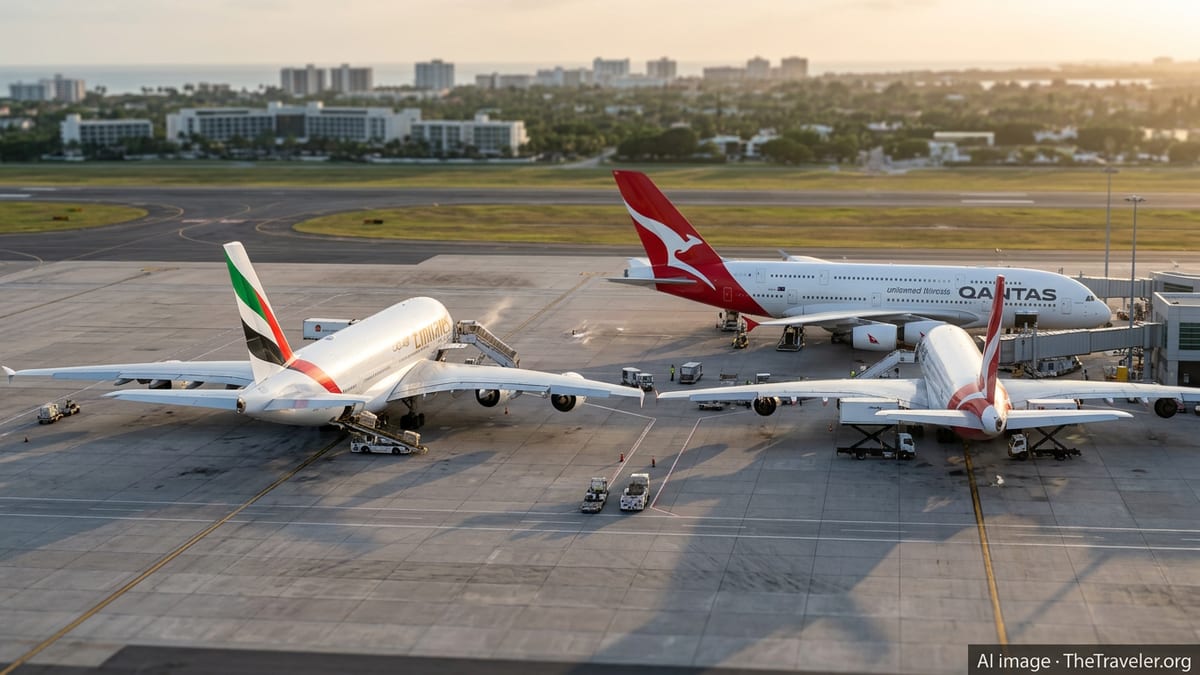
Summer A380 Suspensions Hit Prague and Glasgow
Industry schedule data for the third quarter of 2026 shows that Emirates will operate its Dubai–Prague and Dubai–Glasgow services with Boeing 777-300ER aircraft throughout the peak summer period, rather than the flagship Airbus A380 that had been planned. The adjustment covers July through September and follows earlier June timetable changes that already removed the A380 from a series of European and Asia-Pacific destinations.
Reports from aviation schedule trackers indicate that from 1 July to 30 September 2026, both Prague and Glasgow remain on a once-daily rotation to and from Dubai, but exclusively on the 777-300ER. Earlier in June, Emirates had already dropped the A380 from Glasgow and a group of other cities, citing a broader recalibration of its superjumbo deployment.
The move comes at a time when Emirates continues to be the world’s largest A380 operator, yet is trimming the type’s footprint on certain routes as it balances demand, operational constraints, and a major cabin retrofit program. For Prague and Glasgow, the impact is less about flight frequency and more about aircraft size and onboard product.
In practical terms, the shift means fewer total seats on each flight compared with the A380 layout, particularly in premium cabins. It also changes the onboard experience for travelers who had specifically booked the larger aircraft for its layout, quieter cabin, or high-profile amenities in premium classes.
Capacity, Cabins, and the Premium Economy Puzzle
The replacement of A380s with 777-300ERs over the summer reshapes both capacity and cabin options on the Dubai–Prague and Dubai–Glasgow corridors. Emirates typically deploys high-density A380s with larger overall seat counts, including generous premium cabins, whereas the 777-300ER configuration offers fewer seats and a different layout in business and economy.
Publicly available fleet information and airline statements on the retrofit program show that Emirates is in the process of rolling out refurbished interiors across both A380s and 777s, introducing Premium Economy and refreshed cabins on a growing list of routes. Some A380s serving key markets already feature the new four-class layout, while an expanding number of 777s are being upgraded to carry the same product mix.
For travelers in Prague and Glasgow, the short-term effect is mixed. While some may lose access to the A380’s upper-deck experience and, on certain frames, the latest-generation Premium Economy cabin, others could still encounter refitted 777-300ERs with updated interiors. Travel forums and customer reports in recent months highlight that equipment swaps can result in either product upgrades or downgrades, depending on whether an older or newly refurbished aircraft is assigned.
The capacity reduction may also play into fare dynamics. With fewer seats available on each departure compared with an A380, high-demand summer dates could see tighter availability, especially in business class. However, maintaining daily frequencies helps preserve connectivity to Emirates’ broader network across Asia, Africa, and Oceania for passengers starting in the Czech Republic and Scotland.
Retrofit Pressures and Fleet Strategy Behind the Changes
The A380 suspensions on the Dubai–Prague and Dubai–Glasgow routes fit into a wider pattern of network adjustments driven by Emirates’ multi-year fleet retrofit program. The airline has publicly detailed its plan to refurbish dozens of A380s and 777s, a process that takes each aircraft out of service for weeks at a time and requires careful juggling of schedules and capacity.
Recent updates from the carrier’s home-market media channels outline how the first high-density two-class A380 retrofits were completed this year, with more aircraft due for similar work by the end of 2026. In parallel, the next phase of the broader retrofit program encompasses 60 A380s and more than 50 Boeing 777s, underscoring the scale of the undertaking and its potential impact on route planning.
Aviation analysts note that such heavy maintenance and refurbishment activity inevitably reduces scheduling flexibility. To keep overall network coverage intact, Emirates has leaned more heavily on its large 777-300ER fleet to backfill routes that temporarily lose the A380. Prague and Glasgow join other destinations where the double-decker has been withdrawn or delayed while the airline cycles aircraft through interior upgrades and balances capacity across markets.
Alongside the retrofit, Emirates is also navigating the timeline for introducing new-generation Boeing 777X aircraft, which are expected to play a central role in its future long-haul network. While the new models are still undergoing certification and testing, industry coverage indicates that the airline is closely managing interim capacity using its existing A380 and 777 fleets.
Passenger Experience and Booking Implications for Summer Travel
For passengers booked on summer flights between Dubai, Prague, and Glasgow, the most immediate consequence of the A380 suspensions is a change in aircraft type that may alter the onboard experience without changing travel dates or flight numbers. Schedule databases and consumer reports suggest that, in many cases, flights continue to operate at similar times, but travelers will find themselves on a 777-300ER rather than a double-decker.
Travelers who selected Emirates specifically for the A380’s features, such as its roomier premium cabins or specific seating arrangements, may be disappointed by the downgrade in aircraft size. Online discussions show that some customers have already received notifications of aircraft changes affecting seat assignments and, in certain cases, cabin class availability when an A380 service is swapped out.
At the same time, the shift can work in favor of some passengers if a refurbished 777 with the latest interior is assigned. Reports on early refitted 777 services describe modernized cabins and the introduction of Premium Economy to additional destinations. For Prague and Glasgow, the variability of aircraft configurations means that passengers are encouraged to review current seat maps and cabin details as departures approach.
On the ground, airports in both cities lose a high-profile widebody for the summer, a symbolic change for local tourism authorities and airport marketers that have used the A380’s presence as a sign of strong long-haul connectivity. Nevertheless, the continuation of daily Emirates service on 777-300ERs maintains a direct link to Dubai’s global hub for leisure and business travelers heading in both directions.
Signals for the Wider Europe–Dubai Market
The Prague and Glasgow adjustments also offer a window into how Emirates is repositioning its capacity across Europe. Data compiled by aviation industry outlets indicates that the airline has trimmed A380 flying across several European gateways for summer 2026, even as it reintroduces or upgrades the aircraft to other cities perceived as higher priority for the refreshed cabins.
Observers note that these choices reflect a more flexible approach to the superjumbo than in the past, with Emirates using the A380 as a premium-capacity tool on select trunk routes while relying on the 777-300ER to maintain breadth of coverage across its European network. For secondary or seasonal markets, the smaller but still long-range 777 provides a way to preserve connectivity during a period of fleet transition.
For travelers and the tourism sectors in Prague and Glasgow, the key message is continuity rather than withdrawal. Flights remain daily, and connections via Dubai to destinations in Asia, the Indian Ocean, and Australasia continue to be available. The trade-off is a change in aircraft size and, for many, a different inflight experience than originally expected when they booked an A380 for the peak summer season.
As Emirates progresses through its retrofit schedule and prepares for the eventual arrival of new-generation widebodies, further adjustments to the A380 network are likely. This summer’s reshaping of services between Dubai, Prague, and Glasgow illustrates how those strategic decisions are already being felt by travelers on both ends of the route.