


I arrived at Pisa’s Sinopie Museum expecting a pleasant but secondary stop after the Leaning Tower. Instead, tracing the ghostly red lines beneath once-celebrated frescoes completely rewired how I understood the making of wall paintings in Italy. In those vaulted former hospital halls, the fresco stopped being a static masterpiece and became a risky, physical process, full of revisions, teamwork and problem solving. By the time I stepped back into the glare of the Piazza dei Miracoli, I felt I had watched the artists at work across six centuries.
Get the latest updates straight to your inbox!
From Bombed Frescoes to Revealed Drawings
The Sinopie Museum occupies the long brick building of the former Spedale Nuovo di Santa Chiara, along the southern edge of Pisa’s Piazza dei Miracoli. In the 13th century this was a pilgrim hospital commissioned after a papal reconciliation; today, its arched interior shelters some of the most revealing drawings in European art. The conversion to a museum only happened in 1979, which explains its slightly modern, pared-back feel compared with the ornate cathedral and baptistery outside.
The story that brings those drawings here is dramatic. On 27 July 1944, during the Second World War, artillery fire set the lead roof of the Camposanto Monumentale ablaze. Melted lead rained down onto the medieval frescoes that lined the cloister walls. To save what they could in the postwar years, conservators detached the surviving painted surfaces from the masonry. When they peeled away the layers, they found something no one had expected to see on such a scale: the sinopie, the full-size preparatory sketches in red pigment that the original painters had used as guides.
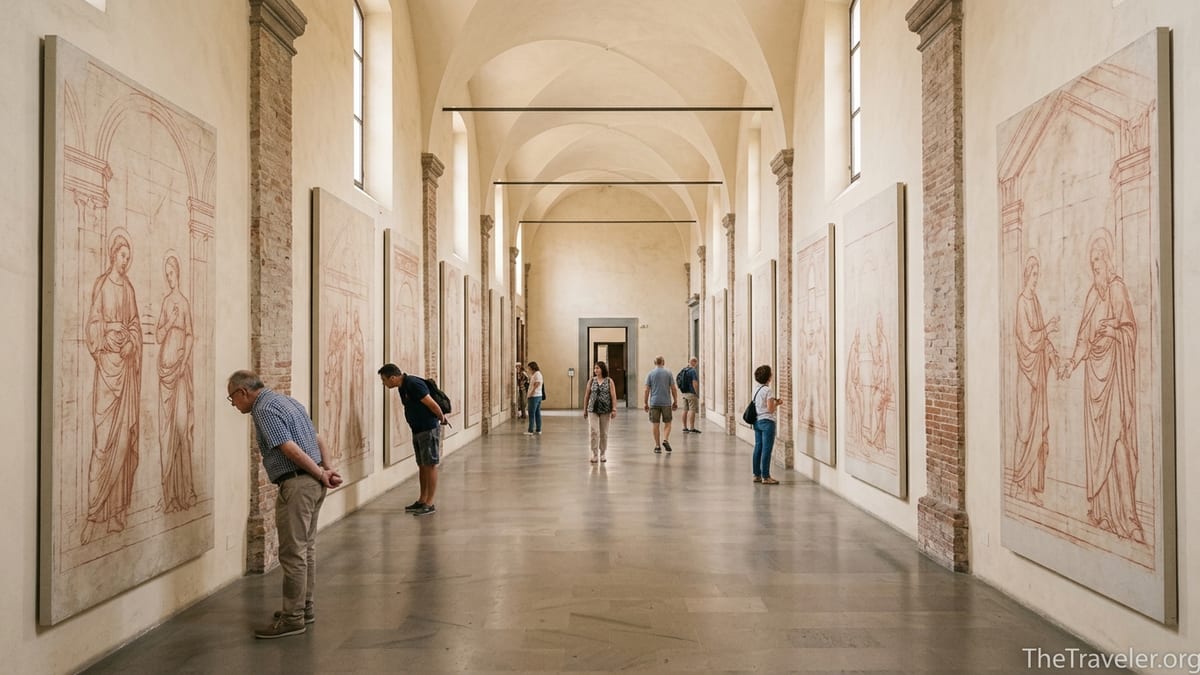
Walking into the first gallery, I realized the museum is less about finished beauty and more about survival and process. The large, cream-colored panels holding the sinopie are mounted along both sides of the room at almost their original scale. You are not looking at a small study behind glass, but at wall-sized drawings once hidden behind plaster and color. It feels like stepping backstage at a theater where the set designs have been left up with all their pencil marks showing.
This origin story is important because it frames everything you see. The sinopie exist because disaster struck. Without fire and emergency restoration, the drawings would still be sealed between layers of mortar. That mix of loss and revelation makes the museum uniquely moving. You are constantly aware that each red line is both a trace of what once was and a record of how it was made.
What a Sinopia Really Is, Seen Up Close
Before visiting, I knew in theory that a sinopia was an underdrawing for a fresco, usually done in reddish earth pigment. In textbooks, it is often defined in a sentence and illustrated with a small reproduction. Standing nose-to-panel in Pisa, that definition felt embarrassingly flat. Here, the pigment from Sinope, the Black Sea town that gave sinopia its name, is not just a color but a way of thinking on the wall.
The museum’s labels, in Italian and English, explain that the artist would first lay down a coarse plaster layer on the wall, then sketch the entire composition freehand with a brush dipped in diluted red pigment. This was not a casual doodle. On a single panel you can see delicate outlines of faces, heavy lines marking architecture, and quick, searching strokes where a hand or foot has been shifted slightly higher or lower. In several sinopie from the Camposanto’s Old Testament cycles, there are faint abandoned arches beside the final ones, where the painter decided to adjust the building’s proportions.
Seeing those corrections was a revelation. We tend to imagine frescoes as monumental, almost inevitable images dictated by a patron and executed by a genius. The sinopie suggest something closer to rough drafting on a huge scale. In one section from Benozzo Gozzoli’s Old Testament stories, the sweep of a cloak is first drawn tight to the figure, then rethought in a broader, more dramatic curve. The earlier line is still visible, ghosting just beneath the later one. It is like watching an animator refine a character frame by frame, except that each frame is a confident brushline in mineral red.
Another surprise is how varied the drawing styles are. Some sinopie, such as those attributed to Taddeo Gaddi, are built from fine, almost calligraphic strokes that search delicately for the right contour of a cheek or shoulder. Others, including parts of the Triumph of Death cycle associated with Buonamico Buffalmacco, rely on thicker, looping lines that carve out entire crowds with a kind of impatient energy. In reproduction, all sinopie can look similar. In person, they become distinct artistic signatures, and you begin to understand why art historians care so much about them.
Following the Fresco Process Step by Step
The museum’s layout lets you map the fresco process from wall to wall. After you have absorbed the initial shock of the red drawings, you begin to notice the technical panels and reconstructed sections that explain how these lines once disappeared under paint. One display walks you through the sequence: rough masonry, base plaster, sinopia drawing, final smooth plaster applied in daily sections, and then pigment brushed into still-wet lime.
One detail changed the way I thought about time in fresco creation. The smooth top layer of plaster, the intonaco, had to be painted while it was wet, usually within a single working day. The area laid each day is called a giornata. The sinopia underneath, however, could be drawn for the entire wall in advance, planning every giornata. On some panels, you can see light incised lines dividing the huge composition into daily segments. The master was effectively choreographing his own future labor, deciding how much narrative he and his assistants could handle before the plaster set.
Consider a large Camposanto scene like the Last Judgment. On the sinopia panel you can see groups of figures subtly clustered into tall vertical bands. Each band corresponds roughly to what could be plastered and painted in one day, perhaps a column of angels or a group of resurrected souls. The drawing not only sets the iconography but also acts as a project management tool, ensuring that no giornata would cut awkwardly through a face or a key gesture. I left the room thinking less of fresco as a single heroic act and more as a sequence of tightly scheduled workdays.
There are also small but telling explanations of how the sinopie were transferred to the new supports after the war. Conservators used techniques similar to those employed in detaching frescoes: gluing layers of cloth to the painted or drawn surface, lifting it away with the thin top layer of plaster, then mounting it on a new panel. Knowing that every sinopia you see has survived not only its original creation but a second risky operation in the 20th century adds another layer of respect for what is on display.
Human Stories Hidden in Red Lines
What makes the Sinopie Museum so compelling is not just technique but personality. The red lines feel intimate, sometimes more so than the surviving fresco fragments in the Camposanto. Without color and finishing layers, you are left with gesture, pose and composition. It is hard not to start reading stories into them that go beyond the biblical narratives they depict.
In the sinopia for the Stories of Job, for instance, Job’s gaunt figure is indicated with a few spare strokes, but the real drama lies in the hands of those around him. Several figures have hands drawn, erased and redrawn in new positions, groping toward a convincing expression of pity or accusation. The artist seems to be wrestling on the wall with how humans react to suffering. No explanatory label is needed; the revisions become a visual record of thought.
Similarly, in the sinopie from the Crucifixion scene painted around the 1320s, the clusters of onlookers at the base of the cross are composed of swift, almost scribbled outlines. Some faces are only a nose and brow in profile, yet their tilt and spacing make the crowd feel restless and unsure. Compared with polished altarpieces in nearby Florence or Siena, these underdrawings feel strangely modern, closer to quick reportage sketches than to polished devotional images.
It is also striking to see where assistants probably stepped in. On several panels, main figures are rendered with confident, sweeping lines, while background soldiers or architectural details look more mechanical, built from repetitive strokes. In a modern analogy, it is like touring a film studio and learning which shots were handled by the director and which by second-unit crews. The sinopie reveal how large workshops functioned, distributing labor in a way that still left the master’s hand clearly legible.
Practical Tips for Visiting Today
For all this richness, many visitors to Pisa walk straight past the Sinopie Museum on their way to the Leaning Tower queues and bus parking. That relative quiet is a gift if you make time for it. The museum sits along the south side of the Piazza dei Miracoli, in the long brick building facing the Camposanto. From the main entrance area of the square, it is less than a two-minute walk, yet stepping inside feels like entering a different rhythm from the crowds outside.
The Sinopie Museum is managed together with the other monuments of the Piazza del Duomo. Ticketing arrangements can change, but in recent years a combined system has allowed visitors to choose one or more monuments on a single ticket, with the Sinopie Museum typically grouped with the Camposanto, the Baptistery and the Opera del Duomo Museum. Prices for a single monument have generally been in the low single digits in euros, with multi-monument combinations costing more but still reasonable compared with the tower climb. Current opening hours usually follow daytime patterns, often from morning through late afternoon, with slightly reduced schedules in winter. It is worth checking the latest information when you plan your day in Pisa, as seasonal adjustments are common.
In practical terms, you should allow at least 45 minutes inside, and longer if you like to sketch or read wall texts carefully. Photography is typically allowed without flash, and the even indoor lighting is kind to cameras and to eyes. The museum’s two-level layout, accessible via ramps and lifts, means that visitors with limited mobility can still enjoy the main displays. Because the building was once a hospital, the rooms are long, relatively wide and not overly crowded with cases, which makes navigation easier than in many older Italian museums.
If you are planning a full day around the Piazza dei Miracoli, a good sequence is to visit the Sinopie Museum either first thing in the morning or in the early afternoon lull. Understanding fresco creation here will deepen what you see next in the Camposanto, where restored frescoes once related directly to these underdrawings. After that, you can tackle the big-ticket experiences like the Leaning Tower climb and cathedral interior with a better sense of the artistic ecosystem that once bound this square together.
How the Museum Changes Your View of Pisa’s Icons
Emerging from the cool interior of the Sinopie Museum back into the bright Tuscan light, you are immediately confronted by the postcard view: the Leaning Tower, the striped marble of the cathedral, the rounded mass of the baptistery. For many visitors, these buildings are about engineering feats and photographic angles. After studying the sinopie, they start to read differently, as supports for large cycles of storytelling in paint.
Knowing that the Camposanto walls once carried dense narratives of the Old and New Testaments, all pre-planned in sinopia, transforms the cloister from a picturesque stone arcade into something closer to a library of lost books. When you walk there after the museum, the restored fresco fragments and modern panels feel less like isolated masterpieces and more like surviving chapters of a planned whole. You can almost picture the artists standing in the open-air corridor, knowing that the red drawings beneath the surface would guide them morning after morning as the sun moved across the courtyard.
This shift in perspective extends beyond Pisa. Many Italian churches and civic buildings once covered in frescoes would have had similar underdrawings, even if they have never been exposed. After seeing the museum, I found myself standing in front of wall paintings elsewhere in Tuscany wondering about the invisible layer just out of sight. The trip made me suspect that the true heart of fresco art lies as much in that first, vulnerable red sketch as in the final, colorful surface.
For travelers interested in art, this makes the Sinopie Museum an excellent bridge between the familiar and the specialist. It is accessible even if you have never taken an art history course, because the drawings are readable as human gestures and scenes. At the same time, it offers enough technical nuance to reward the visitor who wants to understand why fresco is so closely linked to Italy and why conservators work so hard to preserve what little remains of centuries-old walls.
The Takeaway
Visiting Pisa’s Sinopie Museum reframes frescoes from distant masterpieces into living projects, undertaken by artists who planned, hesitated, revised and collaborated at monumental scale. The red-ochre drawings salvaged from the Camposanto’s damaged walls show how ideas were first fixed on plaster, long before color or gilding entered the picture. They capture decision-making in motion, from the placement of a biblical hero to the curve of a cloak or the size of a crowd.
In practical travel terms, the museum is an easy addition to any itinerary that already includes the Leaning Tower and cathedral, yet it offers a quieter, more reflective kind of encounter. Instead of vying for a perfect photograph outside, you spend time tracing the arc of a painter’s hand across a wall six centuries old. By the time you step back into the Piazza dei Miracoli, the monuments feel less like isolated wonders and more like parts of a vast, long-running conversation between architecture, painting and the people who pass through them.
If you care about how things are made, especially how art moves from idea to execution, the Sinopie Museum is one of the most revealing stops you can make in Tuscany. It turns the act of looking into an act of understanding, and it may leave you, as it left me, seeing every fresco you encounter afterward as the visible tip of a much deeper, red-inked iceberg.
FAQ
Q1. Where is the Sinopie Museum located within Pisa’s Piazza dei Miracoli?
The Sinopie Museum stands along the south side of the Piazza dei Miracoli, in the long brick former hospital building facing the Camposanto cloister.
Q2. What exactly is a sinopia in fresco painting?
A sinopia is a full-scale preparatory drawing for a fresco, sketched in red earth pigment on the base plaster to plan figures, architecture and composition before painting.
Q3. Why were the sinopie in Pisa revealed only in the 20th century?
They were uncovered after a 1944 wartime fire damaged the Camposanto. Conservators detached the frescoes to save them and discovered the hidden red drawings underneath.
Q4. How long should I plan to spend inside the Sinopie Museum?
Most visitors are satisfied with 45 to 60 minutes, but art enthusiasts who like to read labels or sketch may comfortably spend up to 90 minutes.
Q5. Is the Sinopie Museum suitable for visitors who are not art experts?
Yes. The drawings are easy to follow as scenes and gestures, and bilingual wall texts explain the fresco process in clear, accessible language.
Q6. Can I combine a visit to the Sinopie Museum with other Pisa monuments on one ticket?
Often you can. Ticket systems commonly allow you to choose several monuments, such as the Camposanto, Baptistery and Opera del Duomo Museum, on a combined pass.
Q7. Are there accessibility considerations inside the museum?
The museum occupies a former hospital with wide halls and generally good access, including ramps and lifts, making it manageable for most visitors with reduced mobility.
Q8. Is photography allowed inside the Sinopie Museum?
Photography without flash is typically permitted, allowing visitors to capture the large red-ochre drawings, though it is wise to confirm any current restrictions at entry.
Q9. What is the best time of day to visit the Sinopie Museum?
Early morning and mid-afternoon are usually quieter, making it easier to contemplate the drawings without the larger crowds found at the Leaning Tower.
Q10. How does seeing the sinopie change the way I will view the Camposanto frescoes?
After studying the underdrawings, the surviving frescoes in the Camposanto feel less like isolated artworks and more like the final layer of a carefully planned, multi-stage process.