

More news on this day
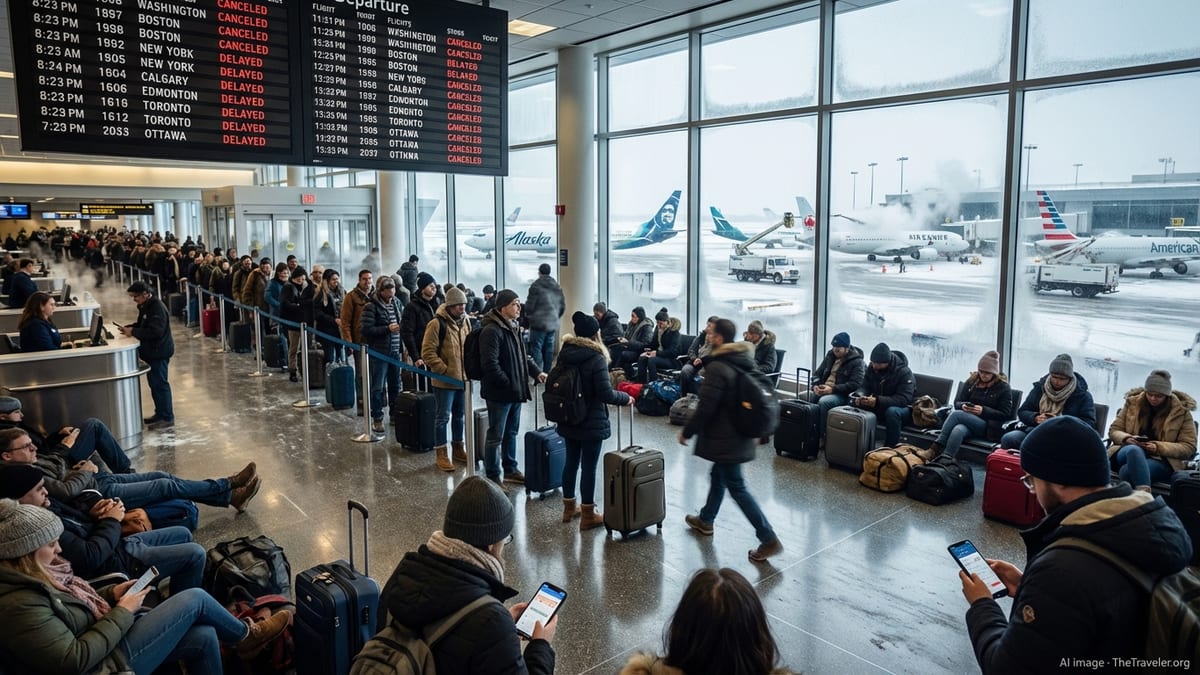
A fresh wave of weather-driven disruption has swept across North American air corridors, with 59 flights canceled and at least 513 facing extended delays on Friday, snarling travel in Washington, Massachusetts, New York, and key cross-border hubs in Alberta and Ontario and leaving passengers on Alaska Airlines, WestJet, Air Canada, and American Airlines scrambling for answers on when they will finally get moving again.
Blizzard Legacy Keeps Travel Networks Under Strain
The latest cancellations and delays come in the immediate aftermath of the historic February 2026 blizzard that crippled much of the Northeast and Atlantic Canada earlier in the week. While skies have begun to clear, its operational aftershocks are still rippling through airline schedules, particularly at airports that endured near-total shutdowns on February 23 and 24.
Major hubs serving Washington, Boston, and New York are working through congested backlogs of aircraft and crew still out of position days after the worst of the storm passed. Aviation analysts note that clearing a nationwide disruption of this scale can take several days even in ideal conditions, and residual weather and runway constraints in affected regions are extending that recovery curve.
In Canada, cross-border traffic to and from Alberta and Ontario remains particularly vulnerable, as airlines juggle transborder schedules alongside domestic recovery. Operational planners are prioritizing core trunk routes while trimming frequencies and canceling select flights, contributing to the 59 outright cancellations and hundreds of rolling delays seen today.
Key Airports in Washington, Massachusetts and New York Hit Hard
In the United States, the focus remains on Washington area airports, Boston Logan, and New York’s LaGuardia and John F. Kennedy, all of which suffered severe storm-related shutdowns earlier in the week and are now grappling with lingering congestion. Even as runways and taxiways are cleared of snow and ice, ground operations are slowed by high winds, de-icing bottlenecks, and staffing stretched by days of extended shifts.
At Washington’s Reagan National and Dulles International, morning departures again saw a cluster of cancellations and extended holds as airlines concentrated resources on longer-haul and hub-connecting services. In Boston, where blizzard conditions and hurricane-force gusts recently pushed cancellation rates to some of the highest in the country, Friday’s operations were technically open but heavily constrained, with long lines forming at security and gate areas as passengers awaited new departure times.
New York’s airports, which earlier in the week recorded cancellation rates in excess of 90 percent, remain central choke points. Even a relatively modest number of fresh cancellations can cascade through the system when aircraft and crews are still out of rotation. Travelers reported rolling gate changes, repeated pushback delays for de-icing, and arriving aircraft diverted or held in holding patterns as controllers managed residual congestion.
Cross-Border Hubs in Alberta and Ontario Feel the Shockwaves
North of the border, airports in Alberta and Ontario that serve as gateways between Canada and the United States have been drawn into the wider disruption. Calgary and Edmonton, both critical WestJet bases, saw a wave of knock-on delays as aircraft coming from storm-battered U.S. cities failed to arrive on time, forcing last-minute schedule adjustments.
In Ontario, Toronto Pearson and Ottawa reported a familiar pattern of elongated ground times and shuffling of departure banks as Air Canada and WestJet worked to re-accommodate passengers from scrubbed U.S.-bound flights. Cross-border services linking these airports to New York, Boston, and Washington are among those showing the highest incidence of delays, reflecting how tightly integrated the transborder network has become.
With aircraft and crews operating across multiple time zones and regulatory limits on duty hours, a delay on a single early-morning leg into Ontario or Alberta can reverberate across a full day’s operations. As a result, some carriers have opted to proactively cancel flights rather than risk rolling, late-night arrivals that could leave travelers stranded without accommodation options.
Major Carriers Struggle to Rebuild Reliability
Among the airlines most visible in today’s disruption are Alaska Airlines, WestJet, Air Canada, and American Airlines. Each is wrestling with its own version of the same challenge: how to restore a predictable schedule when aircraft, crews, and even airport ground teams are still displaced or exhausted by days of intense operations during and after the storm.
Alaska Airlines has been particularly vulnerable on routes linking the Pacific Northwest with the East Coast, where tight turnaround times and long stage lengths leave little margin for recovery once the system is knocked off balance. Delays on eastbound flights have in turn affected westbound returns, causing a rolling series of pushed-back departure times in Washington state and beyond.
WestJet and Air Canada are balancing heavy domestic winter operations with transborder services into the same U.S. airports that are still clearing backlogs. For both carriers, managing aircraft availability for high-demand Canadian routes while fulfilling cross-border obligations has meant targeted cancellations on lower-yield services and last-minute equipment swaps on busier flights.
American Airlines, one of the largest operators along the East Coast corridor, has spent much of the week rebuilding its schedule in and out of Washington, Boston, and New York after thousands of systemwide storm cancellations. While Friday’s figures are far below the peak of the blizzard disruption, the additional 59 cancellations and more than 500 delays underline how fragile operational stability remains.
Stranded Passengers Face Long Lines and Limited Options
For travelers, the operational details translate into a frustrating and often expensive wait. At affected airports across the U.S. and Canada, lines for rebooking counters and customer service hotlines stretched for hours, with many passengers reporting that the earliest available alternatives were one or even two days away, especially on popular transborder and coast-to-coast routes.
Families returning from school vacations, business travelers trying to make critical meetings, and international visitors with onward connections in Europe and Asia all found themselves competing for limited inventory on remaining flights. With hotels near some major hubs already stretched by days of disruption, same-day accommodation became increasingly difficult to secure at short notice.
Airlines have urged passengers to use digital tools for rebooking and flight-status checks rather than queuing at airport counters, and many are issuing winter weather waivers that allow customers to change travel dates without additional fees. Nonetheless, for those already stranded in terminals or whose plans are tied to time-sensitive events, the uncertainty around when “normal” operations will truly return is proving as stressful as the delays themselves.
Meteorologists expect conditions to gradually stabilize across most affected regions into the weekend, offering hope that Friday’s fresh wave of cancellations and delays may be among the last echoes of this week’s historic storm. But as airlines, airports, and passengers are discovering yet again, in the tightly wound world of modern aviation, a single powerful weather system can leave a long and disruptive shadow across the continent’s travel networks.