


More news on this day
House Foreign Affairs East Asia and Pacific Subcommittee Chair Young Kim is urging the U.S. Department of State to elevate its travel advisory for mainland China, arguing that a higher risk rating is warranted after a new warning on wrongful detentions and exit bans stopped short of telling Americans to reconsider travel.
Get the latest news straight to your inbox!
A Call to Lift China’s Advisory to Level 3
In an October 29 letter released by her office, Representative Young Kim asked Secretary of State Marco Rubio to raise the People’s Republic of China’s travel advisory from Level 2, “Exercise Increased Caution,” to Level 3, “Reconsider Travel.” Publicly available materials on the letter indicate that she views the current rating as out of step with the severity of risks now highlighted in official guidance.
The request follows an October 19 update to the State Department’s China advisory that added a prominent “Wrongful Detention” risk indicator and expanded language on arbitrary enforcement of local laws and the use of exit bans affecting U.S. citizens. Despite the sharper language, the overall advisory level remained at Level 2, the same tier as a range of U.S. allies in Europe where primary concerns center on crime or localized security issues.
Kim’s appeal argues that, unlike those destinations, Americans in China face systemic, state-driven risks that can affect travelers across the country. The letter contends that keeping China at Level 2 understates those dangers and could leave U.S. citizens without a clear sense of how legal exposure, surveillance and potential detention might affect even short-term visits.
According to summaries of the correspondence and regional media coverage, Kim also ties her request to broader congressional scrutiny of what some lawmakers describe as “hostage diplomacy,” in which foreign nationals are detained in ways that appear linked to wider political disputes rather than individual conduct.
Wrongful Detentions and Named U.S. Citizen Cases
The push for a higher risk rating is closely linked to specific cases of detained Americans. Public reporting indicates that Kim’s letter cites researcher Min Zin, a U.S. citizen focused on Myanmar issues who was detained in China on June 3, 2026, as well as seismologist Youlin Chen, a U.S. citizen of Chinese heritage taken into custody in Beijing after returning to visit family in November 2024.
Chinese authorities have not provided detailed public explanations for these cases, and open-source accounts describe lengthy detentions with limited transparency. The detentions have been referenced in congressional hearings examining how China and other governments handle foreign nationals in sensitive political or security environments.
Kim is pressing for these names to appear directly on the State Department’s China advisory page, arguing in her materials that listing real-world examples would give prospective travelers a more concrete understanding of the risks outlined in general terms. Travel-risk advocates note that such case references are sometimes used in advisories for other countries where wrongful detention has been identified as a recurring concern.
The focus on individual detainees also reflects a broader trend in U.S. policy debates, as lawmakers evaluate how to balance consular support, diplomatic engagement and public warnings when citizens are held abroad in circumstances Washington later classifies as wrongful under U.S. law.
What the Current China Travel Advisory Says
As of October 29, 2026, the State Department’s official advisory for mainland China remains at Level 2, “Exercise Increased Caution,” with two listed risk indicators: “Wrongful Detention” and “Other.” The updated summary warns that U.S. citizens may face arbitrary enforcement of local laws, exit bans imposed without a fair and transparent legal process, and a risk of wrongful detention.
The advisory emphasizes that expansive national security, counterespionage and data security laws give officials broad discretion to question, search or detain foreign nationals. It notes that activities commonly associated with tourism, business, academic work or professional exchanges can draw scrutiny, including routine research, participation in conferences, and public commentary that might be considered sensitive.
Public guidance flags several groups as facing heightened exposure, including U.S. citizens of Chinese heritage, individuals involved in commercial or civil disputes in China, and those with current or past ties to the U.S. government, military, intelligence community or law enforcement. Travelers connected to government-funded programs are similarly identified as potentially vulnerable to exit bans or other restrictive measures.
The advisory also underscores that access to U.S. consular assistance can be constrained. While China formally adheres to consular notification agreements, consular access may be delayed in practice, particularly in cases involving state security allegations. Certain regions, such as the Tibet Autonomous Region, are subject to additional travel restrictions, and local regulations can change with limited public notice.
How Level 2 Differs from a Level 3 “Reconsider Travel” Rating
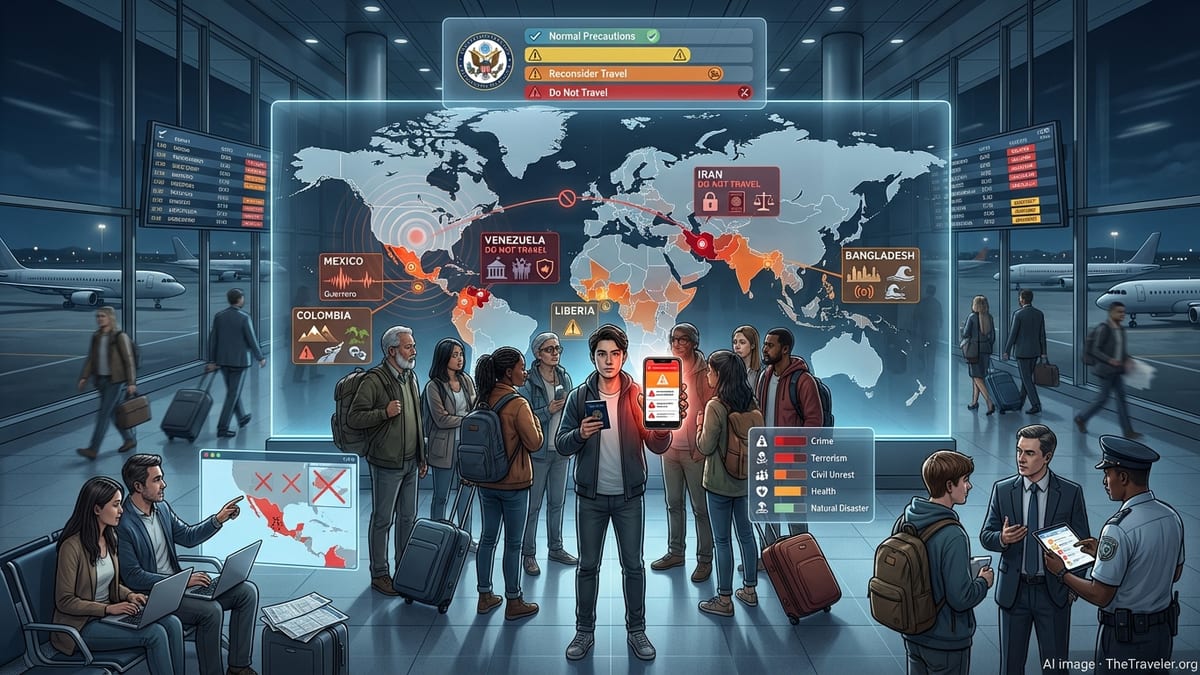
The State Department’s global advisory system uses a four-level scale, from Level 1, “Exercise Normal Precautions,” to Level 4, “Do Not Travel.” Level 2 indicates that travelers should exercise increased caution because of elevated security, legal or health concerns, but it does not constitute a broad recommendation against most forms of travel.
Level 3 advisories, by contrast, urge people to reconsider travel altogether. Public descriptions of the scale explain that Level 3 is used when there are serious risks such as extensive crime, persistent civil unrest, significant terrorism threats, or legal and security environments that could severely affect a traveler’s safety or access to assistance. Countries at this level are typically reviewed more frequently, reflecting the higher perceived baseline risk.
Kim’s letter relies on this distinction to argue that China’s pattern of wrongful detentions, the scope of its national security laws and the use of exit bans place it closer to destinations already in the Level 3 category. Comparative advisory tables show China currently grouped with Level 2 countries, while a separate set of destinations facing sustained violence, political instability or extensive restrictions are placed in Level 3 or Level 4.
For U.S. travelers, a shift to Level 3 would not in itself prohibit travel, but it would signal that the U.S. government believes conditions warrant more serious reconsideration of nonessential trips. Such a move could influence corporate travel policies, academic exchanges, and the planning of group tours or study programs that weigh official advisories in their risk assessments.
Implications for Travelers Weighing Trips to China
For now, Americans planning to visit China must navigate a situation in which the written advisory language has grown more stringent while the headline risk level remains unchanged. Travel.State.gov continues to list China at Level 2, and there has been no public announcement of a decision on Kim’s request to move the advisory to Level 3.
Travelers reviewing the current guidance are advised to consider how their personal background and activities might intersect with the risks highlighted in the advisory. Those with Chinese heritage, involvement in sensitive commercial or academic sectors, or past service with U.S. government agencies may wish to pay particular attention to the sections on exit bans, data security and questioning at borders.
The advisory reiterates that U.S. citizens generally need a valid U.S. passport with at least six months of remaining validity and an appropriate Chinese visa for entry. It highlights that China does not recognize dual nationality in practice, which can limit the ability of U.S. consular officials to assist dual nationals who enter on Chinese documentation or who are regarded by local authorities as Chinese citizens.
Publicly available travel guidance notes that many visitors complete trips to China without serious incident, but it also stresses that legal norms, investigative practices and court procedures differ substantially from those in the United States. Kim’s call to raise the risk rating ensures that how Washington labels and communicates those differences will remain under debate, and U.S. travelers are likely to watch closely for any future change from Level 2 to Level 3.