


More news on this day
Growing concern over wrongful detentions and exit bans in China has prompted Representative Young Kim of California to press the U.S. State Department to raise its China travel advisory from Level 2, "Exercise Increased Caution," to Level 3, "Reconsider Travel," intensifying debate over how clearly Washington should warn Americans about the risks of visiting the country.
Get the latest news straight to your inbox!
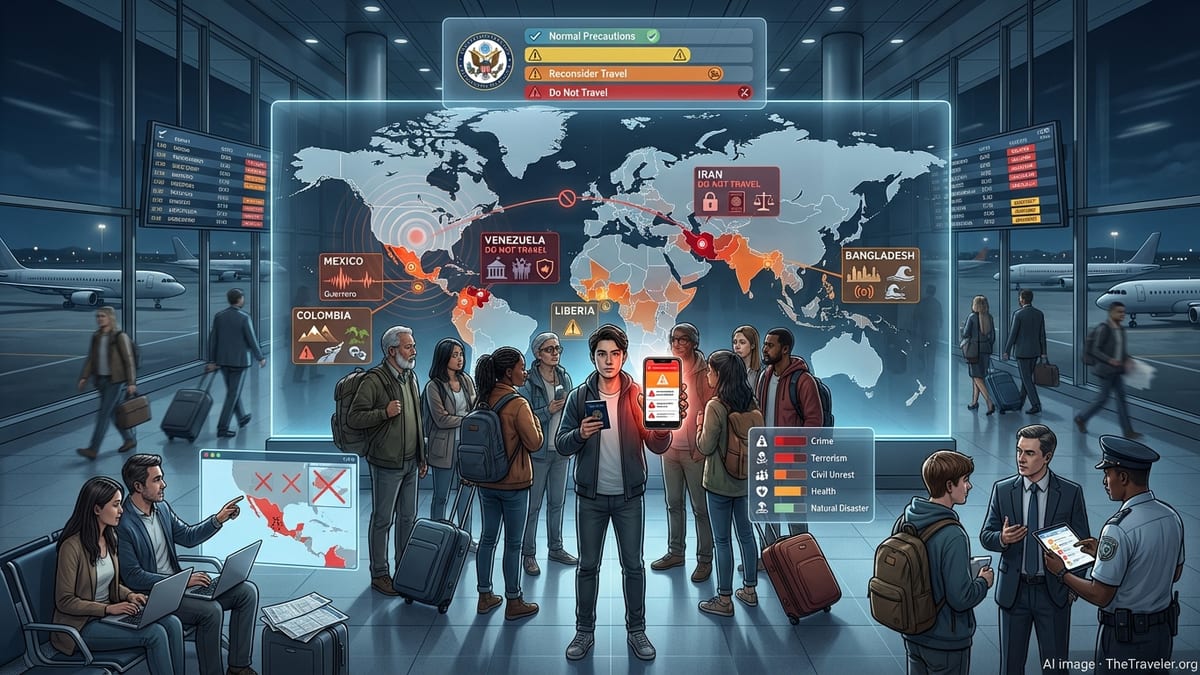
Call to Elevate China’s Travel Risk Rating
In a letter released on October 29, 2026, publicly available congressional records show that Representative Young Kim, who chairs the House Foreign Affairs Subcommittee on the Indo-Pacific, urged Secretary of State Marco Rubio to upgrade the travel advisory level for the People’s Republic of China. She is asking that the current Level 2 rating be raised to Level 3, a category that tells Americans to reconsider travel.
Kim’s appeal follows an October 19 update to the China travel advisory, in which the State Department added a “wrongful detention” risk indicator while keeping the overall rating at Level 2. The updated notice warns that Americans could face arbitrary enforcement of local laws, extensive surveillance, and exit bans without transparent legal procedures, but it stops short of advising travelers to avoid or defer nonessential trips.
Published coverage of Kim’s letter indicates that she argues China’s treatment of U.S. citizens differs fundamentally from the risks typically covered by Level 2 advisories in allied countries such as Italy, Germany, or the United Kingdom. In those destinations, the main threats are described as localized crime or non-state terrorism, while in China, Kim contends that the danger stems directly from the state security apparatus.
State Department’s Current Advisory and Risk Indicators
The State Department’s China advisory, updated on October 19, 2026, currently directs U.S. citizens to “exercise increased caution” when traveling in mainland China and lists two risk indicators: “Wrongful Detention” and “Other.” Official travel guidance outlines concerns over sweeping national security, counterespionage, and data laws that grant authorities broad latitude to question, detain, or restrict the movement of foreigners, including Americans.
The advisory highlights the possibility of exit bans, which can prevent travelers from leaving China for extended periods. Reports indicate that such measures may be used in connection with business disputes, investigations, or efforts to pressure family members or associates who are outside the country. In some documented cases, U.S. citizens have only learned of exit bans when attempting to depart at airports.
The notice also underscores the risk that routine research, business due diligence, or even accessing publicly available information might be interpreted as violating national security or state-secrets provisions. The guidance stresses that U.S. citizens of Chinese heritage, those with ties to U.S. government institutions, and individuals involved in civil or commercial disputes may face heightened scrutiny.
Under the State Department’s four-tier system, a Level 3 advisory signals “Reconsider Travel” and is used when serious security or safety risks warrant that Americans think carefully before visiting. Level 4, “Do Not Travel,” is reserved for the most dangerous situations, including active conflict or extreme instability. Travel advisories at Levels 3 and 4 are reviewed more frequently than those at Levels 1 and 2, reflecting the higher level of concern.
High-Profile Detention Cases Driving Congressional Pressure
Kim’s push comes amid increasing attention in Washington to individual Americans detained in China. Reports describe at least two cases that have become focal points for lawmakers: Min Zin, a Myanmar-focused scholar detained in June on national security allegations, and seismologist Youlin Chen, held since 2024 on espionage charges. Both have been designated as wrongfully detained by the U.S. government, meaning officials have formally concluded that their cases meet criteria laid out in federal law for politically motivated or unjust detention.
In her letter, Kim urges the State Department not only to raise the advisory level but also to reference specific detention cases by name on the China advisory page. Advocates for a stronger warning say listing ongoing detentions alongside the risk indicators would underscore that the threat is not theoretical and may help travelers better understand how academic or professional activities could draw unwanted scrutiny.
The congresswoman’s latest move builds on a recent subcommittee hearing titled “Lives Not Leverage: The Long Arm of China and North Korea’s Repression,” where lawmakers examined how foreign governments use criminal charges, exit bans, and other forms of pressure against citizens and foreign nationals abroad. During that session, members of Congress raised questions about whether the current Level 2 advisory accurately reflects the risk of what critics describe as “hostage diplomacy.”
Implications for U.S. Travelers and the Tourism Corridor
While Congress cannot directly set travel advisory levels, campaigns like Kim’s can increase public scrutiny of the State Department’s risk assessments and shape how travelers interpret existing warnings. For Americans with business, family, or academic ties to China, even the current Level 2 advisory already carries practical consequences, as companies and universities weigh insurance requirements, duty-of-care obligations, and the feasibility of sending staff or students.
Travel industry data in recent years have shown that U.S. visitor flows to China have been slower to recover compared with some other destinations, reflecting a combination of pandemic legacies, bilateral tensions, and regulatory uncertainty. A shift to Level 3 would not prohibit travel, but it could influence corporate travel policies, increase scrutiny from insurers, and prompt more organizations to pause nonessential trips or require additional approvals.
For individual travelers, the present advisory emphasizes careful planning: ensuring long-valid passports and visas, registering with the Smart Traveler Enrollment Program, and considering evacuation and medical coverage in travel insurance. It also warns that U.S. citizens may have little recourse if detained or subject to an exit ban and may not be able to contest restrictions in a transparent court process. These cautions apply regardless of whether the advisory is ultimately raised to Level 3.
Public information from the State Department stresses that conditions can change with little notice and that advisories can be updated at any time. Kim’s intervention adds political momentum to calls for a more forceful warning, but for now, the official guidance remains at Level 2, leaving policymakers, travelers, and the tourism industry watching closely for any further revision.
Ongoing Review of Risk and Future Outlook
According to the State Department’s published methodology, destination advisories are reviewed at least every 12 months for Levels 1 and 2 and at least every six months for Levels 3 and 4, with interim updates when security conditions shift. The October 19 revision to the China advisory, which introduced the wrongful detention indicator without changing the overall level, suggests that risk assessments are already under active review.
Observers in Washington note that future decisions will likely weigh the safety concerns highlighted by Kim and other lawmakers against broader diplomatic and economic considerations in the U.S. China relationship. Tensions over technology, trade, and regional security, alongside efforts to preserve channels of dialogue between the two governments, all shape the context in which travel warnings are calibrated.
For now, Americans planning trips to China face a complex picture. Official guidance points to serious and growing risks related to national security enforcement, surveillance, and the possibility of detention, even as inbound travel gradually resumes. Kim’s call to raise the advisory level places additional pressure on the administration to decide whether those risks now merit a more urgent message: that potential visitors should think twice before boarding a flight.