


More news on this day
Abha International Airport in southwestern Saudi Arabia is facing a second day of disruption after a missile and drone attack claimed by Yemen’s Houthi movement, with government advisories and airline schedules updated to warn travelers of rising risks near the Yemeni border.
Get the latest news straight to your inbox!
New strike reignites concerns over Abha’s vulnerability
Publicly available reporting indicates that Yemen’s Houthi forces launched a combined missile and drone attack on Abha International Airport on Monday 13 July 2026, describing the operation as a response to earlier strikes on Sanaa’s airport. Regional media and wire services say the attack targeted the runway area and temporarily halted air traffic at the popular domestic and regional hub.
The incident marks one of the most serious escalations around the Saudi-Yemen frontier since a United Nations brokered truce in Yemen largely reduced cross-border fire in 2022. Previous rounds of conflict saw Abha repeatedly struck, and aviation analysts note that the airport’s proximity to Houthi-held territory has long made it a focal point of tension.
Houthi military messaging following the latest strike included a warning to commercial airlines to avoid Saudi airspace until restrictions on Sanaa’s airport are lifted. While aviation regulators have not issued a blanket prohibition on Saudi overflights, the rhetoric has added to unease among travelers already watching regional flashpoints closely.
Early assessments shared in open sources suggest the latest attack caused disruption and property damage but did not result in mass casualties. Civil aviation authorities have focused on restoring safe operations while airlines reevaluate short term exposure to further strikes.
Flights cancelled again as regional carriers adjust schedules
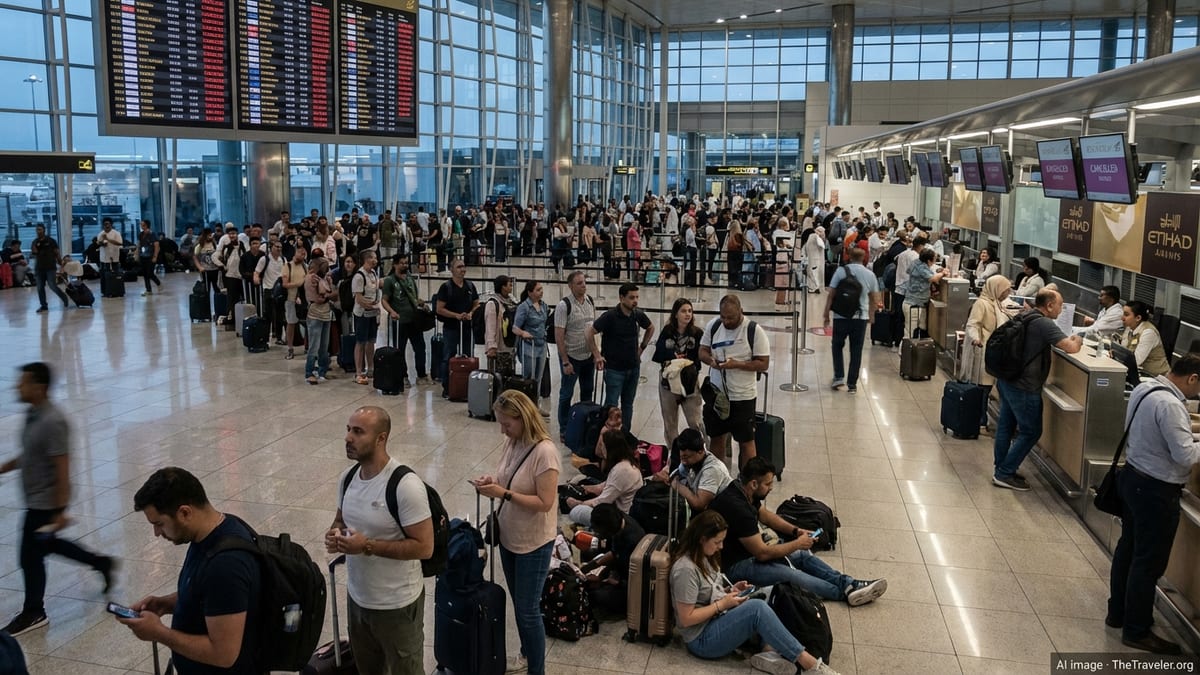
Airline schedules show that the impact on commercial travel has been immediate. Regional coverage on Tuesday and Wednesday indicates that Abha’s departures board has filled with cancellations for a second straight day, including services to Dubai, Sharjah and other Saudi cities that normally see heavy summer traffic.
Carriers such as Saudia, flynas, Flyadeal and flydubai have pulled a series of Abha rotations from their networks this week, according to flight data cited by regional outlets. At least one Cairo based airline has also suspended its Abha route, advising passengers to contact call centers or travel agents to rearrange itineraries, request refunds or accept alternative destinations inside the kingdom.
Some flights already en route at the time of the attack were reportedly diverted to other Saudi airports when Abha’s airspace was temporarily closed. Travel forums and social media posts from passengers describe last minute gate changes, extended ground holds and unexpected overnight stays as crews and operations centers adjusted to rapidly changing security assessments.
Despite the cancellations, major hubs in Riyadh, Jeddah, Dammam and the United Arab Emirates appear to be functioning normally, with disruption largely concentrated on routes directly serving Abha or using the airport as a regional connector. Industry observers say this pattern reflects a targeted risk response rather than a broader shutdown of Saudi or Gulf aviation.
Canada, UK and US update travel advisories
The security incident at Abha has quickly filtered into official travel guidance. Canada’s latest advisory for Saudi Arabia, updated on 14 July 2026, now explicitly warns against non essential travel to Abha International Airport and surrounding areas due to the risk of missile and drone attacks and the possibility of sudden flight cancellations.
Advice from the United Kingdom continues to highlight longstanding regional risks along Saudi Arabia’s southern border, urging travelers to carefully review itineraries that involve airports close to Yemen and to monitor local media for signs of renewed hostilities. The Abha strike has been cited in British coverage as an example of how cross border tensions can flare with little notice, affecting both resident expatriates and tourists transiting through the southwest.
The United States already classifies parts of southern Saudi Arabia as higher risk and cautions against travel near the Yemeni frontier. While Washington’s primary aviation restrictions focus on Yemen and specific conflict zones, the latest events at Abha are reinforcing calls for US travelers to follow airline updates closely and to remain flexible about routing changes.
Collectively, the advisories underline that risk exposure is highly localized. For most travelers to Saudi Arabia, business centers and religious destinations remain accessible, but journeys that route through Asir province or involve regional hops near the border now carry additional uncertainty.
Travelers weigh options as Abha bookings thrown into doubt
The renewed instability around Abha is creating cascading decisions for travelers with upcoming plans in southern Saudi Arabia or connections via the airport. Online travel communities show passengers questioning whether to reroute through Riyadh or Jeddah, switch to alternative Gulf hubs, or postpone trips entirely until the security picture becomes clearer.
Some passengers with imminent departures report that airlines have proactively rebooked them through other Saudi cities at no extra cost, while others say they are being offered date changes or refunds instead of guaranteed alternative routings. Policies vary by carrier, and consumer advocates recommend that travelers facing cancellations document all communications and check the fine print of both airline contracts and travel insurance.
Insurance coverage is emerging as a key variable. Many standard policies limit payouts for war related disruptions or treat government travel warnings as a trigger for exclusions, leaving some travelers exposed to out of pocket costs for last minute itinerary changes or accommodation. Specialized policies that explicitly cover political violence or security incidents may offer broader protection, but tend to carry higher premiums.
For residents of Abha and nearby cities, the attack and subsequent shutdowns mean delays in routine travel for work, education and medical treatment. Domestic tourism to the cool highlands around Abha, which normally attracts visitors during the hottest summer months elsewhere in the Gulf, is also likely to suffer if potential visitors perceive the region as unstable.
What airlines and passengers can expect next
Aviation analysts following the situation say the next few days will be critical in determining whether the Abha attack is an isolated spike in violence or the start of a renewed campaign against Saudi infrastructure near the Yemen border. If there are no further strikes, carriers may gradually restore limited service, potentially with revised schedules that avoid night operations or concentrate flights into shorter operating windows.
Any additional attacks or credible threats, however, could prompt a deeper pullback. Airlines tend to respond conservatively when it comes to missile and drone risk, especially at airports that sit within range of relatively short notice rocket fire. In past conflicts affecting airports elsewhere in the region, operators have relied on short term suspensions, diversions to alternative hubs and the use of larger aircraft on remaining routes to consolidate demand.
For now, travelers booked through Abha in the coming weeks are being advised by publicly available guidance to remain in close contact with airlines or travel agents, check flight status frequently on the day of departure and allow extra time at originating airports in case of rebooking. Those still in the planning phase are increasingly steering toward itineraries that use larger, better defended hubs farther from the Yemeni border.
With regional diplomacy under strain and Yemen’s conflict showing signs of sliding back from fragile de escalation, Abha’s experience this week illustrates how quickly front line airports can move from routine operations to rolling cancellations. For the global travel industry and individual passengers alike, the episode is a reminder that route maps across the Middle East remain closely tied to shifting security dynamics.