


More news on this day
Travel through Abu Dhabi faced fresh disruption on 9 July as a cluster of delays and cancellations on routes linking the United Arab Emirates with Riyadh, Muscat and other Middle East destinations added new uncertainty for passengers already navigating a volatile regional air network.
Get the latest news straight to your inbox!
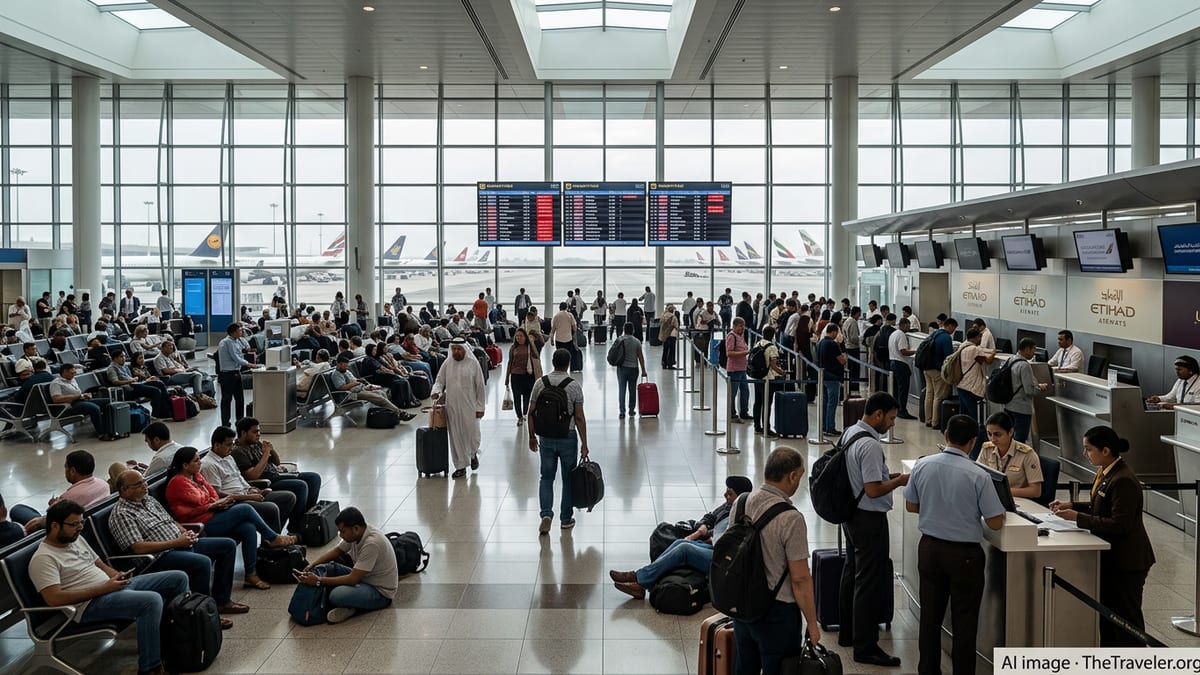
Cluster of delays and cancellations around Abu Dhabi hub
According to live airport and flight-tracking data for 9 July, at least four services linked to Abu Dhabi were running significantly late while three others were cancelled outright, affecting connections across the Gulf and wider region. The impact was most visible on short-haul links that feed regional hubs, including services between Abu Dhabi, Riyadh and Muscat.
Real-time trackers show Etihad’s EY551 service from Abu Dhabi to Riyadh operating with a departure delay before ultimately landing in the Saudi capital behind schedule, adding to missed-connection risks for onward long-haul travel. Separate monitoring of services between Abu Dhabi and Muscat also indicates a mixed picture, with one Etihad-operated flight listed as cancelled and another showing a delayed departure time on Thursday’s schedule.
The pattern fits into a broader backdrop in which individual flights are operating, but with less predictability than passengers on these traditionally high-frequency Gulf routes are used to. In practical terms, even a short delay from Abu Dhabi can cascade into missed onward flights to Europe, Asia or North America for travellers who rely on tight connections through the hub.
The latest disruption is unfolding while airlines and airports across the region continue to adapt schedules and routings in response to an unsettled security environment, constrained airspace and shifting demand. For many passengers, that has translated into a blend of last-minute timetable changes, rolling delays and sporadic cancellations rather than large-scale, blanket shutdowns.
Wider Middle East tensions keep pressure on flight schedules
Published advisories and recent factbox-style overviews from global media and risk consultancies underline that the problems in Abu Dhabi are part of a much larger, fluid situation affecting Middle East aviation. Over recent months, multiple international carriers have suspended or reduced services to airports including Abu Dhabi, Riyadh and Muscat as they recalibrated operations around regional conflict zones and restricted airspace.
Coverage of airline responses shows that several European groups have halted flights to Abu Dhabi and neighbouring hubs such as Muscat and Riyadh for extended periods, in some cases into the autumn season, as they reassess routings and crew safety. Other airlines have resumed limited services, but often with reduced frequencies and carefully defined corridors that avoid higher-risk airspace.
Travel-security advisories issued this northern spring and early summer consistently describe UAE airports, including Abu Dhabi, as operational but caution that services can be disrupted with little notice. They also highlight that while airspace over Saudi Arabia and Oman remains technically open, certain international routes have been suspended and schedules on others trimmed back, which in turn narrows options for rerouting passengers when delays occur.
These constraints mean even routine operational issues, such as aircraft rotation or crew availability, can have a greater knock-on impact than before. With fewer alternative flights on some regional sectors, a single cancellation from Abu Dhabi to Riyadh or Muscat can strand travellers for longer or force complex rebookings through third-country hubs.
What the latest Abu Dhabi disruption means for travellers
The latest batch of four delayed and three cancelled flights around Abu Dhabi underscores how fragile travel plans remain for anyone transiting the Gulf, particularly those relying on short connection windows. A delay of less than an hour into or out of Abu Dhabi can be enough to break an itinerary that depends on carefully timed transfers to long-haul services.
Passenger reports and recent social media accounts from the region describe a travel environment in which flights may operate broadly as scheduled for days at a time, only for sudden, localised disruption to ripple through particular city pairs. For travellers, that can translate into overnight stays, unplanned stopovers or rebookings onto entirely different routings when aircraft are delayed leaving Abu Dhabi or when return legs from cities such as Riyadh and Muscat are scrubbed.
Publicly available guidance from airlines and advisory firms continues to stress a few common themes for those heading through Abu Dhabi and other UAE hubs. Travellers are encouraged to monitor flight status repeatedly in the 24 hours before departure, allow additional time for connections, and be prepared for rebooking if their original route is affected by a cancellation or extended delay.
In addition, many carriers operating through the region have introduced more flexible policies around date changes or refunds on impacted services. While conditions vary, recent policy updates have generally allowed passengers whose flights are cancelled or significantly delayed to move travel dates without penalties or to request refunds, reflecting how quickly conditions can shift on routes into and out of Abu Dhabi.
Riyadh and Muscat routes remain critical but constrained
Riyadh and Muscat stand out in current schedules as strategically important spokes feeding Abu Dhabi’s long-haul network, and the latest disruptions highlight how sensitive these links are. Flight-status feeds for 9 July show Riyadh services from Abu Dhabi operating but not immune to delays, while Muscat connections display a mix of on-time, delayed and cancelled flights.
In parallel, broad industry reporting over recent weeks notes that some international airlines have paused their own Abu Dhabi, Riyadh and Muscat operations entirely, leaving regional carriers to shoulder most of the remaining traffic. That has concentrated demand on a smaller number of daily services, making each individual delay or cancellation more consequential for travellers trying to move between the Gulf and key markets in Europe and Asia.
Risk assessments issued in March, April and June describe Saudi Arabia and Oman as having open airspace but acknowledge intermittent suspensions of flights to and from certain countries. When combined with already reduced frequencies from some non-regional airlines, that backdrop limits the number of backup options available if a passenger’s original Abu Dhabi itinerary via Riyadh or Muscat falls apart.
The upshot is that, while these routes continue to operate and remain vital for business and migrant labour flows, they offer less redundancy than before. Travellers whose plans hinge on a single daily departure between Abu Dhabi and a regional city may face longer waits for the next available seat if a disruption occurs.
Practical steps for passengers with upcoming Abu Dhabi connections
For travellers booked through Abu Dhabi in the coming days, the pattern of four delays and three cancellations on 9 July is a reminder to build resilience into itineraries. Choosing longer connection times where possible, especially on itineraries involving Riyadh, Muscat or other Gulf cities, can reduce the risk of misconnecting if an inbound flight runs late.
Public information from airlines and travel advisers consistently recommends checking flight status directly with carriers and airports before leaving for the airport and again upon arrival at the hub. In the current environment, schedules that appear stable a day in advance can still change close to departure as airlines adjust to airspace constraints, operational considerations or shifting demand.
Travellers are also encouraged to familiarise themselves with their airline’s disruption policies before departure, including rules for hotel accommodation, meal vouchers and rebooking rights in the event of delays or cancellations. Understanding these terms in advance can make it easier to navigate customer service channels if a flight from Abu Dhabi to destinations such as Riyadh or Muscat is affected.
While large-scale shutdowns are not currently in place at Abu Dhabi, the latest disruptions show that localized interruptions remain a feature of flying through the region. Passengers who remain flexible, stay informed and allow extra time in their schedules are likely to cope better with the continuing unpredictability of Middle East air travel.