


More news on this day
Travelers using Dubai International Airport are facing renewed disruption as 26 flights are reported delayed and 27 cancelled, affecting busy regional and long haul routes including services to Jeddah, Riyadh, Taipei and several other cities across Asia and the Middle East.
Get the latest news straight to your inbox!
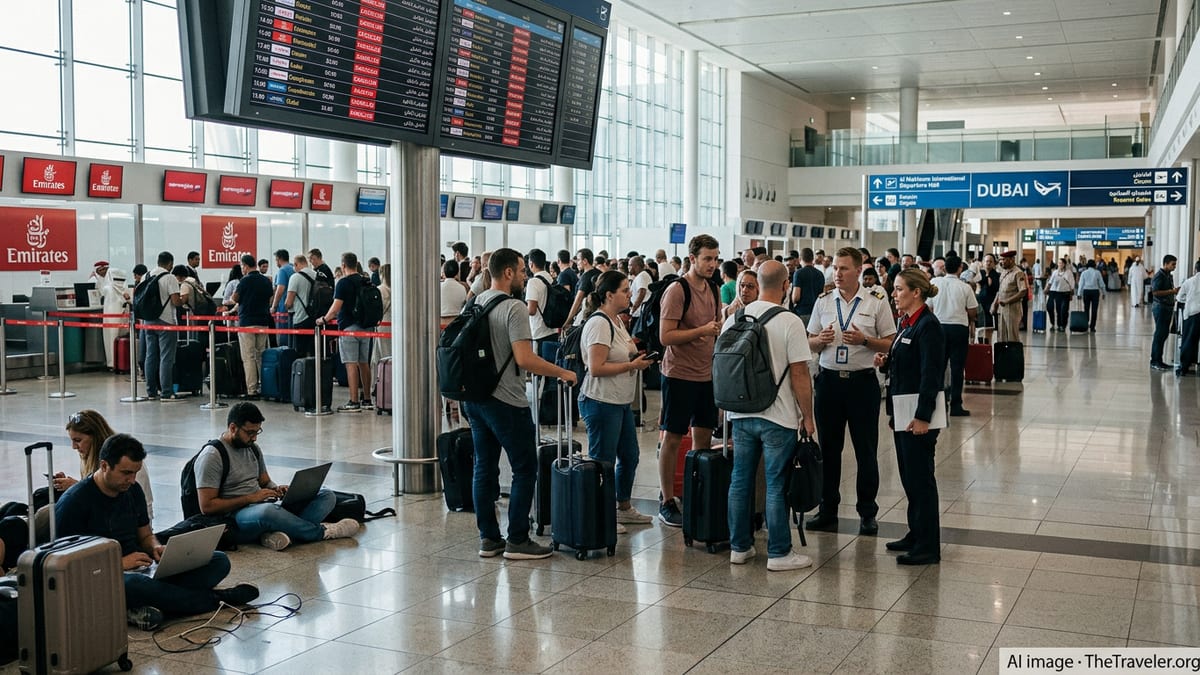
Latest disruption in Dubai’s already strained air network
The latest round of delays and cancellations in Dubai comes against the backdrop of an already fragile regional aviation landscape influenced by the ongoing conflict in the wider Middle East and periodic airspace restrictions. Publicly available flight-tracking data and schedules indicate that services into and out of Dubai remain vulnerable to short notice operational changes, even as airlines gradually rebuild networks.
Reports from airline factboxes and regional travel advisories show that carriers have been continuously adjusting schedules across the Gulf, with Dubai often used as a key transit hub. As a result, a cluster of disrupted flights at Dubai International can quickly ripple across connecting services to Saudi Arabia, East Asia and Europe, magnifying the impact for passengers who rely on the city as a transfer point.
The latest tally of 26 delayed and 27 cancelled flights represents a snapshot over a short operational window rather than a full day’s schedule, but it illustrates how volatile conditions remain. The affected services include both point to point routes and long haul connections, which increases the likelihood of missed onward journeys and overnight layovers for travelers.
Operationally, airlines are using a mix of same day rebooking, longer rerouting via alternative hubs and, in some cases, temporary suspensions of specific city pairs. Passengers with bookings in the coming days on routes touching Dubai are being advised, through airline websites and travel agency channels, to monitor their reservation status closely.
Key routes hit: Jeddah, Riyadh, Taipei and beyond
Among the most affected are high demand routes linking Dubai with Saudi Arabia and East Asia. Published schedules and disruption summaries show particular pressure on flights to Jeddah and Riyadh, two of the busiest Saudi gateways for both business and religious travel. Earlier network decisions by some carriers to reduce or consolidate services to these cities have already limited daily frequencies, meaning any cancellation can quickly leave flights fully booked for days.
Coverage of recent airline schedule changes also highlights disruptions on services between Dubai and Taipei. Taiwan connections are an important part of the broader Asia network from the Gulf, and constraints on these flights can complicate itineraries for passengers traveling onward to Japan, Korea and Southeast Asia. Some travelers are being routed via alternative Asian hubs when direct Dubai Taipei options are not available.
Beyond Jeddah, Riyadh and Taipei, the present wave of disruption reaches into a wider web of destinations that rely on Dubai as a connecting point. These include other Saudi cities, Gulf capitals and select European and African gateways where airlines have already trimmed frequencies in response to regional security concerns and fuel cost volatility.
Travel industry briefs note that several international carriers have permanently dropped or temporarily suspended Jeddah from their networks while planning reduced frequencies to Riyadh and Dubai. In parallel, some regional airlines are operating modified schedules to and from Dubai, which means fewer backup options when irregular operations occur.
Why flights are still vulnerable in mid 2026
Although many airlines have resumed parts of their Middle East networks since the sharp escalation of conflict earlier in 2026, the operating environment remains unpredictable. Publicly available digests on the aviation response to the crisis describe a patchwork of airspace restrictions, shifting risk assessments and fuel supply challenges that continue to shape day to day decisions in airline operations centers.
Dubai has experienced several high profile disruption episodes this year, from temporary airspace closures to capacity constraints that forced schedule reductions and diversions to other airports in the United Arab Emirates. Even when the airport is fully open, airlines must sometimes reroute to avoid certain neighboring airspaces, which can lengthen flight times, compress turnaround windows and increase the chances of knock on delays.
Factbox style updates compiled by global newswires show that some carriers are still cancelling or deferring services into the Gulf region, including Dubai and Riyadh, or limiting frequencies to a single daily flight on routes that previously had multiple departures. Such structural reductions mean that routine operational issues, such as crew duty time limits or late inbound aircraft, can more easily tip into outright cancellations when spare capacity is limited.
The broader regional picture also remains fluid. Airlines are continually rebalancing capacity between the Gulf, Levant, Europe and Asia, responding to demand shifts and evolving security assessments. In this context, even a relatively modest spike in disruptions at Dubai can leave travelers with fewer same day alternatives than they may have been used to before 2026.
What affected passengers can realistically expect
For travelers caught up in the latest wave of Dubai delays and cancellations, the passenger experience will depend heavily on the airline, ticket type and routing. Most major carriers have introduced flexible commercial policies at various points during the Middle East crisis, and many continue to allow fee free date changes or rerouting when flights are disrupted for security or operational reasons.
Publicly accessible airline advisories indicate that rebooking is generally prioritized on the next available flight on the same route. However, with reduced frequencies on some key city pairs such as Jeddah and Riyadh, the next available option may be 24 hours or more later. In some cases, travelers may be offered rerouting via an alternative hub or a nearby airport if capacity from Dubai is constrained.
Travelers connecting through Dubai from Asia to Europe or the Americas may face longer layovers than originally booked, as missed connections cascade through the network. Airline notices and travel agent briefings suggest that hotel accommodation, meal vouchers and ground transport are being provided in some situations, particularly when the disruption is directly linked to operational decisions rather than external airspace closures, although the exact entitlements vary by carrier and jurisdiction.
Passengers who booked through third party agents or online travel platforms may need to coordinate both with their airline and their intermediary to finalize new itineraries or refunds. Industry forums and passenger rights groups continue to advise travelers to keep all receipts for incidental expenses and to document communications with airlines, especially when journeys involve multiple carriers or complex routings through Dubai.
Planning upcoming trips through Dubai
With conditions still evolving, travelers planning to use Dubai as a gateway in the coming weeks are being urged by travel advisors and industry analysts to build additional flexibility into their itineraries. This can include choosing longer connection times, avoiding last flight of the day options on critical legs such as Jeddah, Riyadh or Taipei, and ensuring that accommodation bookings at the final destination offer flexible change or cancellation terms.
Experts writing in aviation and business outlets note that demand for travel through Dubai remains strong despite the disruptions, especially during peak holiday and pilgrimage periods. As a result, spare seats on alternative flights can be scarce when irregular operations occur, particularly in premium cabins and on routes that have already seen structural capacity cuts.
Travelers are also encouraged to enroll in airline mobile notifications, regularly check their booking status in the days leading up to departure and verify real time information on the day of travel before heading to the airport. While cancellations and delays cannot be entirely avoided in the current environment, early awareness of changes can significantly increase the chances of securing favorable rebooking options.
For now, the cluster of 26 delayed and 27 cancelled flights at Dubai International underscores how sensitive the region’s aviation system remains to operational strain. Until airspace conditions stabilize and airlines fully rebuild capacity on core routes to cities such as Jeddah, Riyadh and Taipei, passengers transiting through Dubai should continue to anticipate potential last minute changes and plan with contingency in mind.