

More news on this day
Aerial images from the scene of a train collision in the United Kingdom show emergency crews working along the tracks to treat injured passengers and secure damaged carriages, as rail services in the area remain disrupted and investigators begin examining how the crash occurred.
Get the latest news straight to your inbox!
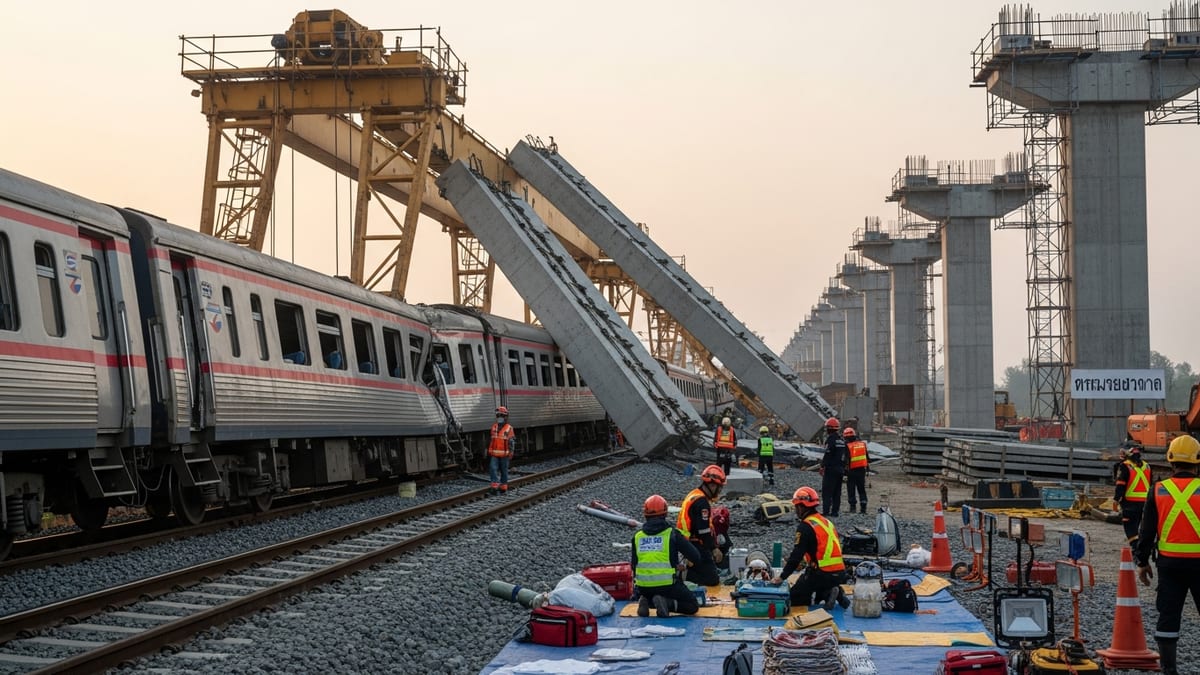
Aerial views reveal scale of rescue operation
Footage captured from above the line shows multiple emergency vehicles positioned along a rural stretch of track, with crews clustered around at least one visibly damaged train. Responders appear to be working both beside the rails and between carriages, focusing on areas where the impact was most severe.
Images indicate that triage points were set up near the track, with staff in high-visibility clothing moving between the train and medical areas. Stretchers and other equipment can be seen being carried towards the carriages, suggesting that a number of passengers required assistance at the scene before transport to hospital.
The aerial perspective also highlights the logistical challenges of reaching the train, which is positioned away from public roads. Access routes appear to have been created along service tracks and across adjacent fields, enabling ambulances, fire appliances and specialist rail response vehicles to get close enough to support casualty care and technical rescue work.
Passenger injuries and medical response
Early information from public reporting indicates that several people were injured in the collision, with a number believed to have been taken to hospital for further assessment. The exact total and the severity of injuries had not been fully confirmed in initial updates, but on-scene treatment activity suggests a mix of minor and more serious trauma.
Emergency responders shown in the footage appear to include paramedics, critical care specialists and fire and rescue teams trained in dealing with incidents on the rail network. Their work includes stabilising passengers inside the carriages, assisting those able to walk to safe areas, and coordinating the movement of stretchered casualties to waiting ambulances.
Helicopter movements visible above the scene indicate that air support was also involved, potentially providing both aerial assessment and rapid medical transport capacity. Use of air assets is common in UK rail incidents where journey time to major trauma centres can affect outcomes for the most seriously injured.
Impact on rail services and nearby communities
The collision has led to the suspension of services on the affected section of line, with operators advising passengers to check for revised timetables and alternative routes. Trains already on the network have been diverted where possible, while replacement road transport is being organised to connect key stations.
Local communities near the crash site are experiencing increased emergency traffic and congestion, as access roads are used by response vehicles and engineering teams. Residents have reported hearing continuous sirens and seeing helicopters overhead while the initial phase of the operation continues.
Rail infrastructure managers are expected to carry out a detailed assessment of the tracks, signalling and overhead equipment once the rescue phase is complete. Any damage to the line will need to be repaired and safety-checked before trains can resume normal operations, a process that can range from hours to several days depending on the extent of the impact.
Early focus of the safety investigation
Specialist rail accident investigators are being deployed to the site, in line with standard practice for significant collisions on the UK network. According to publicly available information about previous cases, inquiries of this kind typically examine train speed, signalling data, braking performance, driver actions, and the condition of the track and rolling stock.
Investigators are expected to recover data recorders from the involved trains, analyse radio communications and signalling logs, and take detailed measurements of the crash scene. Witness accounts from passengers, crew and railway staff usually form an important part of building a timeline of events leading up to the collision.
While early attention often focuses on the immediate cause, such as a missed signal or technical failure, past UK rail reports show that wider systemic issues can also be identified, including maintenance regimes, training, and operational procedures. Any interim findings that point to urgent safety risks are typically shared with rail companies and infrastructure managers to support prompt action.
Context of rail safety and emergency preparedness
The incident comes against a backdrop of generally strong rail safety performance in the United Kingdom, where serious passenger train collisions are relatively rare but attract intense scrutiny when they occur. Recent investigations into collisions and near-misses have led to recommendations on braking systems, signalling technology and communication protocols between drivers and control centres.
Rail operators and infrastructure bodies in the UK routinely conduct live exercises and simulations to prepare for low-frequency, high-impact events such as train collisions. The coordinated deployment of multiple emergency services to the current crash, as seen in the aerial footage, reflects these planning efforts and the priority placed on rapid casualty care and scene protection.
As the rescue phase gives way to recovery and investigation, attention is likely to turn to what additional safeguards, if any, may be required on the affected route and across the wider network. For now, the focus at the scene remains on supporting injured passengers, stabilising the site and restoring rail links for communities that depend on the line for daily travel.