


More news on this day
Emergency services are responding to a serious rail incident near Bedford after two southbound passenger trains collided on Friday afternoon, leaving at least one person dead and several others injured on a key route into London.
Get the latest news straight to your inbox!
Collision on busy corridor north of London
Initial reports indicate that the collision occurred on the main line south of Bedford, on a section of track used by fast intercity and airport services heading into London St Pancras. Publicly available journey data suggests both trains were travelling southbound when they made contact in the early evening period, at a time when many commuters and leisure travellers were on board.
According to published coverage, one of the services is believed to have come to a halt on the line before being struck from behind by a following train, resulting in visible damage to carriages and significant disruption to rail traffic in the area. Images from the scene show one train partially derailed and at an angle, with the second unit stopped close behind on the same track.
Early information from rail tracking sites and passenger accounts suggests the trains involved included high speed services operating between East Midlands destinations such as Nottingham and Corby and London St Pancras. The line forms part of a major north south corridor that also carries Luton Airport rail services, making it one of the busiest stretches of railway in the region.
Rail crash investigators have been reported at the site as emergency teams work to secure the area and assess the structural integrity of the rolling stock and nearby infrastructure. The location, on an approach to Bedford, includes multiple tracks and high speed junctions, adding complexity to both the response and the eventual recovery of the trains.
Casualties reported as major incident declared
Published reports from national and regional media indicate that at least one person has died in the collision, with a number of other passengers sustaining injuries of varying severity. Some accounts from those on board describe travellers being thrown forward by the impact, with visible fractures and head wounds among the injured.
A major incident has been declared in the Bedford area, triggering the deployment of multiple emergency resources. Public information from emergency service statements indicates that fire, ambulance and police teams are all in attendance, alongside specialist rail response units trained to work around damaged rolling stock and live railway infrastructure.
Air ambulances were dispatched to the scene, according to regional coverage, reflecting initial concern about the seriousness of some injuries. Helicopters were tracked landing at nearby hospitals as medical teams prepared to receive patients from the collision.
While full casualty figures have not yet been confirmed, reports suggest that a significant number of people required on site assessment, with some transported to hospital for further treatment. Passenger interviews shared by broadcasters describe scenes of confusion and shock in the immediate aftermath, as staff and emergency responders moved through the carriages.
Severe disruption for rail passengers and airport travellers
The collision has caused major disruption on the rail corridor linking London St Pancras with key East Midlands cities and with Luton Airport, affecting both long distance and commuter traffic. According to information published by the affected operators, services between London and destinations including Leicester, Nottingham, Sheffield and Corby have been suspended or heavily reduced.
Real time travel updates show that trains are unable to pass the affected section near Bedford while emergency work continues, leading to cancellations, extended journey times and diversions where capacity allows. Replacement bus services and alternative rail routes are being advised for passengers attempting to travel between the East Midlands and London on Friday evening.
Airport users are also being affected, as the route forms an important link between central London and Luton Airport. Public travel alerts indicate that some Luton Airport Express services have been caught up in the disruption, with passengers urged to check live departure boards and consider additional travel time to reach flights.
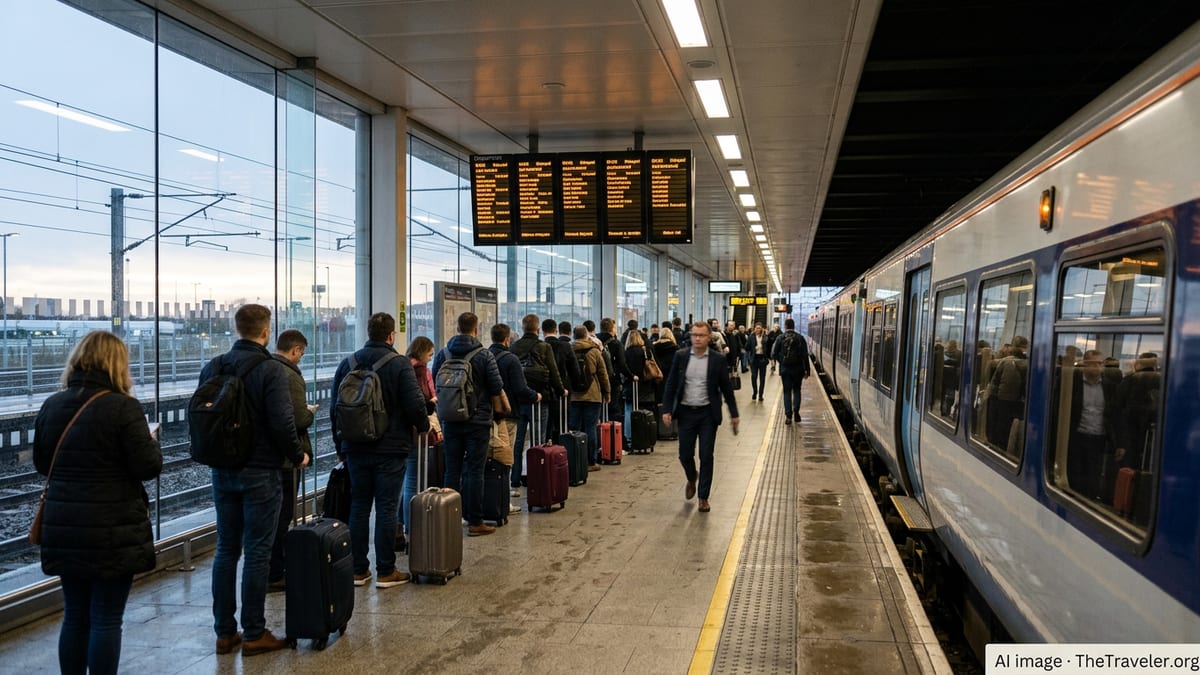
Industry commentators note that the line through Bedford is a critical artery for both regional and intercity travel, and any prolonged closure is likely to have knock on effects across neighbouring routes, including services via Kettering and Wellingborough. Evening peak travellers have been particularly impacted, with images and social media posts showing crowded concourses and departure boards carrying warning messages.
Investigation to focus on train protection systems
While it remains too early for definitive conclusions about the cause of the collision, early technical discussion in specialist rail forums and initial media analysis is focusing on how two passenger trains came to be in the same section of track. Commentators are examining the role of signalling, driver actions and on board protection systems designed to prevent such events.
Some reports circulating in rail industry coverage suggest that one train may have been brought to a standstill by a safety system intervention before being struck at relatively low speed by the following service. In the United Kingdom, multiple layers of protection are typically in place, including trackside signals, in cab warnings and automatic braking systems, with modern rolling stock designed to mitigate the effects of collisions when they do occur.
Rail accident investigators are expected to collect data from on train recorders, lineside equipment and signalling logs to reconstruct the sequence of events. This process typically includes detailed examination of braking performance, speed profiles and communication records between drivers and control centres, as well as inspection of the track and any relevant maintenance history.
Past inquiries into similar low to medium speed rear end collisions have often highlighted the interaction between human factors and technology, such as signal approach awareness, equipment failures or unexpected operational constraints. Observers anticipate that the Bedford investigation will also consider whether any lessons from previous incidents on busy commuter and intercity corridors are relevant to the circumstances of this crash.
Context within rail safety and passenger confidence
The collision near Bedford comes against a backdrop of generally strong rail safety performance in the United Kingdom, where fatal incidents involving moving passenger trains are relatively rare compared with many other forms of transport. Nonetheless, events of this kind tend to prompt renewed public scrutiny of infrastructure investment, rolling stock standards and operational practices.
Travel industry analysts note that high profile rail accidents can have an immediate impact on passenger confidence, particularly on routes popular with international visitors and business travellers. The line serving Bedford and London St Pancras is frequently used by tourists heading to and from Luton Airport, as well as by travellers connecting to Eurostar services that depart from the same London terminus.
In the near term, attention is likely to focus on how quickly full services can be restored and how effectively affected operators communicate with disrupted passengers, including those unfamiliar with the UK rail network. Clear information on alternative routes, ticket acceptance and refund options is seen as critical for maintaining trust among both domestic users and visitors.
Longer term, findings from the official investigation are expected to inform any recommendations on infrastructure upgrades, operating rules or technology enhancements on high traffic corridors similar to the Bedford route. Travel observers will be watching for any proposals that could influence future timetabling, capacity planning and safety margins on intercity lines that form part of national and international travel itineraries.