


More news on this day
Aerial footage circulating on news broadcasts and social media shows the wreckage of two high speed passenger trains that collided on Friday south of Bedford, disrupting a major rail artery linking London with towns and cities in central England.
Get the latest news straight to your inbox!
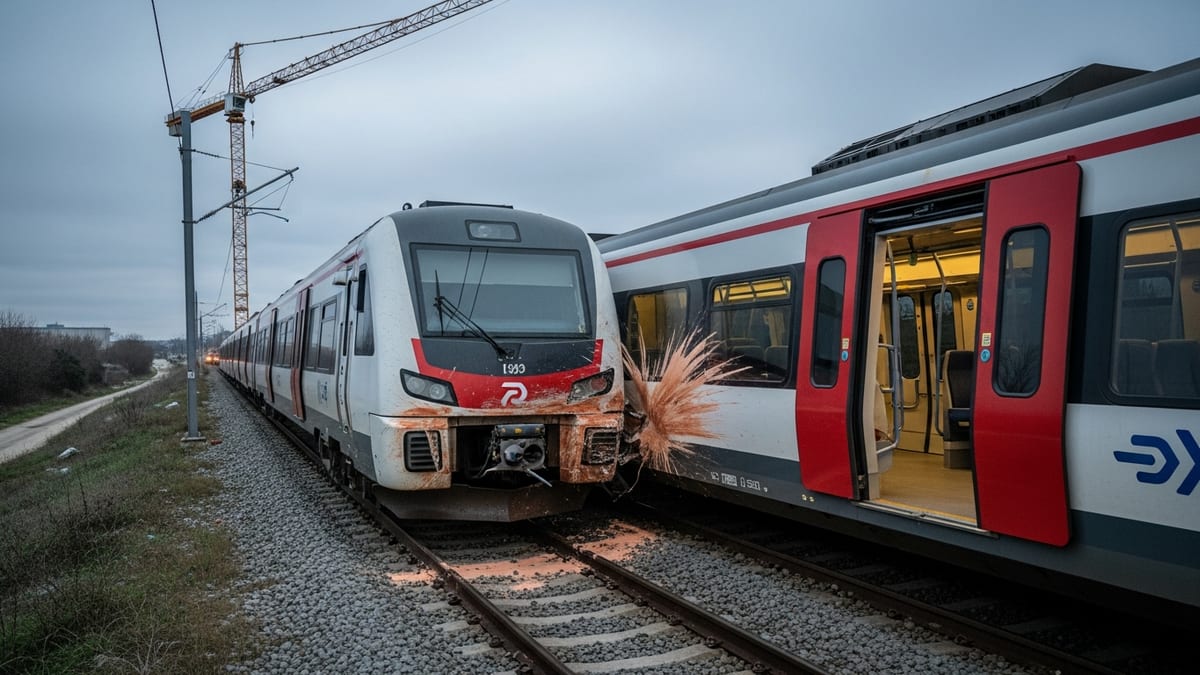
Collision north of London captured from the air
The collision occurred on the busy route between London St Pancras and the East Midlands, on open track a few miles south of Bedford. According to published coverage, two East Midlands Railway services travelling toward the capital were involved, with one train striking the rear of another that had stopped on the line.
Aerial footage broadcast by UK news channels shows two multi carriage trains still broadly aligned with the tracks but visibly damaged at the point of impact. The leading units of the rear train appear crumpled against the back of the train ahead, with twisted metal and shattered windows marking the contact point.
Images shot from helicopters and drones also show a wide emergency perimeter set up along the line, with multiple sets of flashing lights from ambulances, fire appliances and police vehicles gathered beside the railway. Rail workers in high visibility clothing can be seen moving along the ballast between the two trains, while medical teams appear to be working beside several carriages.
From above, the incident scene stretches for several hundred metres along the four track section of main line, underlining the scale of the disruption on one of the principal northbound corridors out of London.
Passengers injured as emergency response unfolds
Initial reports from national and local media indicate that a number of passengers sustained injuries in the impact, with at least one death reported in early updates. Footage filmed inside the carriages and later incorporated into broadcast packages shows shaken travellers assisting one another, some with visible cuts and bandages.
According to publicly available information, air ambulances were dispatched to the scene alongside ground based paramedics and fire and rescue crews. The aerial images show at least one helicopter on nearby farmland and a steady movement of stretchers to and from the trains.
Rescue teams appear to have focused first on the junction between the two trains, where the greatest structural damage is visible. From the air, several doors are seen opened by staff and passengers, with step ladders and mobile platforms positioned to help people down from the high floor level of the intercity sets.
Rail accident specialists and senior emergency managers later joined the frontline response. Their presence, visible in wide shot aerial frames, reflects the complexity of safely stabilising damaged rolling stock, protecting high voltage overhead lines and preserving evidence for investigators.
Major disruption on the London to East Midlands corridor
The line where the collision occurred is one of the key rail corridors in Britain, carrying a dense mix of intercity and commuter services linking London with Luton, Bedford, Wellingborough, Kettering, Corby, Leicester and beyond. Following the crash, train operators announced widespread cancellations and diversions, with services suspended through the affected section for a prolonged period.
According to real time rail data referenced in media reports, the trains involved were a Nottingham to London St Pancras service and a Corby to London service. Both are part of the high speed network that usually allows journey times of around 40 minutes between Bedford and the capital, significantly faster than alternative stopping routes.
Aerial shots underline the operational challenge facing engineers seeking to restore traffic. Both damaged trains occupy the same pair of fast lines, and the incident site lies amid complex overhead electrification and signalling equipment. While the slow lines appear unobstructed in some images, the proximity of recovery work and ongoing investigations may limit how quickly any tracks can safely reopen.
Passengers travelling between London and the East Midlands face extended journey times, replacement buses on parts of the route and potential crowding on alternative lines. Travel bulletins advise checking live updates before setting out and allow for significant delays.
Early focus on signalling, safety systems and train design
Although it is too early for any formal conclusions, early analysis in specialist rail forums and media coverage has highlighted several potential areas of interest for investigators. These include how signalling systems were operating on the approach to the incident site, why one train had come to a halt on the main line and what warnings or braking distances were available to the second train.
The corridor where the collision occurred is equipped with modern colour light signals and multiple layers of train protection technology. Commentators note that rear end collisions on main lines are rare in the United Kingdom, and any failure, whether technical or human, is likely to be examined closely.
Rail enthusiasts and engineers commenting in public discussions have also drawn attention to the designs of the fleets involved. The trains are relatively modern high speed units with energy absorbing structures built into their driving ends. The aerial images appear to show that these crumple zones have partially deformed, which may have helped to limit the degree of intrusion into passenger spaces despite the severity of the crash.
Investigating teams are expected to combine data from on board recorders, signal logs and radio communications with the visual record captured by ground level photography and extensive aerial footage.
Travel advice for visitors and regular commuters
For domestic and international travellers using London as a base to explore central and northern England, the collision near Bedford adds a significant disruption point on a route that normally offers fast, frequent links. Travel information platforms advise that journey plans involving London St Pancras, Luton Airport services and East Midlands destinations may require rebooking or rerouting while the line remains partially blocked.
Alternative rail options include routes from London Euston toward the West Midlands and connections from there, or slower stopping services via other operators where available. However, reports indicate that these lines are likely to be busy as displaced passengers seek other paths around the damaged section of track.
Coach operators are also expected to see increased demand on corridors paralleling the Midland main line, with services between London, Luton, Bedford, Northampton and Nottingham taking on additional passengers. Travellers are advised to allow extra time for road congestion near rail replacement hubs and major motorway junctions.
Tourism bodies and local authorities along the corridor are monitoring the situation as rail access is a key factor for weekend city breaks and business travel. While aviation and road links continue to operate normally, the aerial images of the collision site north of London serve as a reminder of how central the rail network is to the region’s mobility.