


More news on this day
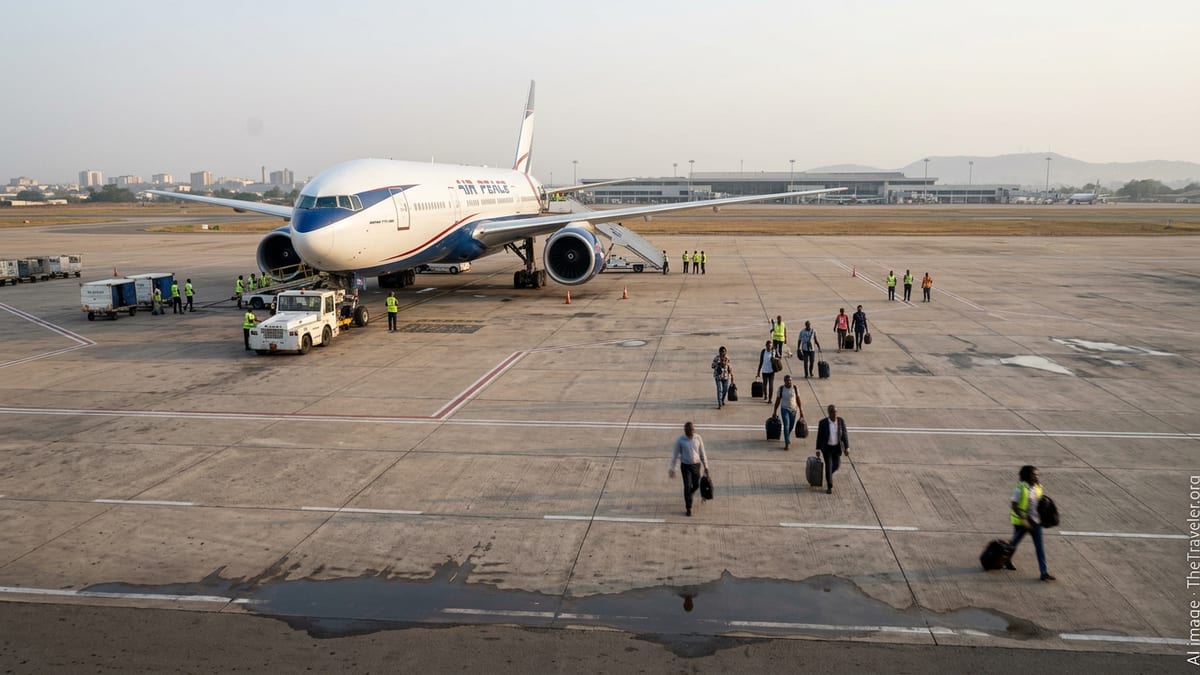
Air Peace and Nigeria’s civil aviation regulator are locked in a public dispute over how airline performance should be measured, after an August 2026 flight-disruption scorecard triggered sharp disagreement about delay rates, flight counts, and what qualifies as an airline-controlled disruption.
Get the latest news straight to your inbox!
What triggered the latest dispute
Published coverage indicates the Nigeria Civil Aviation Authority (NCAA) circulated a “Summary of Domestic Airline Flight Disruption Operations” for August 2026, presenting carrier-by-carrier totals for delayed and cancelled flights in Nigeria’s domestic network. The figures quickly spread across local media and travel forums, where the headline numbers were treated as a proxy for reliability.
Reports based on the NCAA summary put the domestic market’s August totals at 4,765 delayed flights and 36 cancellations. In that same reporting, Air Peace and United Nigeria Airlines appear among the carriers associated with the highest disruption counts for the month, intensifying scrutiny around operational planning and schedule integrity.
Subsequent coverage describes a formal Air Peace pushback, arguing that the scorecard’s presentation and underlying dataset can mislead travelers if readers assume each recorded delay reflects an airline-only failure, rather than a systemwide chain of constraints that can spill across multiple rotations in a day.
Air Peace’s core argument: flight counts and “inflated” percentages
Air Peace’s rebuttal has centered on the denominator: how many flights the airline says it actually operated in August 2026 versus the number shown in the regulator’s disruption table. Multiple reports describe Air Peace as stating it operated 2,564 flights in August, compared with 1,864 listed in the NCAA summary, a gap the carrier says materially changes the reported delay rate.
In published coverage, Air Peace also argues that omitting more than 700 “fully operational” flights from the dataset creates an artificially high delay percentage. The airline’s position, as summarized by several outlets, is that the scorecard needs a clearer reconciliation between scheduled flights, operated flights, and the disruptions attached to each, particularly when performance metrics are translated into simplified rankings.
Some reporting also attributes to the airline an internal breakdown of delay causes, suggesting only a minority of disruptions were “internally caused,” with the balance linked to factors outside the carrier’s direct control. While those allocations are difficult to independently verify from the scorecard alone, the claims underscore the central fault line: what counts as airline responsibility versus system responsibility.
Why performance metrics are so contested in Nigeria’s domestic market
At the heart of the dispute is methodology. Travelers often interpret a delay rate as a customer-facing reliability indicator, but aviation operations do not always allow for clean attribution. A single late aircraft arriving into a hub can cascade into multiple delayed departures, even if the original trigger was weather, air traffic flow restrictions, airport congestion, or a ground-handling bottleneck.
In Nigeria, commentary and analysis around the August scorecard have also pointed to infrastructure and airport-process constraints that can affect punctuality across carriers at the same time. Separate published commentary responding to the NCAA data has argued that some disruptions can be misread when statistics do not clearly separate airline-driven events from factors such as airport access issues, terminal constraints, or broader network disruptions.
The dispute also highlights a transparency challenge: passengers want clear, comparable reliability measures, while airlines want context and categorization that reflects operational complexity. Without shared definitions for “delay,” “cancellation,” and “cause,” a scorecard can become as much about narrative as about performance improvement.
What the NCAA data suggests for travelers planning trips
For travelers, the immediate takeaway is not a single carrier’s ranking, but the scale of disruption reflected in August’s systemwide totals. Reports based on the NCAA summary indicate that more than half of domestic flights in the period were delayed, a signal that schedule padding, connection buffers, and flexible day-of-travel planning remain important for many itineraries.
Travelers planning time-sensitive trips within Nigeria may want to treat published delay-scorecards as directional rather than definitive, especially during periods of industry-wide strain. When delays are widely distributed, the practical question becomes how quickly a carrier recovers operations after disruption, how it communicates schedule changes, and how it handles rebooking and refunds.
Publicly available information on the NCAA’s broader consumer-protection remit also shows the regulator’s role goes beyond scorecards, including fare and tariff filing oversight and collection of certain charges under existing aviation law. That wider mandate suggests passenger-facing reliability metrics may increasingly be used alongside consumer complaint mechanisms and operational oversight measures.
What to watch next as the metrics debate continues
The near-term question is whether the NCAA will publish clarifications on how it compiles monthly disruption tables, including how it sources flight counts, how it treats diversions and reschedules, and whether it categorizes disruptions by attributable cause. Any adjustments to definitions or data reconciliation would likely reshape how monthly performance is interpreted.
Another point to watch is whether domestic aviation performance reporting in Nigeria evolves toward blended metrics that combine on-time performance with completion rates, or other reliability scoring systems already circulating in the market. Those models can reduce the distortion caused by cancellations being excluded from punctuality calculations, but they still depend on transparent and consistent data inputs.
For now, the Air Peace-NCAA dispute is less about a single month’s delay percentage and more about the rules of measurement. As long as performance metrics can swing sharply based on which flights are counted and how causes are assigned, travelers should expect periodic flare-ups whenever a new scorecard is released.