


More news on this day
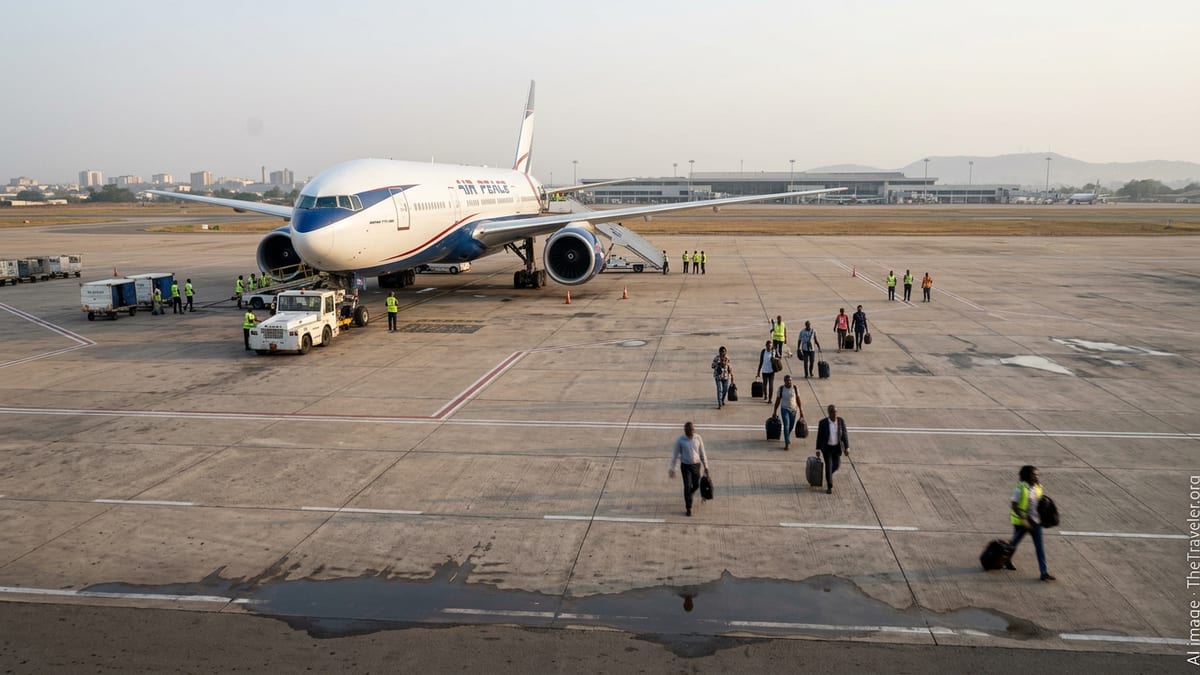
Air Peace is disputing Nigeria’s aviation regulator’s latest domestic flight disruption summary for August 2026, arguing that the widely circulated delay counts do not reflect the underlying causes and that only about 15% of the delays attributed to the airline were within its control.
Get the latest news straight to your inbox!
What the NCAA’s August disruption summary showed
Published coverage of the Nigeria Civil Aviation Authority’s (NCAA) August 2026 snapshot indicates domestic airlines operated 7,961 flights during the month, with 4,765 recorded as delayed and 36 cancelled. That works out to a systemwide delay rate of about 59.9% across the 15 carriers included in the summary.
Multiple reports describing the NCAA’s release also point to Air Peace and United Nigeria Airlines among the carriers with the largest disruption totals for the month. The same coverage places Air Peace at 1,330 delayed flights out of 1,864 operations in August, a delay rate of roughly 71.4% on that accounting.
The NCAA’s monthly disruption summaries are closely watched in Nigeria because they provide a simple, airline-by-airline count of delays and cancellations, which can quickly shape traveler perception even before passengers understand why a flight slipped off schedule.
Air Peace’s core argument: delay counts are not the same as airline fault
Air Peace’s rebuttal focuses on the difference between a flight being delayed and a delay being “airline-caused.” In the carrier’s framing, the NCAA’s summary is being interpreted by some readers as a direct measure of operational competence, even though the summary format does not necessarily separate controllable causes from factors outside an airline’s control.
In its public pushback, Air Peace has also challenged the underlying data representation, including how many flights were attributed to the airline in the regulator’s month-end tally, and it has emphasized that disruptions can be driven by constraints beyond the carrier, such as airspace and airport bottlenecks, weather, and knock-on disruptions from earlier rotations.
The airline’s “15%” claim is essentially a causation argument: that most delays affecting its operation should be assigned to external conditions rather than the airline’s own processes, staffing, aircraft availability, or ground handling decisions.
Why “cause of delay” is difficult to interpret from topline tables
Globally, delay reporting typically starts with a binary classification: a flight is considered delayed once it crosses a defined threshold against the scheduled arrival time. That approach makes delay rates easy to compare, but it does not, on its own, explain what actually drove a late departure or arrival.
Another complication is delay propagation. A flight that departs late because the aircraft arrived late is still a delay that passengers experience in real time, but the original root cause may trace back to weather, airport congestion, air traffic flow restrictions, or maintenance events earlier in the day. Without a cause breakdown, one month’s delay rate can overstate or understate what is controllable by the airline.
In the U.S., for example, publicly available Department of Transportation guidance explains how delay causes are categorized when they are reported, separating airline-controlled factors from weather, security, and air traffic or airport system constraints. That kind of categorization can change the story significantly compared with a single headline delay percentage.
What it means for travelers booking Nigeria domestic flights
For passengers, the immediate takeaway is that a high delay rate in a regulator’s monthly summary should be treated as a schedule reliability signal, not a definitive assignment of blame. Regardless of cause, frequent delays can create missed connections, long airport waits, and disrupted hotel or ground-transport plans.
Travelers planning time-sensitive trips inside Nigeria may want to build more buffer into itineraries on historically disruption-prone days and time windows, especially during peak business travel periods and weather-sensitive seasons. The operational reality is that even short delays compound when aircraft utilization is tight and spare capacity is limited.
Passengers can also benefit from keeping records of itinerary changes, notifications, and receipts for meals or accommodation when disruptions occur, since documentation can matter if a complaint or reimbursement request becomes necessary under consumer protection processes. Published coverage around the NCAA’s summaries has repeatedly underscored how quickly delay tables can become a proxy for service quality in the public debate.
What to watch next: clearer definitions and more granular disclosure
The dispute highlights a recurring issue in aviation oversight: transparency works best when the metrics are specific about definitions and methodology. A delay total can be accurate as a count while still being incomplete as an explanation of what drove the performance.
As more Nigerians rely on domestic air links, pressure is likely to grow for disruption reporting that pairs monthly delay and cancellation totals with additional detail such as on-time performance percentages, typical delay duration, and a clearer split between airline-attributable issues and external constraints.
For now, the NCAA’s August 2026 table has done what such summaries often do: it has put reliability back in the spotlight, while the airline’s 15% claim has shifted the discussion toward causation and the need for reporting formats that better distinguish delays passengers feel from disruptions airlines can realistically prevent.