


More news on this day
Major international airlines are again suspending and rerouting flights across the Middle East as renewed hostilities between the United States and Iran deepen safety concerns over already fragile regional airspace.
Get the latest news straight to your inbox!
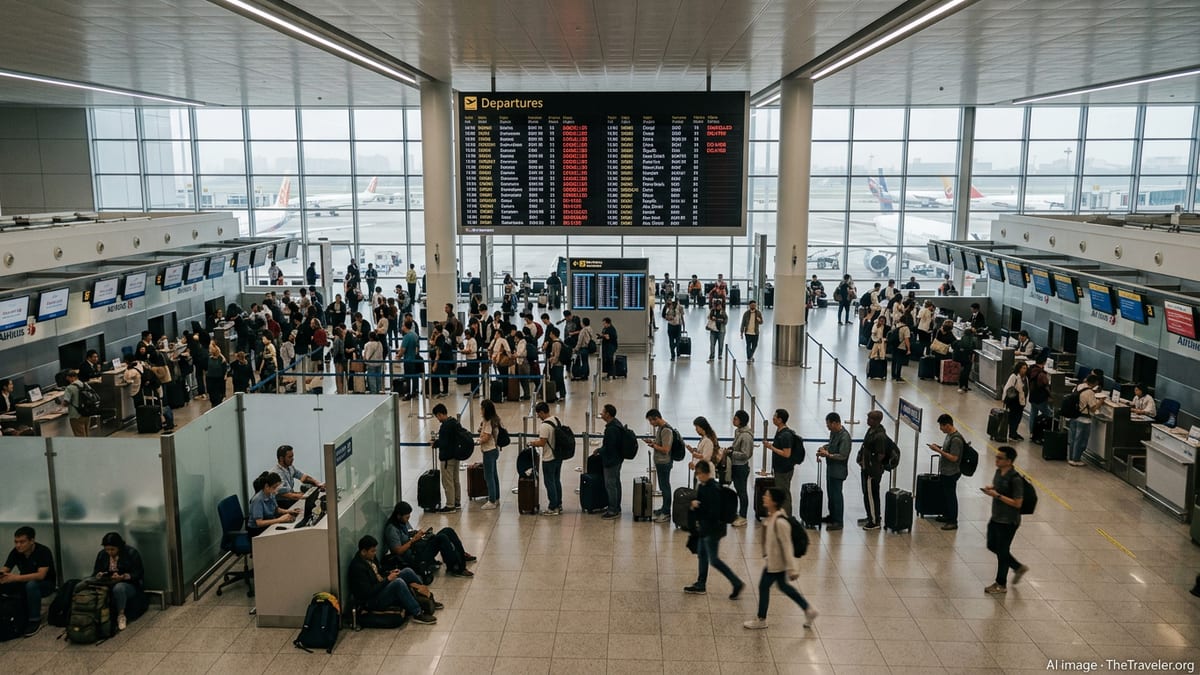
Fresh escalation revives fears over conflict-zone skies
The latest round of US strikes on Iranian targets, following a foiled missile attack on American forces in the region, has coincided with a new wave of aviation disruption across the Middle East. Recent coverage of the conflict describes a steadily widening air campaign, renewed drone and missile activity, and fresh attacks on infrastructure inside Iran, all of which have reinforced industry anxiety about flying through or into the region.
Earlier phases of the 2026 Iran war had already pushed oil above 100 dollars a barrel and forced thousands of cancellations as airspace over Iran and several neighboring states was shut or heavily restricted. Aviation analysis and official advisories cited by regional media outlined closures affecting large parts of Iran, Iraq, Syria and the Gulf, creating what amounted to a moving no-go zone for commercial jets.
Despite intermittent pauses in the fighting, the renewed strikes and threats in late July have made it harder for carriers to plan a steady return to normal operations. Public information from airlines and regulators indicates that many are keeping temporary suspensions in place or extending them into August, reflecting both security assessments and the complexity of rerouting long-haul traffic around conflict areas.
Major carriers extend suspensions and diversions
According to timelines compiled by aviation monitors and industry reports, a broad group of European and Asian airlines halted most passenger services to the Middle East at various points this year, including links to Iran, Iraq, Lebanon and the Gulf. International carriers such as Air India, Biman Bangladesh Airlines, British Airways, Cathay Pacific, IndiGo, Lufthansa, Virgin Atlantic and Wizz Air were among those that suspended routes into the conflict-affected region as the war escalated.
Regional airlines have also been hit. Publicly available information on airport operations shows that flights at Tehran’s main international hub have been effectively halted for months, while state-owned and private carriers based in Kuwait, Qatar and other Gulf states sharply cut schedules whenever airspace closures tightened. Local media in Lebanon and the Gulf reported waves of cancellations from Middle East Airlines and several Gulf-based carriers on days when surrounding countries closed their skies.
Some airlines opted for partial service rather than a full retreat, maintaining a limited number of flights into relatively less affected hubs while suspending operations to cities closer to the front lines or along high-risk corridors. Even these scaled-back schedules remain subject to sudden change, with operators warning that departures can be delayed, diverted or cancelled at short notice if the security picture worsens.
Airspace closures reshape global routings
Aviation outlook studies produced in recent months describe the current Middle East airspace environment as one of the most challenging for commercial aviation since the early stages of the COVID-19 pandemic. Analysts note that closures and restrictions across up to ten countries have repeatedly forced airlines to redraw flight paths linking Europe and North America with South and East Asia.
Where carriers once relied heavily on direct corridors across Iran and the Gulf, many long-haul flights are now threading through alternative northern and southern routes. Traffic that would normally cross Iranian and Iraqi skies has been pushed toward the Caucasus, Central Asia and the eastern Mediterranean, or south via Egypt and Saudi Arabia, adding flight time and fuel burn and increasing congestion along these substitute paths.
Industry assessments suggest that roughly 15 percent of global passenger traffic previously flowed through major Middle Eastern hubs that have faced partial shutdowns or capacity limits during the conflict. With parts of the network still constrained, the ripple effects have reached far beyond the region, as aircraft and crews are repositioned, connection banks are thinned out, and schedules in Europe, Asia and Africa are adjusted to cope with ongoing uncertainty.
Rising fuel costs and operational strain on airlines
The war’s impact on global oil markets has compounded the operational challenge. Economic analyses of the conflict’s fallout highlight how higher crude prices, driven in part by disruption in and around the Strait of Hormuz, have pushed up jet fuel costs just as airlines are absorbing longer routings and schedule instability.
Public reporting from the logistics and freight sector points to sharply higher transportation costs across supply chains since the conflict began. Passenger airlines, facing similar pressures, have reacted by raising fares on certain routes, trimming frequencies that have become unprofitable at current fuel prices, and delaying some planned capacity growth into the region.
For carriers already operating on tight margins, the combination of elevated fuel bills, complex detours and weaker demand for itineraries touching the Middle East has been particularly acute. At least one North American low-cost airline cited the cumulative impact of war-related fuel costs as a factor in its decision to cease operations earlier this year, underlining the broader financial stress the conflict has placed on the aviation sector.
Travelers face uncertainty amid shifting advisories
For passengers, the most visible consequence of the renewed US–Iran flare-up is persistent uncertainty. Online megathreads, airport statements and airline advisories throughout 2026 have warned travelers to monitor flight status closely, often up to the hour of departure, as conditions can change quickly with each new military development.
In periods of intense escalation, flight-tracking data and airport departure boards have shown clusters of cancellations and diversions affecting Beirut, Tel Aviv, Doha, Dubai, Abu Dhabi and other regional gateways. On quieter days, some services resume, only to be suspended again when airspace warnings are tightened or new strikes are reported.
Travel specialists note that standard travel insurance policies do not always cover disruptions linked to war, leaving many passengers dependent on airline rebooking and refund policies. Consumer advocates advise that anyone planning to transit the Middle East in the coming weeks should build in extra flexibility, keep contact details updated with airlines and be prepared for last-minute rerouting via alternative hubs if the US–Iran confrontation continues to unsettle the region’s skies.