


More news on this day
Hours long queues, missed connections and frayed tempers are rippling across major European hubs this summer as the European Union’s new biometric border regime fully replaces manual passport stamping for non EU travellers.
Get the latest news straight to your inbox!
A long planned security upgrade meets peak travel season
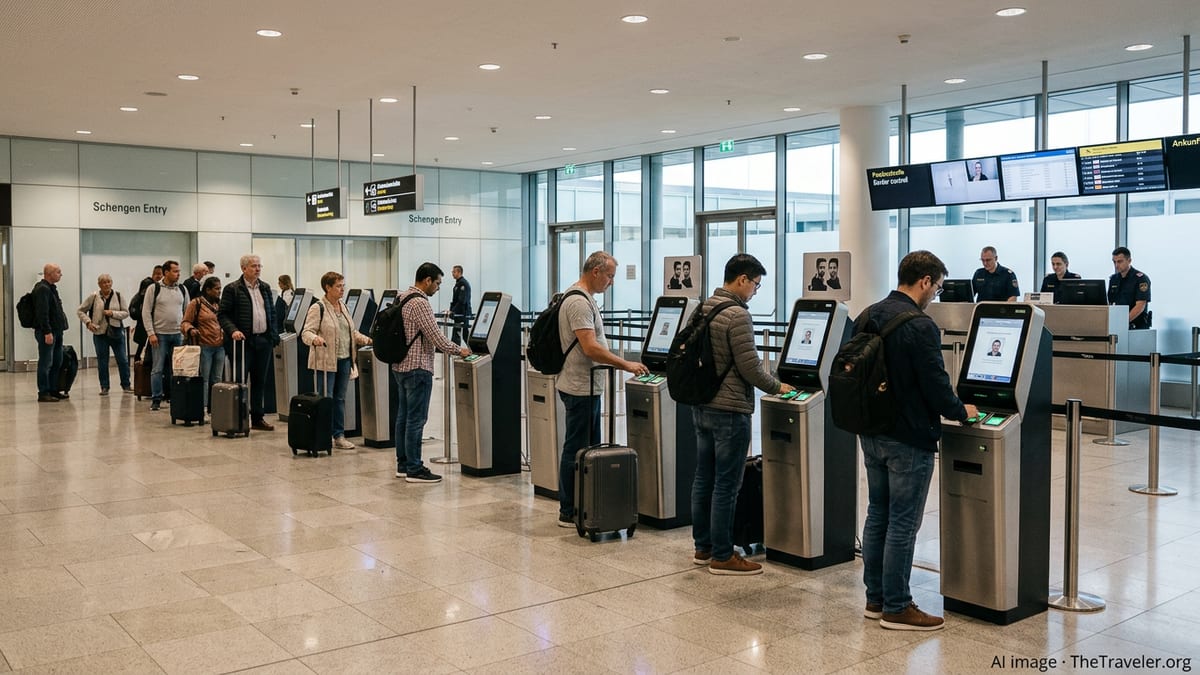
The EU’s Entry Exit System, known as EES, became fully operational at all external Schengen border crossings in April 2026 after a phased rollout that began in late 2025. The large scale programme records the entry and exit of non EU nationals in a centralised database, capturing biometric data such as fingerprints and facial images alongside travel details for short stay visits.
According to publicly available information from European institutions, the system is designed to modernise border management by replacing ink passport stamps with digital records, tightening enforcement of the 90 day stay limit, and making it harder for travellers to overstay or use falsified documents. Officials have repeatedly framed EES as a cornerstone of the bloc’s security architecture.
The timing of full deployment, however, has collided with a powerful rebound in post pandemic travel. Passenger numbers at busy Schengen gateways such as Barcelona, Amsterdam, Lisbon and Rome were already brushing against or exceeding pre crisis capacity before biometric checks were layered on top. Aviation groups had warned in advance that a summer launch risked overwhelming frontline border facilities.
Reports from airport operators and industry associations in early 2026 highlighted concerns about staffing levels, testing of new equipment and the readiness of national systems to plug into the shared EU platform. A progressive launch was intended to smooth the transition, but the combination of unfamiliar procedures and record passenger flows is now being felt in terminal queues across the continent.
Scenes of disruption at key holiday gateways
Social media posts and traveller forums since April describe lengthy delays at passport control in several Schengen airports that serve high volumes of non EU visitors, including British and North American holidaymakers. Accounts from Italy point to queues at Pisa and Florence for non Schengen arrivals and departures, where new self service kiosks and manual desks are struggling to keep pace with peak arrivals.
Similar experiences have been shared from major hubs such as Frankfurt and Amsterdam, where passengers transiting from Schengen to long haul flights report unexpectedly long lines at border control and tight or missed connections. Some travellers describe spending multiple hours in queues as only a handful of staffed booths remained open while new biometric stations processed passengers far more slowly than traditional checks.
At land borders, reports indicate that the new system has contributed to congestion at crossings between Schengen states and neighbouring non EU countries, although traffic surges and local infrastructure constraints are also playing a role. Recent coverage from the Croatia Serbia frontier described motorists waiting for hours in summer heat while biometric registration and document checks were completed.
Airport managers and airline representatives have publicly warned that the greatest pressure is falling on departures and transfer flows, where travellers have less buffer time and are more likely to miss flights if queues grow unexpectedly. Industry organisations have cited cases in which passengers arrived at airports well in advance only to be stranded airside because they could not clear border control in time.
Glitches, duplicated profiles and complex procedures
Beyond the sheer volume of passengers, early experience with EES is exposing teething problems that appear to compound delays. Travellers who have already enrolled biometrics on a previous trip report being asked to repeat the process on subsequent journeys, suggesting that some records are not being retrieved correctly or are being duplicated within the system.
In online accounts, some passengers describe being told that multiple profiles had been created against the same passport, or that their earlier registration could not be located, forcing them back through fingerprinting and facial scans. Travel industry commentary suggests that these errors, if widespread, risk undermining one of the central promises of the project: that repeat visitors would benefit from faster processing once their data is on file for several years.
There are also indications that workflows at border checkpoints have become more cumbersome in the transition phase. At several airports, travellers describe a two step process that involves scanning passports and completing biometric capture at kiosks before joining a separate queue for manual inspection by border staff. This effectively creates two bottlenecks in succession rather than streamlining movement through a single channel.
Publicly available statements from aviation groups point to unresolved technology issues with some e gates and kiosks, as well as limited roll out of mobile pre registration tools that were expected to shift part of the process away from the border itself. The combination of unfamiliar interfaces, varied national implementations and differing rules for specific nationalities is adding layers of complexity at precisely the moment volumes are highest.
Industry pushes for flexibility as summer chaos mounts
Airlines and airports across Europe have intensified calls for greater flexibility in how the new system is applied while technical and staffing issues are resolved. A joint communication from major aviation associations earlier this year warned that, if full biometric registration were enforced during the height of the season without adjustments, waiting times at some airports could stretch to four hours or more for non EU passengers.
Airport groups have urged national governments to adjust staffing plans, expand the use of traditional passport booths during peak periods and make wider use of derogations in the Schengen Borders Code that allow temporary relaxation of some checks when queues become excessive. Some associations have also advocated for a more coordinated approach to pre registration, arguing that a single mobile application for the entire Schengen zone would ease the burden on border points.
European Union communications, by contrast, have emphasised that the progressive roll out was achieving its security objectives and that the overall launch had taken place largely without system wide failures. Officials in Brussels have highlighted tens of millions of successfully recorded entries and exits, as well as refusals of entry, as evidence that the underlying architecture is functioning as intended.
National authorities retain considerable discretion over how quickly they require all non EU nationals to be enrolled and how they balance automated and manual checks. In practice, this is producing a patchwork of experiences, with some airports still relying heavily on conventional stamping while others attempt to process most third country travellers through the digital route.
What travellers can expect in the months ahead
For visitors from countries outside the EU and Schengen, the practical impact of the new border regime is immediate. First time arrivals since the launch must expect to provide fingerprints and a facial scan in addition to a passport check, whether at a self service kiosk or a staffed desk. Repeat visitors should, in theory, pass more quickly once their EES record exists, but early evidence suggests that this advantage may be uneven until data quality and retrieval issues are ironed out.
Travel advice from airports and airlines now consistently recommends arriving earlier than usual for flights to or through the Schengen area, particularly during school holidays and weekend peaks. Passengers with tight connections through major hubs are being urged to build in additional buffer time in case they need to clear border control between flights, even when remaining within airport transit zones.
The biometric overhaul is also only one part of a broader transformation of European border management. A separate electronic travel authorisation system for visa exempt visitors, known as ETIAS, is scheduled to follow EES into operation, adding an advance registration requirement on top of the new entry exit database. Travel industry observers note that the interaction of these layers, and the capacity of national authorities to manage them smoothly, will shape the experience of international visitors well beyond the current summer.
As the holiday rush continues, the immediate picture at many airports is one of experimentation under strain, with procedures being adjusted in real time and passengers bearing the brunt when lines back up. How quickly border agencies and technology providers can stabilise the new system will determine whether this season of disruption proves a short lived shock or a prolonged adjustment for travellers heading to Europe.