


More news on this day
Europe’s long-delayed biometric border system is now fully live across the Schengen Area, and early reports from airports suggest the transition is straining passport control lines, disrupting flight connections and testing traveler patience just as the peak summer season gets underway.
Get the latest news straight to your inbox!
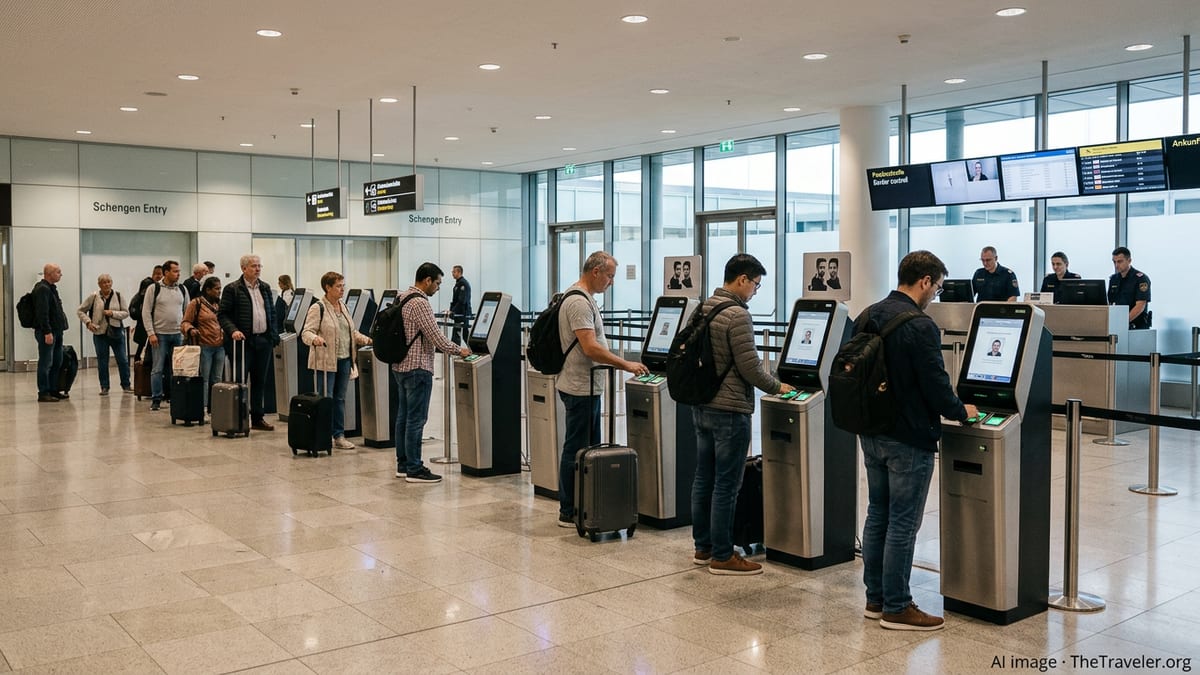
A long-planned digital shift hits real-world bottlenecks
The European Union’s Entry/Exit System, or EES, became operational at all Schengen external borders in April 2026, replacing manual passport stamping for most non-EU travelers with a centralized database that stores facial images, fingerprints and entry records. The project, managed by the EU’s border IT agency eu-LISA, is designed to tighten security controls and automate tracking of short-stay limits for third-country nationals.
According to publicly available information from EU institutions, the system has been introduced progressively since late 2025, with airports among the first to connect. The full switch in April marked the moment when biometric registration shifted from trials to an everyday requirement for millions of visitors, including travelers from the United States, United Kingdom and many other non-Schengen countries.
While the European Commission has described the roll-out as largely successful in technical terms, aviation and tourism stakeholders have been warning for months that the operational impact on border queues would depend heavily on staffing levels, airport layouts and how quickly passengers could be guided through unfamiliar procedures.
Those warnings are now colliding with reality at some of Europe’s busiest gateways, where early holiday crowds are meeting a system that still appears to be adjusting to full-scale use.
Hours-long lines and missed flights at key hubs
Reports from airports such as Frankfurt, Geneva, Lisbon, Pisa and Florence indicate that the first full weeks of EES have brought sharply longer waits for many non-EU arrivals and departures. Posts circulating on traveler forums and social media in June and July describe queues of several hundred passengers at passport control, with only a handful of booths open and biometric kiosks operating unevenly.
At Germany’s Frankfurt Airport, one of Europe’s main intercontinental hubs, travelers transiting from Schengen to non-Schengen flights have reported queues stretching through long corridors and waits of more than two hours to clear border checks. Accounts from June mention missed connections even when passengers had several hours scheduled between flights.
Similar scenes have been described at regional gateways serving popular leisure destinations. Travelers at Pisa and Florence in Italy, for example, reported that initial EES registrations around the Easter period and after full activation regularly took more than an hour at peak times, with some passengers arriving at their departure gates just as airlines were closing doors.
Outside the airport environment, recent coverage of road crossings on the Croatia–Serbia border highlighted waits of several hours in heavy traffic as officers processed non-EU travelers. While multiple factors influence congestion at land frontiers, the timing of the delays so soon after EES went fully live has added to concerns about the system’s real-world impact.
Why biometric checks are slowing border control
Under the new rules, most non-EU travelers entering the Schengen Area for the first time since EES went live must have four fingerprints scanned and a facial image captured in addition to presenting a valid passport. Once registered, subsequent crossings are supposed to require only a biometric verification and document check, theoretically speeding up the process.
In practice, the first registration is proving significantly slower than the simple passport stamps it replaces. Industry analyses and official briefings published earlier this year indicated that initial EES enrollment can take several minutes per person, compared with a matter of seconds for manual stamping. When multiplied by a full aircraft of non-EU passengers arriving at once, border control queues can expand rapidly if staffing and equipment are not scaled up.
Documents from European airport and airline associations published in late 2025 and early 2026 warned that processing times at some locations had already risen by up to 70 percent as biometric capture was progressively introduced. Those organizations also highlighted chronic understaffing at border control units, technical glitches with automated gates and inconsistent introduction of pre-registration tools that were expected to ease the burden.
Public commentary from travel operators following the April switch suggests that such constraints are still evident. In some cases, airports appear to be relying heavily on manual booths because self-service kiosks are underused or unavailable during busy waves, eroding one of the key efficiency gains promised by the digital overhaul.
Communication gaps leave travelers unprepared
Beyond the technical and staffing challenges, confusion among travelers is emerging as a major amplifier of delays. Accounts shared by passengers in recent weeks describe airport staff redirecting people between lines designated for EU, non-EU and biometric registration, sometimes with little explanation of who needs to do what and when.
Several travelers report only learning about the need to register fingerprints and facial images when they reached border control, despite having flown from major hubs where airlines could have provided basic information at check-in or during boarding. This lack of advance guidance, they say, contributed to hesitation at kiosks, repeated attempts to complete scans and disputes over queue placement.
Some travel companies monitoring the rollout have argued in public analyses that clearer, multilingual signage at terminals, dedicated staff to triage passengers before they reach the booths and better use of airport public address systems could reduce bottlenecks without major investment. Early feedback from smaller airports suggests that where such measures have been implemented, waits remain noticeable but more manageable.
There is also growing discussion about whether airlines should build longer minimum connection times into itineraries that involve Schengen border crossings, particularly for non-EU travelers who have not yet completed their first EES registration. For now, many bookings still reflect pre-EES assumptions, leaving little margin for passengers caught in slower-than-expected lines.
Pressure mounts for flexibility before peak summer
With annual travel through the Schengen Area estimated in the hundreds of millions of passengers, the stakes for smoothing out the new border regime are high. Industry groups representing airports and airlines have repeatedly called for what they describe as “operational flexibility” during the system’s bedding-in period, including the option to temporarily scale back biometric checks at pinch points.
Public statements from these groups ahead of the April 2026 switchover warned that, without such measures, some airports could see routine waits extend beyond two hours for non-EU travelers at peak times, and up to four hours in worst-case scenarios during the height of the summer season. The scenes already emerging at certain hubs are likely to intensify those appeals.
European institutions, for their part, have emphasized the long-term benefits of EES for border security and migration management, pointing to millions of entries and exits already logged and a growing number of refusals of entry processed through the system. Official documents also highlight that member states retain some discretion to manage the pace of rollout and the balance between automated and manual checks.
As July and August traffic builds, the coming weeks will show whether incremental adjustments at border posts can contain the disruption or whether broader changes to how EES is applied at airports will be needed. For travelers planning trips into and out of the Schengen Area, the safest short-term response appears to be simple: allow significantly more time at passport control, especially if crossing a Schengen border for the first time since the biometric era began.