


More news on this day
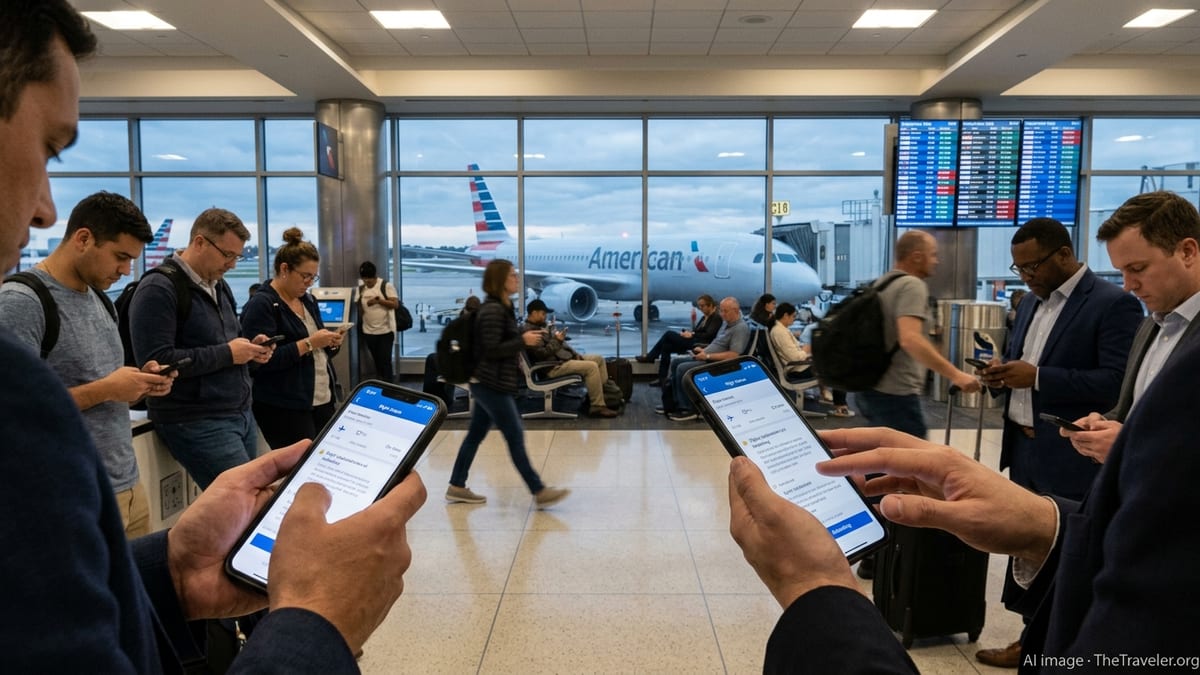
American Airlines is preparing a new operational trial designed to curb one of the most common frustrations for its customers: “rolling delays,” when departure times repeatedly slip in small increments that keep passengers tethered to the gate for hours without a clear end point.
Get the latest news straight to your inbox!
What the airline is testing in Charlotte
Published coverage indicates the trial will start at American’s Charlotte Douglas International Airport (CLT) hub, where flight updates are expected to be calculated more conservatively in certain scenarios by anchoring estimates to the inbound aircraft’s projected arrival time. In practice, that aims to reduce the familiar cycle of 10- to 30-minute delay extensions that often build into long waits.
The operational change is less about eliminating the underlying causes of delays and more about improving how they are communicated and managed. Rolling delays can happen when the inbound aircraft is late, a gate is unavailable, a crew is out of position, or maintenance takes longer than first predicted. The airline’s stated goal, as described in recent reporting, is to set more realistic expectations earlier so customers can make better decisions about food, restrooms, nearby seating, and rebooking options.
Charlotte is a logical starting point because it is one of American’s busiest connecting hubs, where even modest disruption can cascade into missed connections across the network. A test at a hub also produces large volumes of real-world data quickly, including how schedule adjustments affect gate availability, boarding flows, and connection integrity.
Why rolling delays became a recurring complaint
Rolling delays draw outsized passenger anger because they create uncertainty rather than simply a late departure. A long delay posted upfront gives travelers the chance to rebook, notify hotels, or step away from the gate. By contrast, an optimistic new departure time that keeps slipping can lead travelers to wait for hours in the belief that boarding is always about to begin.
Customer frustration has also been amplified by the modern travel environment: fewer quiet places to wait, crowded gate areas during peak banks, and higher stakes for connections on full flights. When rolling delays drag on, the psychological toll is often tied to the lack of a dependable “plan B,” not just the lost time.
The issue lands in a wider consumer-protection context. Federal rules require covered carriers to update flight status information within 30 minutes after becoming aware of a cancellation, delay of 30 minutes or more, or diversion, including on airport flight information displays and other sources under the carrier’s control. Those requirements shape how quickly an airline must reflect known irregularities, but they do not guarantee that early estimates will be accurate, especially when the underlying constraint is still evolving.
How a more conservative estimate could change the travel experience
If the trial works as intended, passengers could see fewer incremental “drip” extensions and more upfront acknowledgement that a flight is likely to depart substantially later. For travelers, that can translate into practical improvements: less time standing shoulder-to-shoulder at the podium, fewer rushed trips back from concourses after another small schedule change, and clearer timing for meals, rides, and childcare pickups.
There is also a tradeoff. More conservative estimates can make published performance look worse in the short term, because the airline may effectively commit to later departure times earlier in the disruption cycle. That can reduce the number of “on-time recoveries” where a delay shrinks unexpectedly, but it may improve the credibility of the information passengers rely on most: the next time they can reasonably expect to board.
For connecting itineraries, earlier realism can matter even more than the final delay length. A passenger who learns sooner that a connection will be missed has a better chance of securing remaining seats on alternate flights. It can also reduce crowds at customer-service points if travelers can reroute themselves through apps while options still exist.
Operational pressures behind the scenes
Rolling delays often reflect uncertainty in the system: an inbound aircraft’s arrival time can shift with air traffic control flow programs, gate holds, or last-minute maintenance. At large hubs, gate availability becomes a chessboard problem, especially when irregular operations compress many flights into the same limited space.
The trial also arrives as the U.S. aviation system faces renewed attention on delay reduction strategies. Recent published coverage has highlighted federal efforts to improve traffic management, as well as broader airline schedule adjustments in response to shifting cost conditions. While American’s Charlotte test appears focused on customer-facing timing and communication, the same network dynamics that create rolling delays are influenced by everything from staffing to aircraft rotations to congestion at constraint-heavy airports.
For passengers, the most visible impact may be a subtle one: fewer instances where a delay message suggests boarding is imminent when the inbound airplane is still airborne or not yet at the gate. That doesn’t eliminate weather, maintenance, or congestion. But it can reduce the feeling of being “stuck” in a perpetual countdown that never ends.
What travelers should watch for during the trial
Travelers flying through Charlotte may notice longer posted delays earlier in the disruption timeline, paired with fewer last-minute extensions. A key indicator of success will be whether the posted times stay stable once updated, rather than shifting repeatedly.
Passengers can also expect that a more definitive delay estimate may prompt earlier decisions about rebooking or refunds. U.S. Department of Transportation guidance states that consumers are entitled to a refund when an airline significantly delays a flight and the consumer chooses not to travel, though the DOT does not set a single universal time threshold for what counts as “significant,” and airline-specific policies and the facts of each itinerary still matter.
For now, coverage suggests the program is a pilot rather than a permanent systemwide change. If the Charlotte results show improved accuracy without creating new bottlenecks at gates or in connections, the approach could expand to other hubs where rolling delays have been most visible to passengers.