


More news on this day
Asia’s peak summer travel season has been hit by another wave of disruption, with monsoon rains and storm systems combining to trigger 212 cancellations and 6,639 delays in a single day across major hubs from Jakarta and Bangkok to airports in China and the wider region.
Get the latest news straight to your inbox!
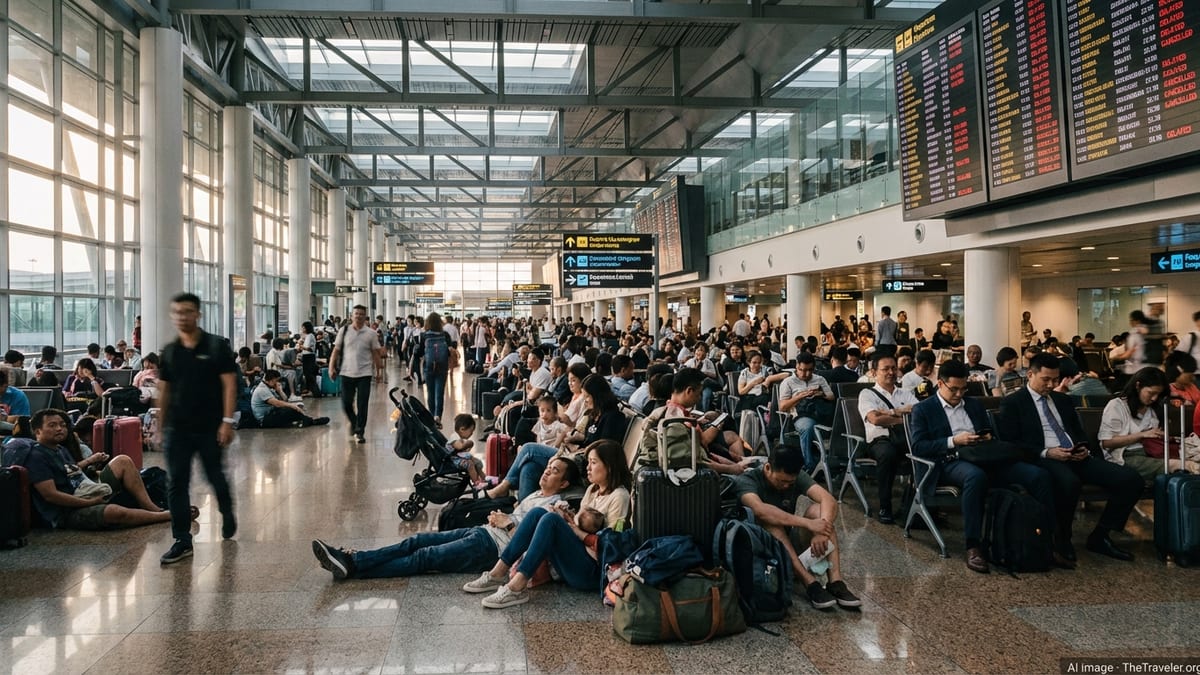
Monsoon Systems and Typhoon Activity Drive a New Surge in Disruptions
Operational data compiled from regional trackers and airport performance dashboards indicate that the latest spike in cancellations and delays is closely linked to the interaction of seasonal monsoon systems with stronger storm events across East and Southeast Asia. Publicly available coverage of August 2026 flight operations highlights one mid‑August day on which 212 cancellations and 6,639 delayed flights were recorded across Asia, with disruption concentrated at Jakarta Soekarno Hatta International Airport and Bangkok’s dual‑airport system, alongside busy hubs in China, Japan and the Gulf.
Reports on Asia’s wider aviation performance this summer describe a pattern in which relatively routine seasonal weather has combined with more intense events such as Typhoon Dolphin to produce severe knock‑on effects. Channel NewsAsia and other outlets covering Typhoon Dolphin note that the storm triggered top‑level weather alerts in eastern China, prompting mass evacuations and over 1,000 flight cancellations as rain and high winds forced repeated runway closures and schedule changes at coastal airports.
Travel and aviation analysts point out that such storms are hitting networks that are already running with limited slack after several years of rapid traffic recovery. Aggregated August data cited by industry trackers show multiple days with more than 3,000 delays across Asia, and previous July sequences where more than 6,900 flights were disrupted in a multi‑day stretch focused on China’s largest hubs. In that context, a single day with 212 cancellations and 6,639 delays fits a broader pattern of repeated weather‑driven strain on regional infrastructure.
Weather‑monitoring services covering the northern Philippines, Thailand and parts of Indonesia also show clusters of heavy rainfall, low cloud ceilings and thunderstorms persisting through late August. Recent reporting from northern Luzon, for example, describes repeated rounds of rain and poor visibility at Laoag International Airport, contributing to local cancellations and extended delays and echoing conditions seen at larger hubs.
Jakarta and Bangkok Emerge as Epicenters of August Turbulence
Jakarta’s Soekarno Hatta International Airport and Bangkok’s Suvarnabhumi and Don Mueang airports appear prominently in recent disruption tallies. A late‑August analysis published by TheTraveler.org, drawing on live departure and arrival boards, notes that Jakarta repeatedly logged more than 150 cancellations on some days, peaking at 212 cancellations on 16 August 2026. On the same mid‑month dates, Bangkok’s main international gateway and its low‑cost focused sister airport reported hundreds of late departures, rolling delays and clusters of short‑notice cancellations.
Separate operational summaries compiled by compensation and passenger‑rights platforms indicate that between 21 and 23 August, 2,459 flights were disrupted by delays and cancellations linked to congestion and stormy conditions centered on Bangkok. Those figures are consistent with earlier assessments that identify the Thai capital’s airport system as a key pressure point for Southeast Asia, particularly when thunderstorms track across central Thailand at the same time as peak outbound and inbound waves.
Published coverage of Thailand’s aviation sector in mid‑2026 also highlights financial and capacity constraints at several local carriers. Rising fuel costs and schedule adjustments by Thai airlines, including large full‑service and low‑cost operators, have reduced some buffer capacity on dense routes. When combined with monsoon thunderstorms, this leaner operating model leaves fewer spare aircraft and crew available to recover from weather‑related disruption, extending the impact of each delay across the network.
Jakarta faces similar structural challenges. As Indonesia’s main international hub, Soekarno Hatta operates near capacity during peak hours, and regional analyses note that even modest weather interruptions can ripple quickly through its banks of departures to domestic, Southeast Asian and long‑haul destinations. On days when heavy rain or poor visibility reduce runway throughput, the number of delayed flights can climb rapidly, creating backlogs that take many hours to clear.
China, Japan and the Gulf Feel the Ripple Effects
While Jakarta and Bangkok have absorbed some of the most visible impacts of the current disruption, airports in China, Japan and the Gulf have also seen substantial knock‑on delays. An August feature on Asia’s flight disruptions cites multiple days in which more than 3,500 flights were delayed and over 200 cancelled across hubs from Guangzhou, Shanghai and Beijing to Tokyo, Dubai and Riyadh. On one of those days, concentrated thunderstorm and typhoon activity over East Asia coincided with security‑related schedule changes in the Middle East, producing more than 2,500 delays and around 300 cancellations across the combined network.
Typhoon Dolphin’s trajectory through eastern China in early August forced precautionary groundings and schedule reductions at airports in Zhejiang and Shanghai, with local media describing hundreds of suspended services and warnings of continuing disruption even after the system weakened. User reports and travel‑forum posts from passengers transiting Shanghai in the same period describe long waits, last‑minute gate changes and overnight delays as airlines worked around storm‑related restrictions.
Further south and west, Gulf hubs that act as key connectors between Asia, Europe and North America have also been affected. Coverage of regional operations and passenger experiences points to delays at Dubai and other Gulf airports when feeder flights from storm‑affected parts of Asia arrive late or are cancelled outright. Because many Gulf carriers operate hub‑and‑spoke models with tightly timed connections, even limited weather disruption upstream can cascade into missed connections and subsequent retimings for long‑haul services.
Industry briefings and consumer‑rights guides underline that these ripple effects are not confined to local travelers. Passengers originating in North America or Europe but connecting through Dubai, Bangkok or other Asian hubs can experience secondary delays as inbound or onward legs are retimed. National transportation reports for August 2026 in markets such as the United States note that Asian weather events have contributed to late arrivals on some transpacific and transcontinental routes.
Aviation Networks Under Strain as Demand Outpaces Resilience
Behind the headline figures of 212 cancellations and 6,639 delays lies a deeper question about resilience in Asian aviation. Commentaries on the region’s operational performance this year repeatedly point to networks that have added passenger volumes faster than they have expanded runway, apron and air‑traffic control capacity. As a result, when monsoon storms or typhoons hit, there is limited slack to absorb the shock, and relatively small disruptions can quickly grow into multi‑airport events affecting thousands of flights.
Analysts examining July and August data describe a recurring fingerprint across severe disruption days. The same major hubs and carriers frequently appear at the top of delay rankings, particularly large Chinese airports such as Guangzhou Baiyun and Shanghai Pudong, as well as busy hubs in Thailand, Indonesia and the Gulf. In each case, dense scheduling and high load factors mean that a single blocked runway, ground stop or missed connection can trigger a chain of retimings across entire route networks.
Recent episodes in India, the northern Philippines and parts of Southeast Asia further illustrate how tightly coupled the system has become. Local storms and heavy rain over Delhi, Manila and northern Luzon in late August generated waves of diversions and delays that, according to domestic media and social media accounts, extended to smaller airports with limited ground‑handling resources. When several flights are disrupted at once in such environments, queues at check‑in, security and customer‑service desks lengthen, and aircraft can spend extended periods waiting for stands or pushback clearance.
Industry observers note that airlines and airports across Asia are attempting to respond with a mix of schedule fine‑tuning, additional staffing and technology‑driven tools for real‑time disruption management. However, with monsoon season continuing into early September in parts of the region, the risk of further days resembling the recent 212‑cancellation, 6,639‑delay event remains elevated, particularly on routes touching Southeast Asia’s busiest hubs.
What the Disruptions Mean for Travelers Planning Asia Trips
For travelers with upcoming itineraries in Asia, the current disruption pattern has several practical implications. Passenger‑rights advisories and compensation platforms recommend allowing more generous connection times than usual, especially when routing through Jakarta, Bangkok or major Chinese hubs during the monsoon period. Booking slightly longer layovers can reduce the risk of missed onward flights if inbound segments are delayed by storms or traffic restrictions.
Public guidance from airlines and travel‑tracking services also emphasizes the importance of monitoring flight status closely in the 24 hours before departure. Many carriers now push real‑time updates through mobile apps and text messages, while third‑party trackers and airport websites provide live departure and arrival boards. On days when storms are forecast, disruption often escalates quickly, and early awareness of schedule changes can give travelers more options for rebooking or adjusting ground transport and accommodation.
Consumer‑rights information compiled for Asia and major long‑haul markets stresses that passengers may be entitled to assistance or partial compensation depending on the jurisdiction, route and cause of disruption. While weather events are often categorized as extraordinary circumstances in many regulations, airlines are still generally expected to provide care in the form of meals, refreshments and, in some cases, hotel accommodation during long delays or overnight cancellations. Travelers connecting to or from the European Union, for example, may have specific protections under EU rules when flights are operated by EU carriers or depart from EU airports.
Travel planners and tourism businesses across the region are watching the situation closely as the northern hemisphere summer season draws to a close. If monsoon and storm‑related disruption continues at current levels, some destinations may see short‑term impacts on visitor flows and spending. For now, the available data suggest that Asia’s skies remain busy but fragile, with each new storm system carrying the potential to trigger another spike in cancellations and delays on the scale of the 212‑cancellation, 6,639‑delay event recorded this month.
TheTraveler.org: Asia Flight Disruptions Hit Jakarta, Bangkok and Regional Hubs
AirHelp: Bangkok delays at Suvarnabhumi and Don Mueang disrupt 2,459 flights
Channel NewsAsia: Typhoon Dolphin weakens but disrupts travel in east China
AirHelp: Severe summer thunderstorms disrupt 6,961 flights across Asia