


More news on this day
Dozens of Ryanair passengers were left stranded at Lanzarote’s César Manrique Airport after a malfunction at passport control prevented them from reaching the gate for an Edinburgh flight, renewing scrutiny of Europe’s troubled new border technology.
Get the latest news straight to your inbox!
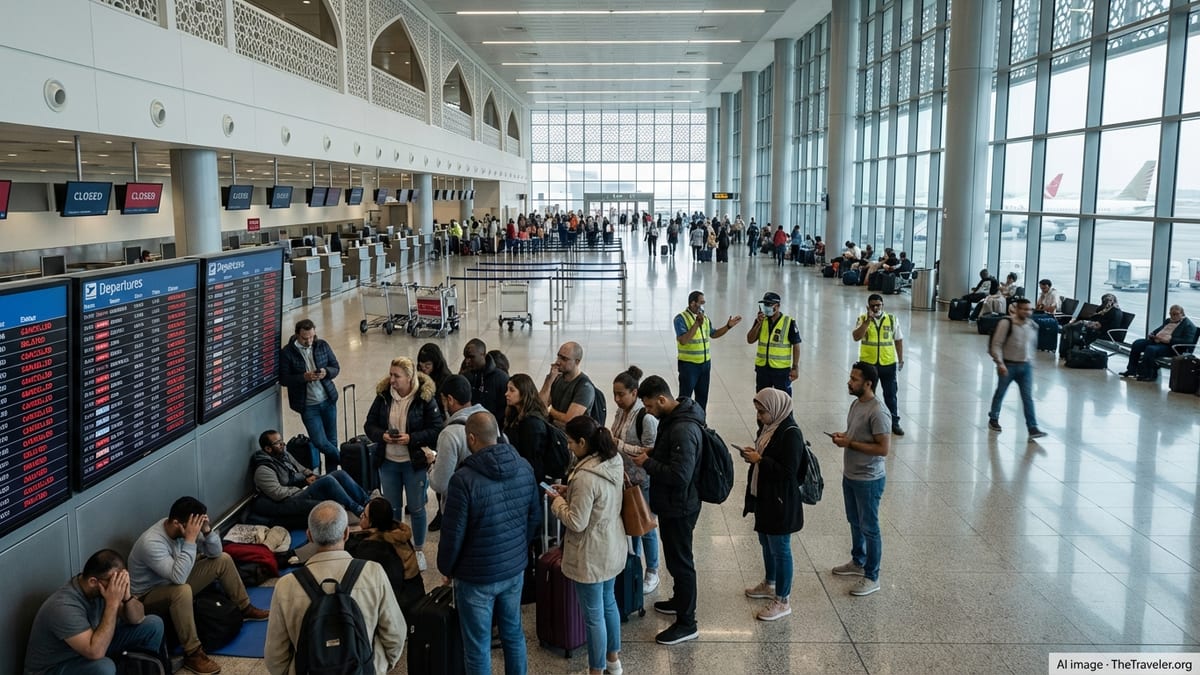
System failure at Lanzarote blocks Edinburgh-bound travelers
Regional media and travel industry reports indicate that the disruption unfolded on the morning of 4 May 2026, when the passport control system at César Manrique Airport experienced a sudden breakdown. The fault affected travelers departing the Canary Island for destinations outside the European Union, who must clear exit checks before proceeding to security and boarding.
According to published coverage, a Ryanair service from Lanzarote to Edinburgh was particularly affected, with nearly 70 ticketed passengers reportedly unable to clear passport control in time to board. The aircraft departed with many seats empty, while stranded passengers remained stuck in queues inside the border control area.
Accounts described long lines forming quickly as the automated system stalled, forcing staff to revert to slower manual processing. By the time some travelers reached the front of the queue, the gate for the Edinburgh flight had already closed under standard cut-off times, leaving them to seek alternative arrangements at airline and airport desks.
The incident has resonated strongly among British holidaymakers and residents who rely on direct links between Scotland and the Canary Islands, highlighting how a technical problem remote from the gate can still determine whether a passenger makes it onto a flight.
Entry/Exit System under mounting pressure
The breakdown in Lanzarote has unfolded just weeks after the wider rollout of the European Union’s new Entry/Exit System, known as EES, which records biometric data and movements of non-EU nationals entering and leaving the Schengen area. Official documentation presents the scheme as a way to tighten border security and reduce manual passport stamping, but early operations have been marked by delays and bottlenecks across several leisure airports.
Travel analysis and local news coverage from Spain and Portugal describe queues stretching well beyond dedicated control areas in busy terminals such as Málaga, Alicante and Tenerife South, with peak waiting times of more than an hour for some arrivals and departures. The Lanzarote disruption is being cited as a fresh example of how the technology can struggle when passenger volumes spike or when systems are not fully stable.
Aviation commentators have also pointed to staffing and infrastructure issues, noting that many airports are still adjusting to new equipment, biometric capture stations and changed passenger flows. Where older buildings were not designed for extensive pre-border queuing, lines can spill into circulation corridors, compounding the risk that travelers who arrived in what used to be considered ample time now miss flights for reasons beyond their control.
While not every delay leads to passengers being stranded, the Lanzarote case underscores how a single technical failure at passport control can cascade into missed departures, hotel costs and rebooking headaches for ordinary travelers.
Passengers question where responsibility lies
In the aftermath of the Lanzarote disruption, discussion among affected travelers has focused on the division of responsibility between the airline, the airport operator and border authorities. Publicly available guidance generally states that airlines are required to close boarding at a fixed time before departure, often around 20 minutes, in order to complete final paperwork and push back on schedule.
Ryanair flights typically follow strict cut-off times, leaving little scope for holding doors open for late-arriving passengers, even when delays are driven by security or passport queues. Industry forums note that carriers can face penalties and operational knock-on effects if they do not adhere to slot times, while airlines argue that they have limited control over border control staffing or technical performance.
For passengers, the distinction can feel academic when they have arrived at the airport hours ahead of departure yet still miss their flight while standing in an official queue. Consumer advocates point out that compensation rules vary depending on whether the disruption is deemed to be within the airline’s control, and that border control failures are often treated as external events.
Early accounts from Lanzarote suggest that some stranded travelers were offered rebooking options on later services, sometimes with additional costs, while others were left to organize new tickets or claim through travel insurance. The absence of clear, real-time communication during the system outage has been cited in commentaries as a key source of frustration.
Ryanair amplifies calls to pause EES for summer
The Lanzarote incident has emerged just as Ryanair intensifies a broader campaign urging European governments to temporarily suspend the EES during the peak summer season. In recent weeks, the airline has publicly pressed authorities in countries including France and Portugal to delay full implementation, arguing that the system is not yet robust enough to handle July and August traffic.
Company statements shared across European media outlets contend that passengers are already facing what the carrier describes as hours-long queues at various airports linked to the rollout of the new checks. Ryanair has framed the issue as a risk not only to its own punctuality metrics but also to the reputation of tourism-dependent regions, warning that repeat episodes like Lanzarote could deter visitors.
Government officials in several member states have acknowledged teething problems with EES and have explored options such as partial pauses or so-called flexibility modes that permit a temporary return to manual stamping in exceptional circumstances. However, there is also pressure to press ahead with modernization after years of preparation and significant investment in biometric infrastructure.
Analysts suggest that the standoff between operational caution and political commitment is likely to play out airport by airport, with local incidents like the Lanzarote breakdown adding practical urgency to what had previously been a largely technical policy debate.
Holiday hotspot faces reputational test
The Canary Islands rely heavily on reliable air links with northern Europe, and Lanzarote in particular markets itself as an easy, year-round getaway for British and Irish travelers. Episodes in which families are left stranded despite arriving well in advance of departure risk undermining that image of simplicity and predictability.
Tourism industry observers in the islands note that disruptions at passport control can have a disproportionate impact on visitors from outside the European Union, including large numbers from the United Kingdom, who now require full third-country checks following Brexit. When technology or staffing levels falter, these passengers tend to bear the brunt of delays, as EU and Schengen nationals can often use separate, faster channels.
Local business groups have already voiced concerns in media commentary that a summer marked by repeated border control failures could push visitors toward competing sun destinations with smoother airport experiences. For an archipelago that depends on air access for almost all international arrivals, maintaining confidence in the journey from check-in to gate is seen as essential.
The events in Lanzarote serve as a visible early test of how well Europe’s new border architecture can cope with real-world holiday crowds. Unless technical reliability and staffing keep pace with rising demand, travel watchers warn that further episodes of stranded passengers may become a recurring feature of the peak season rather than an isolated glitch.