


More news on this day
Hundreds of flight cancellations and thousands of delays rippled across Asia on June 7, 2026, as major hubs in Thailand, the United Arab Emirates, Singapore, Japan and China struggled with fresh aviation disruptions affecting regional and long-haul carriers.
Get the latest news straight to your inbox!
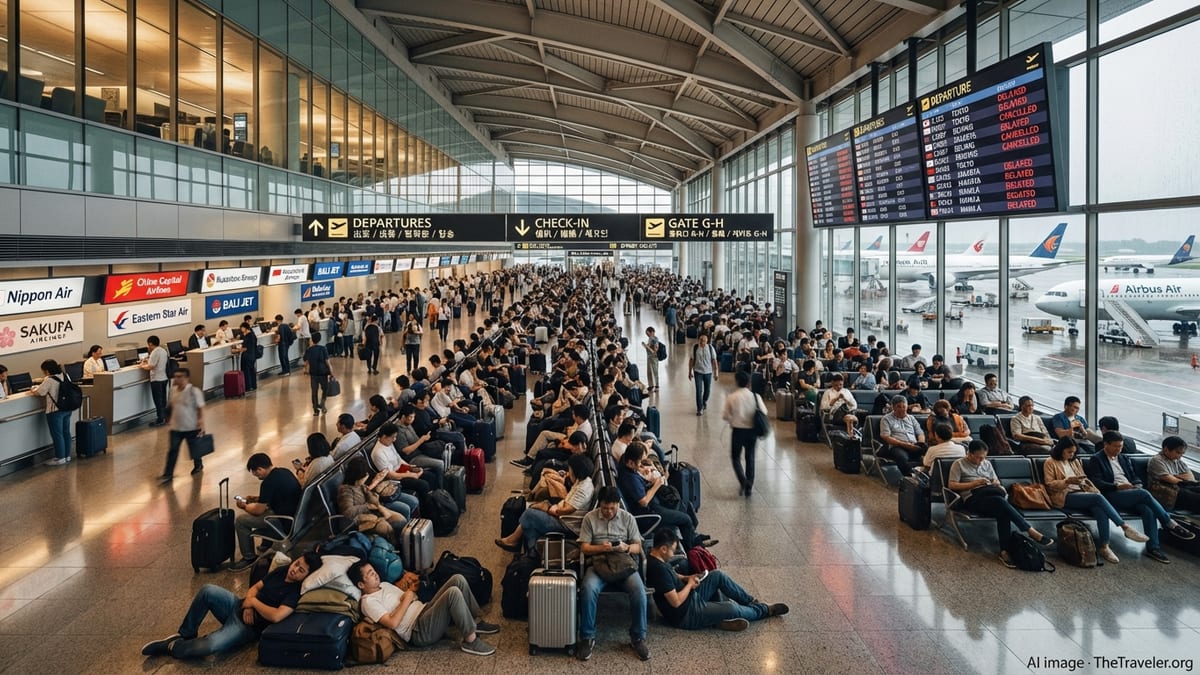
Network Strain Turns Into Regional Gridlock
Publicly available data compiled on June 7 indicates that at least 335 flights were cancelled and about 3,609 delayed across Asia’s key aviation corridors, affecting movements through Beijing, Bangkok, Dubai and several other hubs. The pattern points to mounting strain on a network already dealing with congested airspace, shifting routings and earlier operational issues in parts of the Middle East and East Asia.
Recent disruptions in the United Arab Emirates illustrate how quickly regional bottlenecks can cascade. Earlier in the week, operational breakdowns and ongoing airspace restrictions triggered large numbers of delayed and cancelled flights at Dubai and Sharjah, forcing airlines to retime or reroute services and leaving aircraft and crews out of position for subsequent rotations.
In East Asia, weather and traffic-management challenges have added further pressure. Coverage of Japan’s aviation sector in early June described severe disruption linked to tropical weather systems, while China’s busiest airports reported concentrated waves of delays and cancellations, amplifying knock-on effects for flights connecting to Southeast Asia and the Middle East.
Analysts note that while the headline figure of 3,944 disrupted flights reflects a single intense phase, the underlying causes have been accumulating for weeks. Airlines are operating into tighter, more crowded corridors with less spare capacity, meaning that each local incident has a greater chance of spreading across the region’s timetable.
Flag Carriers From Thailand, UAE, Singapore and China Affected
The latest wave of disruption has hit a broad mix of airlines, including national and network carriers that anchor Asia’s long-haul connectivity. Flight-tracking and schedule data show Thai Airways encountering disruption on services linking Bangkok with China and the Middle East, as delayed arrivals and crew rotations narrowed the buffer between flights at Suvarnabhumi Airport.
Emirates, one of the region’s largest long-haul operators, has been adjusting its schedules throughout June, trimming capacity on select routes and substituting aircraft types on trunk links such as Dubai to Bangkok. These schedule changes, layered on top of intermittent operational constraints at Dubai International Airport, mean that even flights operating as planned are doing so within a more fragile network context.
Singapore’s Changi Airport, typically one of the most reliable hubs in the region, has not been immune. As Singapore Airlines and its low-cost arm Scoot expand services into China and other Asian markets during 2026, they are feeding into the same constrained corridors used by carriers from China and Japan. When weather or airspace restrictions force delays in one sector, subsequent connections can be missed, particularly for passengers transiting between Southeast Asia, North Asia and Europe.
In mainland China, carriers such as Air China, China Eastern and others have recently recorded significant clusters of delays and cancellations at major gateways including Beijing and Shanghai. These issues, when aligned with tight turnaround times and strong seasonal demand, have spilled over into international flights serving Thailand, the UAE and wider Asia.
Beijing, Bangkok, Dubai and Other Hubs Under Pressure
The hubs most visible in the latest figures are also those that carry a disproportionate share of Asia’s connecting traffic. Bangkok, Beijing and Dubai each serve as major transfer points for passengers moving between Europe, the Middle East and the Asia Pacific, so even moderate disruption can quickly manifest as missed connections and extended layovers.
Bangkok’s Suvarnabhumi Airport continues to see heavy traffic from Chinese, Middle Eastern and regional low-cost carriers. As flights arrive late from Beijing, Shanghai or Guangzhou, departures to onward destinations in South Asia, the Gulf and Europe are forced to wait or depart with disrupted connection banks, affecting Thai Airways and partner airlines across their networks.
In Beijing and other Chinese hubs, recent reports of more than a thousand delays in a single day underlined the sensitivity of the system. Congestion at departure and arrival banks creates ripple effects for airlines such as Air China and Hainan Airlines, which operate important links into Southeast Asia and the Middle East. Even when weather is not extreme, minor storms or visibility reductions can trigger holding patterns and ground delays that quickly consume available slack in the schedule.
Dubai’s role as a bridge between East and West magnifies any local difficulty. Earlier regional airspace constraints forced traffic into narrower corridors around the Gulf, extending flight times and compressing turnaround windows at already busy terminals. While airport operators report a gradual restoration of capacity, airlines are still working through the residual imbalance in aircraft positioning and crew duty limits created by weeks of irregular operations.
Passengers Face Missed Connections and Tight Capacity
For travelers, the numbers translate into practical problems: long waits at transfer hubs, missed onward connections and limited rebooking options on popular routes. With many summer-season flights already operating close to capacity, re-accommodating passengers from 335 cancelled services and thousands of delayed ones has quickly filled remaining seats on alternative departures.
Reports from consumer-advocacy and passenger-rights platforms indicate that some travelers in Asia and the Gulf have struggled to secure timely rebookings, particularly on multi-leg itineraries crossing several affected regions. Airlines have in many cases offered refunds or re-routing, but the combination of high demand and ongoing schedule adjustments means that alternatives may involve extended detours or overnight stops.
Industry observers suggest that passengers travelling through hubs such as Beijing, Bangkok, Dubai, Singapore and major Japanese airports should plan for potential disruption over the coming days. Allowing extended connection times, monitoring flight status closely, and being prepared for last-minute gate or timing changes are emerging as practical steps for those who must travel while networks remain under stress.
Some analysts also point to broader structural factors, including higher fuel costs, evolving security restrictions and regional geopolitical tensions, as elements that are narrowing the margin for error in Asia’s aviation system. As airlines and airports move deeper into the mid-year travel peak, operational resilience is likely to remain under scrutiny from both regulators and passengers.
Outlook: Recovery Efforts Compete With Peak-Season Demand
Looking ahead, operators across the region are attempting to stabilize schedules while managing strong demand. Airport authorities in the UAE have indicated that airspace capacity around Dubai is gradually returning to more typical levels, which should ease some of the pressure on long-haul connections between Asia, Europe and Africa as June progresses.
In East Asia, airports and airlines are refining contingency plans for typhoon season and working to improve coordination with air traffic management centers. Publicly available industry analysis points to investments in more flexible routing and enhanced real-time planning tools, although these measures may take time to translate into noticeable improvements for passengers.
For travelers booked on Thai Airways, Emirates, Singapore Airlines, Air China and other carriers serving the affected hubs, the immediate focus remains on day-to-day operations. With 335 cancellations and 3,609 delays already logged across Asia’s skies in this latest phase, the coming days will test how quickly the region’s aviation network can absorb disruption while keeping peak-season traffic moving.
While there are signs that conditions may gradually improve as airspace constraints ease and schedules are recalibrated, the experience of early June 2026 underlines how tightly interconnected Asia’s aviation system has become. A localized breakdown in one hub or corridor can now reverberate across thousands of flights, reshaping travel plans for passengers in cities far beyond the original point of disruption.