


More news on this day
Passengers across China, Indonesia, the United Arab Emirates and other key aviation markets are facing another wave of disruption as a fresh round of cancellations and delays by China Southern Airlines, China Eastern Airlines and Indonesia’s Batik Air strands travelers in Shanghai, Jakarta, Dubai and beyond.
Get the latest news straight to your inbox!
New Data Highlights Scale of Disruptions
Regional aviation tracking and industry reports this week point to at least 55 cancellations and nearly 500 delays involving China Southern, China Eastern and Batik Air services across Asia and the Middle East corridors. These figures sit within a broader pattern of severe congestion in April, with separate datasets indicating more than 2,000 flight delays and close to 300 cancellations across Asian hubs on certain days.
Shanghai Pudong International Airport remains one of the most affected Chinese gateways, repeatedly appearing near the top of regional disruption tables. Recent tallies compiled by travel industry outlets show Pudong handling well over 200 delayed departures in a single day alongside dozens of cancellations, impacting both domestic connections and long-haul services to Europe and the Middle East.
In Indonesia, Jakarta’s Soekarno Hatta International Airport has emerged as a primary bottleneck. Coverage drawing on flight-tracking services describes days with more than 200 delayed departures and over a dozen cancellations at the capital’s main gateway, directly affecting Batik Air’s dense domestic network as well as its regional routes.
Dubai International Airport, a major transfer point between Asia, Europe and Africa, has also been swept into the turbulence. Reports indicate that on some recent days Dubai recorded more than 80 delayed flights and several cancellations, compounding the pressure on itineraries that route Chinese and Southeast Asian travelers through Gulf hubs.
Chinese Mega-Hubs Buckle Under Operational Strain
Publicly available data on China’s busiest airports in mid-April shows how widespread the strain has become for the country’s largest carriers. Beijing’s dual-airport system, Guangzhou Baiyun, Shenzhen Bao’an and Chengdu Tianfu have all registered triple-digit daily delay counts, with cancellations concentrated at major hubs such as Guangzhou and Shanghai.
One recent industry roundup of Chinese operations reported more than 140 flight cancellations in a single update across Guangzhou, Shanghai, Beijing, Shenzhen and Chengdu, involving Air China, China Eastern, China Southern and other domestic airlines. Routes affected include not only high-density domestic links to cities like Wuhan, Tianjin and Dalian but also international services to European destinations including Frankfurt and Munich.
Within this landscape, China Southern and China Eastern have featured prominently in disruption tables tracking daily performance. Earlier assessments in March, compiled amid a different but related wave of schedule changes tied to global tensions, showed China Southern associated with more than 160 delays in one snapshot alone, underscoring how sustained the pressure has been on its network.
China Eastern has likewise ranked among the more heavily affected Asian carriers in several recent analytical breakdowns of delay and cancellation patterns. Aggregated figures from April show the airline contributing hundreds of disrupted operations as reductions in regional capacity and congested airspace force last-minute timetable adjustments.
Batik Air and Indonesian Networks Face Repeated Shockwaves
Indonesia’s Batik Air has been part of the wider turbulence hitting Southeast Asian carriers, particularly those heavily exposed to regional connecting traffic and Middle Eastern routings. Travel and aviation news platforms tracking Asia-wide performance in early April placed Batik Air among the most disrupted airlines in the region, alongside operators from India and Japan.
Earlier in the year, separate coverage focused on Indonesia and neighboring markets described thousands of passengers stranded after 54 cancellations and more than 2,100 delays across countries including Indonesia, Pakistan, Vietnam, Japan and Kazakhstan. Batik Air featured in those tallies, with observers noting that recurring operational challenges were weighing on punctuality at Jakarta, Ho Chi Minh City and other secondary hubs.
By late February, Batik Air had already issued public advisories warning of possible schedule changes related to the evolving security and operational environment along Middle Eastern corridors. Passengers were urged in those notices to monitor flight status closely and allow extra time for connections, foreshadowing the wave of cascading disruptions now being recorded in regional data.
As April’s congestion has intensified, Batik Air’s performance at Jakarta and across its domestic trunk routes has become a bellwether for Indonesian travelers. High seat loads and constrained spare capacity have made it harder to re-accommodate disrupted passengers quickly, contributing to crowded terminals and extended wait times when flights are cancelled or significantly delayed.
Middle East Tensions and Fuel Pressures Feed a Wider Crisis
The current spike in cancellations and delays is unfolding against a backdrop of prolonged geopolitical tension and a restructuring of airspace and fuel supply chains. Coverage of the evolving Iran conflict and the closure of the Strait of Hormuz in March highlights what analysts describe as one of the largest oil supply disruptions in decades, pushing up jet fuel prices and complicating planning for airlines across Asia-Pacific.
Reports from regional business media and travel industry platforms trace a clear link between these fuel and airspace constraints and the sharp increase in timetable changes. Airlines from Pakistan to New Zealand have publicly acknowledged route consolidations and reduced frequencies, while regulators and airport operators across Asia have reported heightened volatility in daily schedules.
Earlier in March, specialized aviation outlets documented more than 460 cancellations and several thousand delays tied to Middle East airspace closures, with Shanghai, Jakarta and Dubai repeatedly named among the hardest-hit hubs. Many of those disruptions involved Gulf carriers and regional partners, but Chinese and Southeast Asian airlines, including China Southern, China Eastern and Batik Air, have faced extended knock-on effects as they share congested routings and limited slot capacity.
By mid-April, tracking snapshots indicated that Asia-Pacific hubs were again grappling with hundreds of cancellations and several thousand delays in a single day, suggesting that the system-wide shock has not fully stabilized. For travelers, this has translated into a higher probability of missed connections, last-minute rerouting and unexpected overnight stays across the region’s major transit points.
What Travelers Are Experiencing on the Ground
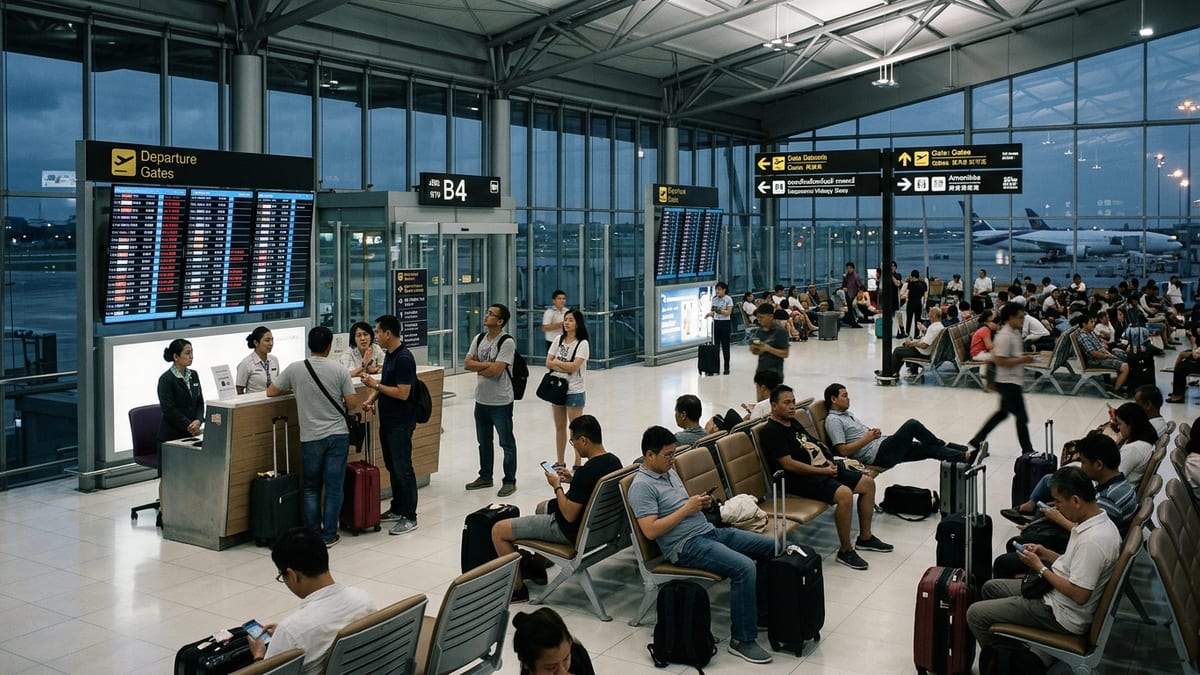
Across the affected airports, publicly available images and accounts point to long queues at check-in counters, customer service desks and security checkpoints as passengers attempt to rebook itineraries or secure overnight accommodation. In Shanghai and Guangzhou, local coverage has described terminals operating close to capacity for prolonged periods, with rolling delays pushing departures late into the night.
Jakarta’s Soekarno Hatta has seen similar scenes, with passengers on disrupted Batik Air and other regional services facing extended waits for alternative flights in a market where spare seats are limited, particularly on peak domestic routes. In Dubai, congestion has appeared most acute in transfer zones serving Asia-bound connections, where even modest schedule changes upstream in China or Southeast Asia can cascade into tight transfer windows.
Consumer advisories issued by airlines and travel organizations across the region emphasize the importance of checking flight status repeatedly on the day of travel rather than relying on initial confirmations. Passengers are being encouraged to allow longer connection times, particularly when itineraries involve multiple carriers spanning Chinese, Southeast Asian and Gulf hubs.
For now, available data suggests that the combined impact of airspace constraints, fuel market volatility and already dense schedules will continue to shape operations for China Southern, China Eastern, Batik Air and their regional peers through April. Travelers planning routes through Shanghai, Jakarta, Dubai and other key nodes are being urged by public advisories to prepare for potential disruption, even when flights remain scheduled as normal.