


More news on this day
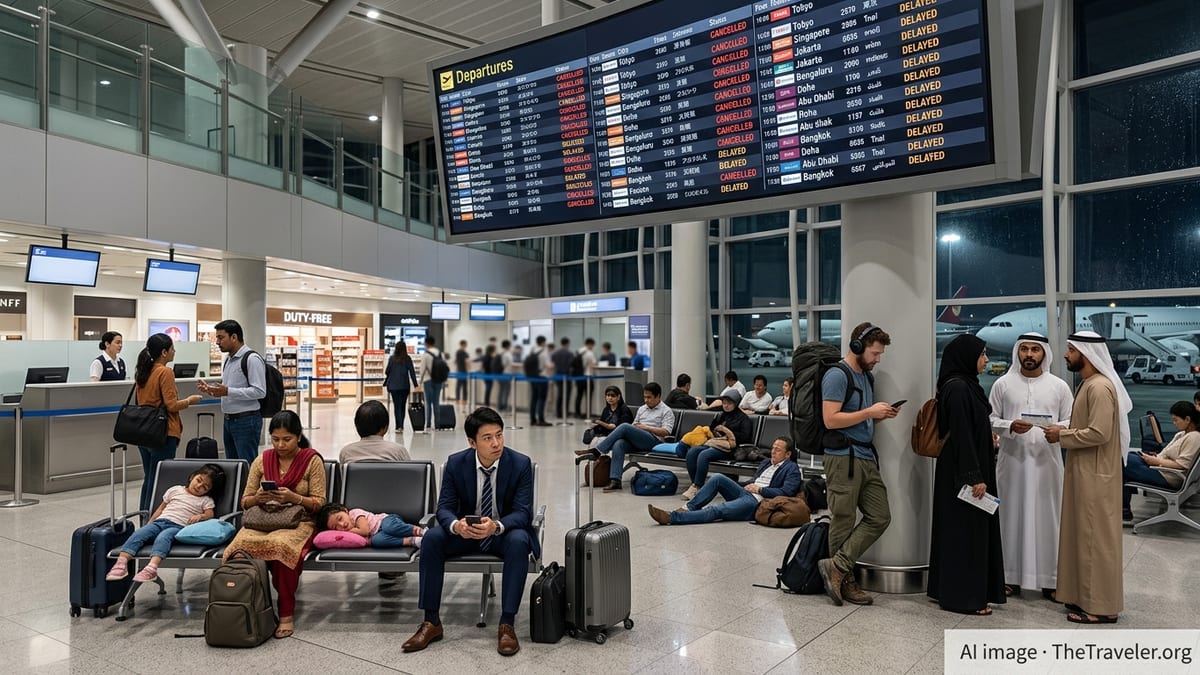
Thousands of travelers across Asia have been left sleeping in terminals, queuing for rebookings and scrambling for scarce hotel rooms as a fresh wave of flight disruptions ripples through some of the region’s busiest airports.
Get the latest news straight to your inbox!
Major hubs grapple with cascading delays and cancellations
Recent operational data and published coverage indicate that airports in cities including Kuala Lumpur, Jakarta, Tokyo, Bangkok, Shanghai and Guangzhou have faced repeated waves of delays and cancellations this season, leaving large numbers of passengers unable to reach their destinations. Industry trackers and aviation news sites describe a pattern in which relatively small incidents or schedule changes quickly cascade across tightly packed timetables, overwhelming hub airports that were already operating near capacity.
At Kuala Lumpur International Airport, a runway closure after a Singapore Airlines jet suffered deflated landing gear tyres on June 13 triggered several hours of disruption, with aircraft forced into holding patterns or diverted to other airports. Separate monitoring by airline-focused services shows that Kuala Lumpur has also seen some of the highest numbers of delayed departures in the region during recent disruption spikes, particularly for low cost and regional carriers.
In North Asia, Tokyo’s Haneda and Narita airports have repeatedly appeared on disruption trackers in recent weeks, especially on days when weather, traffic management restrictions and rerouted long haul flights converge. Reports compiled by passenger rights organisations describe thousands of travelers at these hubs facing missed connections, overnight stays in terminals and extended waits for baggage as ground operations struggle to keep pace.
China’s major international gateways, including Shanghai Pudong and Guangzhou Baiyun, have also experienced heavy disruption days, with several thousand delays recorded across Asia in a single 24 hour period during May according to passenger compensation platforms. Airlines serving these airports have urged travelers to rely on mobile apps and online tools, rather than airport display boards alone, to keep track of last minute changes.
Geopolitics and airspace closures ripple into Asian schedules
Beyond local operational issues, route planners across Asia have been forced to react to airspace closures and restrictions linked to conflict in the Middle East. Industry analyses from early 2026 show that temporary bans on overflights and re-routings around parts of the region resulted in more than a thousand Asia related cancellations and well over a thousand further delays in a matter of days, as carriers rebuilt their long haul schedules.
These changes have extended flight times, complicated crew rostering and increased fuel consumption on key Asia Europe and Asia Middle East corridors. Trade groups for Asia Pacific airlines report that jet fuel price volatility and the need for longer routings have added financial and operational pressure, reducing the margin for error when other disruptions, such as storms or technical incidents, occur.
Some Asian carriers have responded by trimming frequencies, consolidating flights or temporarily suspending certain routes, according to travel industry publications. While these adjustments are intended to stabilise operations, they have also reduced the number of available seats on popular city pairs, meaning that when a flight is cancelled there are fewer immediate alternatives for stranded passengers.
Aviation analysts note that these geopolitical and economic factors are colliding with strong demand, as passenger numbers continue to recover and in some markets exceed pre pandemic levels. The result is a regional network that appears more vulnerable to sudden shocks, with limited spare capacity to absorb them.
Weather, infrastructure and tight turnarounds compound the chaos
Seasonal weather is adding another layer of complexity. Early summer storms and typhoons affecting parts of East and Southeast Asia have already prompted full day shutdowns at certain airports and widespread schedule changes at others. In some cases, rail and road networks have come under stress at the same time, complicating efforts by stranded travelers to reach alternate airports or return home.
Infrastructure constraints at several major hubs are magnifying these weather related disruptions. Airports that regularly operate at or near their declared capacity have less flexibility to reassign gates, reorder takeoff slots or accommodate unexpected diversions. According to operational summaries published by aviation consultancies, even a brief runway or taxiway restriction at a large hub can produce knock on effects lasting well into the next day’s schedule.
Airline planners have also been criticized by some travel advocates for relying on very tight aircraft turnarounds and dense banked connecting waves at hub airports across Asia. When an inbound flight arrives late, these compact schedules leave little room to recover, often resulting in missed connections, aircraft out of position and additional cancellations down the line.
Passenger forums and consumer groups highlight that these structural issues are not confined to one carrier or one country, but reflect wider industry practices across the region. As a result, travelers may experience similar disruption patterns whether flying with full service airlines or low cost operators when conditions deteriorate.
Passengers face long queues, limited support and changing rights
For travelers caught in the middle of these disruptions, the practical impacts are immediate and often stressful. Images and descriptions shared across social platforms, as well as accounts compiled by travel clubs and rights organisations, show crowded departure halls with passengers queueing for hours at check in counters and airline service desks, hoping for rebooking options or hotel vouchers.
Consumer guidance published by passenger advocacy groups notes that entitlements vary significantly depending on the country of departure, airline policies and whether disruption is caused by weather, airspace restrictions or airline controllable factors such as crew planning. While some carriers in Asia provide meal vouchers, accommodation and ground transport during extended delays, others offer more limited assistance, focusing on rebooking and refunds.
Industry commentators point out that unlike in parts of Europe, many Asian jurisdictions do not have unified, binding compensation frameworks for delays and cancellations. Travelers departing from airports covered by European Union rules or similar regimes in other regions may have additional rights, but those protections often do not apply to purely intra Asian itineraries.
Travel experts therefore encourage passengers to review fare rules, travel insurance coverage and airline policies before departure, especially during periods of known instability. They also stress the importance of keeping receipts for out of pocket expenses such as meals, hotels and alternative transport, as some of these costs can later be claimed back under airline goodwill policies or insurance terms.
Carriers adjust schedules as peak summer approaches
With the Northern Hemisphere summer holiday period approaching, airlines and airports across Asia are making further adjustments in an effort to stabilise operations. Published timetables and route announcements for June and July show selected capacity increases on certain trunk routes, as well as targeted reductions on others where demand or operational risk is harder to manage.
Regional airline associations report that member carriers are seeking to build more resilience into schedules by revising block times, adding reserve aircraft or crew where possible and improving data sharing with air navigation providers. Some airports are also expanding use of slot coordination tools and collaborative decision making platforms, which are intended to help airlines and ground handlers respond more quickly when disruption begins.
Nevertheless, analysts caution that the combination of high demand, sensitive geopolitics and weather driven risks means further disruption days across Asia are likely through the summer. Passengers are being advised by travel organisations to check flight status frequently in the 24 hours before departure, allow extra time for connections and consider flexible booking options where possible.
For now, the scenes of stranded travelers and departure boards filled with delays across Asian hubs underline how interconnected and fragile the global air transport system remains, even as airlines work to rebuild networks and restore confidence in the reliability of long distance travel.