


More news on this day
Thousands of passengers across Asia faced major disruption today as aviation data showed 434 flights cancelled and 2,886 delayed in Thailand, Singapore, Japan, Hong Kong, Malaysia, China and Indonesia, snarling operations for major carriers and regional hubs from Beijing to Kuala Lumpur.
Get the latest news straight to your inbox!
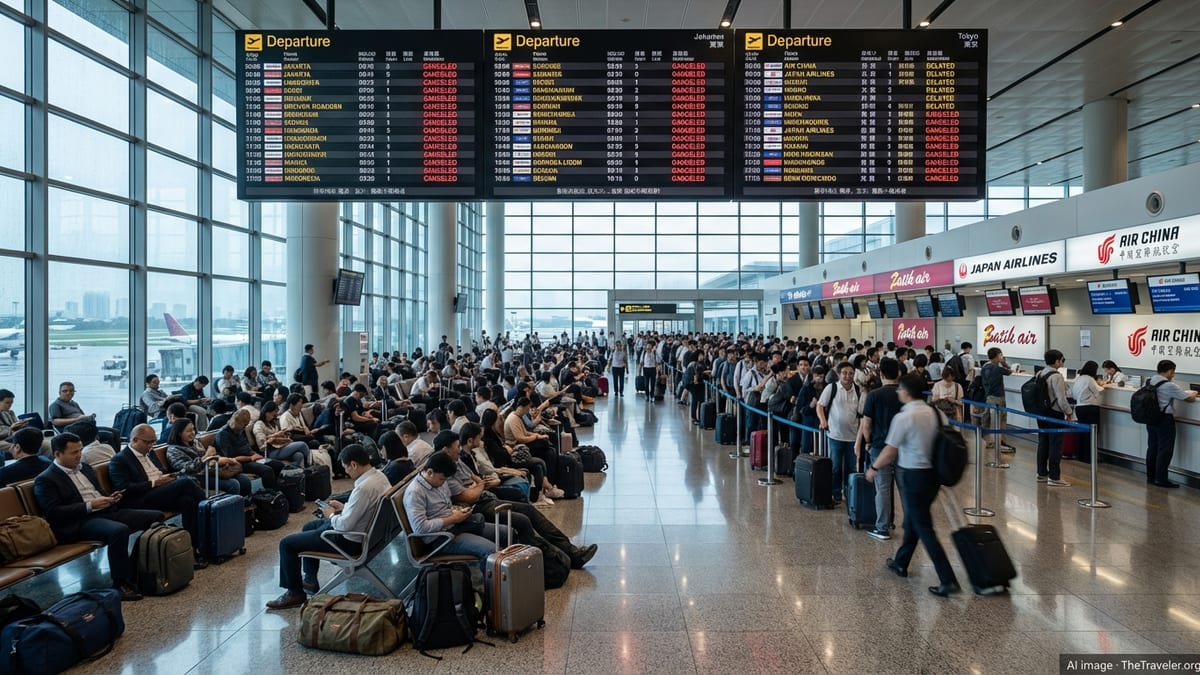
Disruptions Spread Across Asia’s Busiest Hubs
Operational data compiled from regional tracking platforms and industry coverage indicates that the latest wave of cancellations and delays is concentrated at some of Asia’s largest international gateways, including Beijing Capital, Tokyo Haneda and Narita, Bangkok Suvarnabhumi, Kuala Lumpur International, Hong Kong International, and Singapore Changi. These airports function as core transfer points, meaning local disruptions are quickly transmitted across wider regional and long haul networks.
Within today’s tally of 434 cancellations and 2,886 delays, China and Japan account for a substantial share of the affected flights, reflecting both their large domestic networks and heavy international traffic. Published snapshots of recent operating days in the region show similar patterns, with China’s major hubs and Tokyo’s airports frequently appearing among the top locations for irregular operations.
Thailand, Malaysia and Indonesia are also prominent in today’s disruption figures, with Bangkok, Kuala Lumpur and Jakarta acting as key nodes for Southeast Asian traffic. Aviation trackers in recent weeks have repeatedly highlighted pressure on these airports as schedules ramp up faster than staffing, aircraft availability and airspace capacity in some corridors.
In Hong Kong and Singapore, regional connectivity and reliance on tight transfer windows amplify the effect of even modest schedule changes. A delayed arrival into Changi or Hong Kong International can easily cascade into missed onward connections to Japan, Australia or Europe, compounding the impact of each individual delayed or cancelled sector.
Major Airlines Feel the Strain
The latest figures show disruption affecting a wide range of airlines, from full service flag carriers to low cost operators. According to publicly available operational summaries and recent industry coverage, Cathay Pacific, Japan Airlines, ANA, Air China and Bangkok based carriers are among those encountering notable schedule adjustments across today’s network.
Data from recent reporting windows in April and early May already pointed to repeated days of elevated cancellations and delays hitting Cathay Pacific and its Hong Kong hub, as well as Chinese state owned airlines operating dense domestic and regional networks. When today’s 434 cancellations are layered on top of that backdrop, it reinforces the impression of a system operating with little spare resilience.
Japanese carriers, including ANA and Japan Airlines, have been particularly sensitive to knock on effects created by disruptions elsewhere in Asia. Reports from earlier periods this season described situations where inbound delays from Southeast Asia forced tight turnarounds in Tokyo, leading to pushed back departures on onward flights to North America and Europe. Similar dynamics are likely at play today as irregular operations ripple through their schedules.
In Southeast Asia, regional airlines based in Bangkok and Kuala Lumpur are again facing pressure. Previous analyses of Asia wide disruption this year have highlighted how low cost and hybrid carriers can be exposed when aircraft rotations are tightly scheduled, leaving little margin to absorb delays without triggering cancellations later in the day.
Underlying Causes: Capacity, Weather and Network Complexity
Today’s figures for Asia fit into a broader pattern seen across the past several months, in which relatively modest triggers have produced outsized operational impacts. Industry reports point to a mix of factors, including localized weather issues, lingering staffing constraints in air traffic management and ground handling, and airspace bottlenecks linked to geopolitical tensions in neighboring regions.
Analysts tracking on time performance across Asia have repeatedly noted that many carriers are running schedules close to pre pandemic levels while still rebuilding crews and maintenance capacity. When combined with increasingly crowded flight paths in and out of key hubs, the result is an environment where even short lived storms, temporary airspace reroutes or technical issues can cascade into hundreds of delays by day’s end.
The sheer complexity of the region’s network is also a major contributor. Connections between secondary cities and primary hubs often rely on single daily flights that feed into tightly banked waves of departures. When a feeder flight from, for example, a secondary city in Indonesia or China is cancelled, passengers can miss onward long haul services from Kuala Lumpur, Bangkok, Hong Kong or Beijing, increasing rebooking pressure on already full flights.
Recent published tallies of Asia wide disruption have shown that days with several hundred cancellations and several thousand delays are no longer isolated anomalies. Instead, they appear as recurring stress points in a system where growth in demand is outpacing the pace of structural improvements to infrastructure and staffing.
Passenger Impact and Rebooking Challenges
For travelers, today’s disruption translates into missed connections, last minute hotel stays near airports and extended queues at service desks throughout the region. Travel community accounts from similar recent events describe passengers waiting hours for rebooking options, especially when flights involve multiple carriers or complex itineraries across several countries.
In hubs such as Bangkok, Singapore and Hong Kong, the combination of domestic, regional and long haul traffic means that a single cancellation can affect not only origin and destination passengers but also those using the city purely as a transfer point. When aircraft arrive late from one part of Asia and depart late to another, the delay multiplier can be significant.
Publicly available guidance from airlines and regulators in the region generally encourages passengers to monitor flight status closely, allow extra time for connections and use digital tools or mobile applications for rebooking where possible. However, when large numbers of flights are affected on the same day, available alternative seats can quickly become scarce, especially on popular routes linking Asia with Europe and North America.
Travel data from previous weeks also suggests that some passengers are opting to pad itineraries with longer layovers or to route through less congested hubs when possible, trading time for a higher probability of making onward connections during periods of instability.
What Today’s Numbers Signal for Asia’s Aviation Outlook
While the 434 cancellations and 2,886 delays recorded today are striking, they align with a trend of heightened operational volatility that has emerged across Asia since late last year. Aviation analysts observing the region’s recovery have repeatedly warned that infrastructure and staffing enhancements are lagging behind the rapid return of passenger demand.
Recent days have seen multiple reporting snapshots with broadly similar disruption levels, including earlier episodes where more than 4,000 flights in Asia and nearby Gulf hubs were delayed or cancelled within a single 24 hour period. Those patterns suggest that the region’s air transport system remains vulnerable to any new shocks, whether from weather, technical faults or geopolitical events affecting airspace availability.
For airlines, the continuing cycle of irregular operations increases costs and undermines schedule reliability at a time when competition for returning travelers is intense. For passengers, it reinforces the importance of flexible planning, travel insurance coverage and a clear understanding of carrier policies on rebooking and compensation in the event of cancellations or long delays.
As Asia’s aviation market heads into upcoming peak travel periods, today’s disruption metrics serve as another signal that the region’s post pandemic recovery is still in a fragile phase, with reliability gains yet to fully catch up with the resurgence in demand.