


More news on this day
Air travel across Asia and parts of the Middle East faced renewed disruption on 18 June 2026, as a wave of 286 flight cancellations and more than 7,000 delays affected major hubs including Tokyo, Kuala Lumpur, Moscow, Doha and Istanbul, impacting carriers such as Air China, Akasa Air, AirAsia, Batik Air, Saudia and others.
Get the latest news straight to your inbox!
Multiple Hubs See Knock-on Schedule Disruptions
According to operational data from airport boards and flight-tracking platforms, the latest disruption involves a mix of full cancellations and rolling delays that together amount to a significant slowdown of traffic on key Asian and Eurasian corridors. The pattern is most visible at major connecting hubs, where small schedule changes quickly cascade across networks serving China, Southeast Asia, the Gulf and Europe.
Tokyo’s airports, Kuala Lumpur International, Moscow’s main gateways, Doha’s Hamad International and Istanbul’s primary hub all reported elevated levels of late departures and arrivals on 18 June. The affected services range from regional routes to long haul sectors, complicating both point to point travel and through-ticketed connections. Publicly available flight-status boards indicate that the combination of cancellations and delays has pushed average departure times back by well over an hour on some trunk routes.
The disruption is not limited to one carrier or alliance. Instead, it reflects a broader strain on airline and airport systems that were already operating close to capacity, with lean staffing and tight turnaround times. As a result, any local weather issue, crew rotation constraint or aircraft availability problem is more likely to spill into wider network disruption.
Regional aviation analysts have been warning for several weeks that rising fuel costs, jet fuel supply constraints and geopolitical tensions are leaving Asian and Middle Eastern airlines with less flexibility in their schedules. Recent industry publications describe a steady increase in planned flight cuts and day-of-operation cancellations by carriers in China, Malaysia and the wider region, even before this latest spike in disruption.
Carriers From China, India, Southeast Asia And The Gulf Affected
Air China is among the carriers whose operations through Northeast Asia have come under pressure. Flight-status services on 18 June showed the airline adjusting timings on routes linking Beijing with key Japanese airports, while passengers on some itineraries involving Beijing connections have recently reported short-notice cancellations or reroutings affecting travel to and from Tokyo and other Asian cities.
India’s Akasa Air, which focuses largely on domestic and regional services, has been scaling back some frequencies from secondary Indian cities, a trend that aviation forums and local media link to fleet and cost pressures. While many of those cuts were pre-planned for July and August, they leave the carrier with less redundancy when day-of-operation issues arise, reducing options for reaccommodating travelers when irregular operations occur.
Low-cost giant AirAsia and Malaysia-based Batik Air continue to play a central role at Kuala Lumpur, one of the hubs experiencing above-normal disruption. Recent schedule information shows Malaysian carriers trimming or reshaping some Southeast Asian routes in response to higher fuel prices and shifting demand, including reductions on select Indonesia and Indochina sectors. When irregular operations spike on a given day, these leaner schedules can make it harder to rebook passengers at short notice.
In the Middle East, Gulf and Saudi carriers including Saudia and Qatar Airways are also exposed to ripple effects when Asian and European legs run late. Industry traffic monitors note that both airlines have increased their use of tight connection windows at hubs such as Jeddah, Riyadh and Doha to maximize aircraft utilization. On days with large numbers of arrival delays, even a modest number of missed connections can lead to additional onward cancellations or rolling delays.
Travelers Face Missed Connections, Reroutes And Long Ground Holds
For passengers, the most visible impact of 18 June’s disruption has been missed connections and extended ground holds at busy hubs. Reports circulating on consumer travel forums describe itineraries where one segment, such as a Kuala Lumpur connection on a low-cost carrier, is delayed enough to jeopardize a separately booked onward leg on another airline, leaving travelers to shoulder rebooking costs themselves.
Travelers on through-tickets, especially those connecting via Beijing, Doha or Istanbul on full-service carriers, are encountering a different set of problems. In these cases, the operating airline typically assumes responsibility for rerouting, but limited remaining capacity on popular routes can mean long layovers or rebookings one or two days later. Public accounts of recent Air China itineraries, for example, mention single legs being cancelled within complex multi-city journeys, forcing complete reticketing to preserve minimum connection times.
At low-cost hubs such as Kuala Lumpur and Bangkok, flexible, point-to-point ticketing has historically helped travelers find alternatives quickly. However, with several budget airlines consolidating routes and reducing off-peak frequencies in recent months, same-day rebooking options are narrowing. This is especially acute on niche city pairs where one carrier, such as AirAsia or Batik Air, operates the only nonstop service, leaving stranded passengers facing long detours via other hubs.
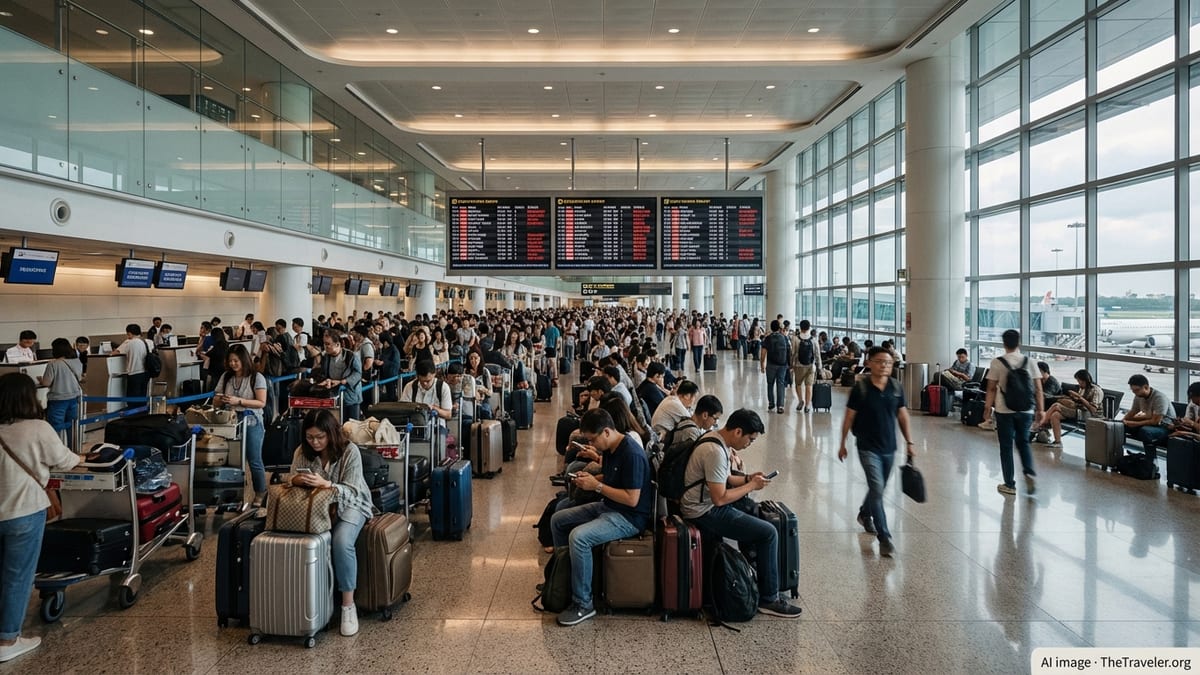
Airports themselves are also feeling the strain. When early-morning departures run late, they often conflict with the midday arrival waves of long haul services, producing temporary congestion at gates, taxiways and immigration queues. Passenger photographs and descriptions from Tokyo, Kuala Lumpur and Istanbul over recent weeks have highlighted overcrowded departure halls and longer waits at security and border control during peak disruption periods.
Structural Pressures Behind The Spike In Cancellations
Aviation industry reports issued in May and June have pointed to several structural factors driving higher cancellation and delay rates across Asia. Chief among them are elevated jet fuel prices, which are encouraging airlines to trim marginal routes and operate with tighter schedules, as well as ongoing crew shortages in some markets. Airlines that expanded rapidly during the post pandemic recovery are now moderating growth, and some are paring back less profitable rotations that previously served as a buffer during irregular operations.
Another factor is the heightened geopolitical tension in parts of West Asia and Eastern Europe, which has forced airlines to adopt longer routings and more conservative contingency planning on flights that previously used shorter corridors. These adjustments can reduce operational slack across the network. When aircraft spend more time in the air or make additional technical stops, they are more vulnerable to arriving late into busy hubs such as Doha or Istanbul, where tight turnarounds are essential to maintaining banked connection schedules.
Industry data from civil aviation bodies and trade publications suggests that mainland Chinese, Japanese and Turkish airlines are among those recording increased day-of-operation cancellations compared with a year ago. The trend is especially pronounced on routes that depend heavily on connecting traffic, such as services linking secondary cities in China and Southeast Asia with European destinations via Istanbul or Gulf hubs.
Regional observers also note that some airlines still lack extensive fuel-hedging or robust redundancy in aircraft and crews. When unexpected maintenance issues or weather events arise, carriers with thin reserves are more likely to cancel flights outright rather than incur additional costs to reposition aircraft or crews. This cost-driven decision making, while rational from an airline perspective, can amplify the impact on passengers when disruptions hit several hubs at once.
What Passengers Can Do As Summer Peak Approaches
With the northern summer travel peak approaching, passenger advocates and travel planners are advising flyers to treat elevated cancellation and delay rates as a persistent risk rather than a one-off event. Public guidance from consumer groups and experienced travelers emphasizes building longer connection buffers, especially on itineraries that mix full-service and low-cost airlines or involve self-connecting between separate tickets at major hubs.
Travel planning resources also recommend monitoring flight status closely in the days leading up to departure, as many airlines are now making schedule adjustments one to two weeks in advance where possible. Identifying alternative routings early, particularly on routes dominated by a single carrier such as AirAsia or Batik Air out of Kuala Lumpur, can improve the chances of securing a workable alternative if a planned flight is cancelled.
For those already en route when disruption hits, publicly available passenger rights information can help clarify what assistance may be available. Entitlements vary widely between jurisdictions, but some regulatory regimes in Europe and parts of Asia require airlines to offer either rebooking or refunds in the event of cancellation, and in some cases compensation or care during extended delays. Knowing which rules apply to each segment of an itinerary can make it easier to negotiate with carriers at crowded service desks or via call centers.
While there is little indication that the broader pressures behind the 18 June disruption will ease immediately, airlines and airports across Asia and the Middle East are likely to refine schedules and staffing as the summer season progresses. For now, though, the combination of hundreds of cancellations and thousands of delays at key hubs from Tokyo to Istanbul underlines how finely balanced the region’s air travel system has become, and how quickly it can be tipped off schedule.