


More news on this day
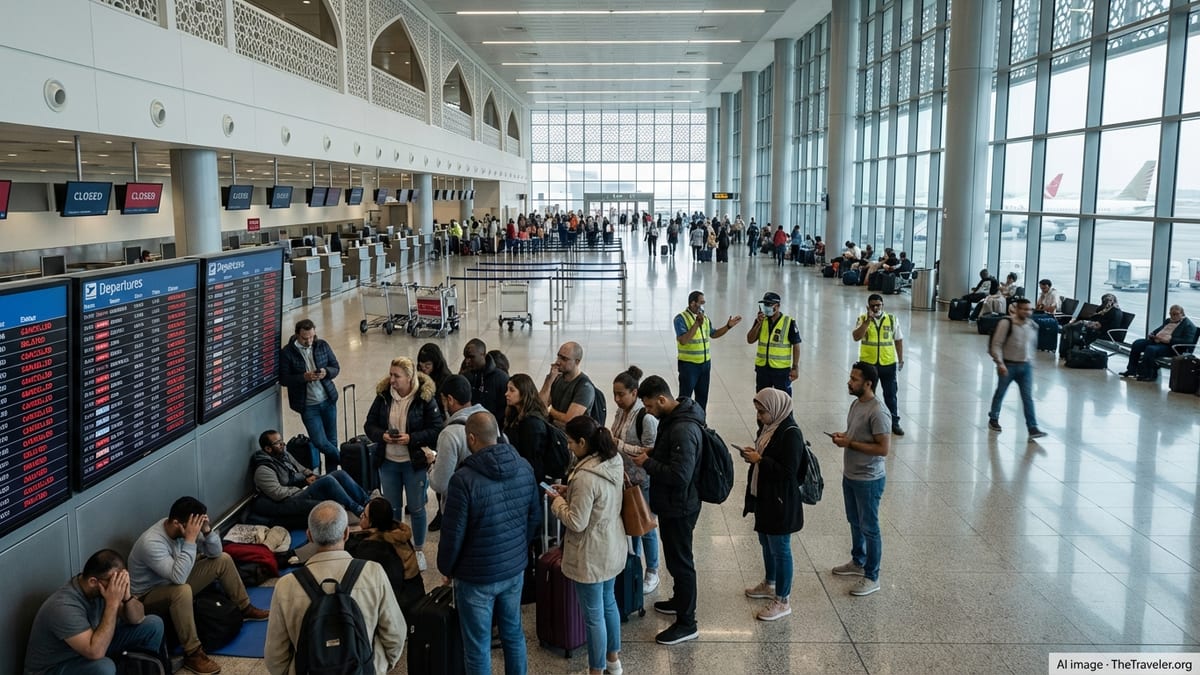
Fresh disruption has hit Gulf air travel as problems affecting ground services in Bahrain led to the cancellation of more than a dozen flights by Flydubai, Gulf Air, Emirates and Air Arabia, narrowing already fragile links between Manama and neighboring hubs such as Dubai, Sharjah and Kuwait City.
Get the latest news straight to your inbox!
New Strain on a Region Already Hit by Airspace Closures
The latest cancellations in Bahrain come against the backdrop of months of regional turbulence in Middle East airspace that has forced intermittent shutdowns, diversions and trimmed schedules across major hubs. Publicly available aviation data and recent industry analysis show that carriers serving Bahrain, the United Arab Emirates and Kuwait have been operating with reduced flexibility after a series of security-related closures and capacity limits in early 2026.
Reports indicate that the Bahrain disruption is focused on ground handling and associated airport services, creating bottlenecks that prevent aircraft from being turned around on time, even when overflight corridors are available. That has left airlines with the choice of cancelling rotations or risking knock-on delays across their networks, with carriers now leaning toward pre-emptive cancellations to keep wider schedules stable.
Travel industry coverage suggests that the episode underscores how vulnerable regional hubs remain to localised operational issues when they are already running constrained schedules. With aircraft and crew redeployed to workaround previous airspace closures, there is limited spare capacity to absorb an additional shock such as a ground services slowdown at Bahrain International Airport.
While precise figures vary by day, compiled movement data and airline advisories reviewed by travel outlets point to over a dozen Bahrain-linked cancellations tied to the current disruption, with some services scrubbed outright and others replaced by less frequent rotations.
Routes to Dubai, Sharjah and Kuwait City Among Those Hit
Among the routes most visibly affected are short-haul links that normally knit together key Gulf gateways. Services between Manama and Dubai, Sharjah and Kuwait City have seen cancellations or schedule thinning as carriers adjust to the ground handling constraints in Bahrain.
Flight tracking snapshots referenced in regional media show Flydubai cutting selected rotations between Dubai International and Bahrain, while Air Arabia has pulled or retimed some Bahrain-related services linked to Sharjah. Gulf Air, whose primary hub is in Manama, has adjusted departures on multiple regional routes, including services feeding into Kuwait City and other nearby capitals, in an effort to match operations with available ground capacity.
Emirates, which had already been operating on a reduced pattern through parts of the spring due to wider Gulf airspace issues, has also logged Bahrain-related cancellations according to recent operations summaries. The result for travelers is a patchwork of service on what are normally high-frequency shuttle routes, with some daily options removed and remaining flights often heavily booked.
Published timetables and booking engines show that while many Bahrain services remain on sale, day-to-day availability is fluctuating. Analysts note that even small adjustments on short regional hops can have an outsized impact, because these flights feed long-haul connections across Europe, Asia and Africa.
Knock-on Impact for Connecting Passengers and Summer Plans
For passengers, the immediate effect is a rise in missed connections, extended layovers and last-minute rebookings. Bahrain serves as a critical transfer point for Gulf Air and a secondary connection node for Flydubai, Emirates and Air Arabia itineraries, so cancellations on feeder sectors can unravel multi-leg journeys to and from cities far beyond the Gulf.
Consumer forums and travel community discussions in recent weeks have highlighted cases where Bahrain-related cancellations forced travelers to reroute via alternative hubs such as Dammam, Doha or Muscat, sometimes at higher cost or with significant schedule changes. These individual accounts align with the patterns seen in operational data, where airlines appear to be consolidating traffic onto fewer, more reliable corridors.
The timing of the disruption is particularly sensitive as airlines and travelers look toward the late spring and summer peak. Industry commentary suggests that carriers had been cautiously rebuilding capacity into the Gulf following earlier airspace shutdowns, marketing restored frequencies to popular destinations including Dubai and Sharjah. The need to pare back some Bahrain-linked flying risks denting consumer confidence just as demand for leisure and family travel typically accelerates.
Travel planners warn that uncertainty around Bahrain operations may persist even if airspace conditions elsewhere in the region continue to stabilise. Until ground service reliability in Manama is fully restored, airlines are likely to keep additional buffers in their schedules, which can mean fewer departure choices and longer minimum connection times.
How Airlines Are Responding and What Travelers Can Do
According to airline notices and publicly available guidance, carriers affected by the Bahrain ground services issue are generally offering standard disruption options, including rebooking on alternative dates or routes and, in some cases, refunds for cancelled sectors. The specifics vary by airline and fare type, with some low-cost tickets subject to more restrictive rules.
Travel rights organizations and passenger advocacy platforms advise that those booked on Bahrain-linked itineraries should monitor their reservations closely through airline apps or booking portals, as day-of-departure changes remain possible. They also recommend building in additional time for connections, especially when a Bahrain leg links to a long-haul flight from Dubai, Sharjah or Kuwait City.
For travelers yet to book, specialist travel outlets suggest considering routings that either avoid tight connections in Manama or use alternative hubs that currently show more stable operations. However, analysts caution that the broader regional backdrop remains fluid, and no Gulf hub is entirely insulated from sudden changes while security-related airspace restrictions can still reappear.
Industry observers note that, from an airline perspective, temporarily trimming Bahrain rotations may be preferable to risking rolling delays that cascade across global networks. That approach can limit wider disruption but concentrates the impact on passengers whose flights are among those selected for cancellation.
Outlook for Bahrain as a Gulf Aviation Hub
Aviation analysts tracking the Gulf region say the Bahrain episode illustrates both the resilience and the fragility of hub-and-spoke systems centered on a small number of airports. In normal times, Bahrain’s role as the home base for Gulf Air and a connective point for regional carriers allows it to punch above its weight in terms of passenger flows relative to its size.
The combination of earlier airspace closures and the current ground services disruption, however, has tested that model. With airlines forced to continually recalibrate timetables, the predictability that frequent Gulf shuttle routes once offered has diminished, at least in the short term. This has implications not only for transit traffic but also for Bahrain’s ambitions in tourism and business travel, where reliable connectivity is a key selling point.
Still, recent operational updates suggest a gradual push toward normalisation, with aviation authorities and airport partners aiming to restore full ground handling capacity and support airlines in rebuilding schedules. Once a stable baseline is re-established, carriers such as Flydubai, Gulf Air, Emirates and Air Arabia are expected to reassess demand and potentially reintroduce some of the frequencies removed during the current disruption.
For now, travelers with plans involving Bahrain, Dubai, Sharjah, Kuwait City or Manama are being urged by travel advisors to stay flexible, keep an eye on airline communications and be prepared to adjust itineraries at short notice as the Gulf’s aviation network continues to recover.