


More news on this day
Bahrain is moving in lockstep with regional and Western partners on emergency aviation safety measures, as a new round of US–Iran strikes prompts flight reroutes, heightened monitoring and fresh global alerts over Gulf airspace risk.
Get the latest news straight to your inbox!
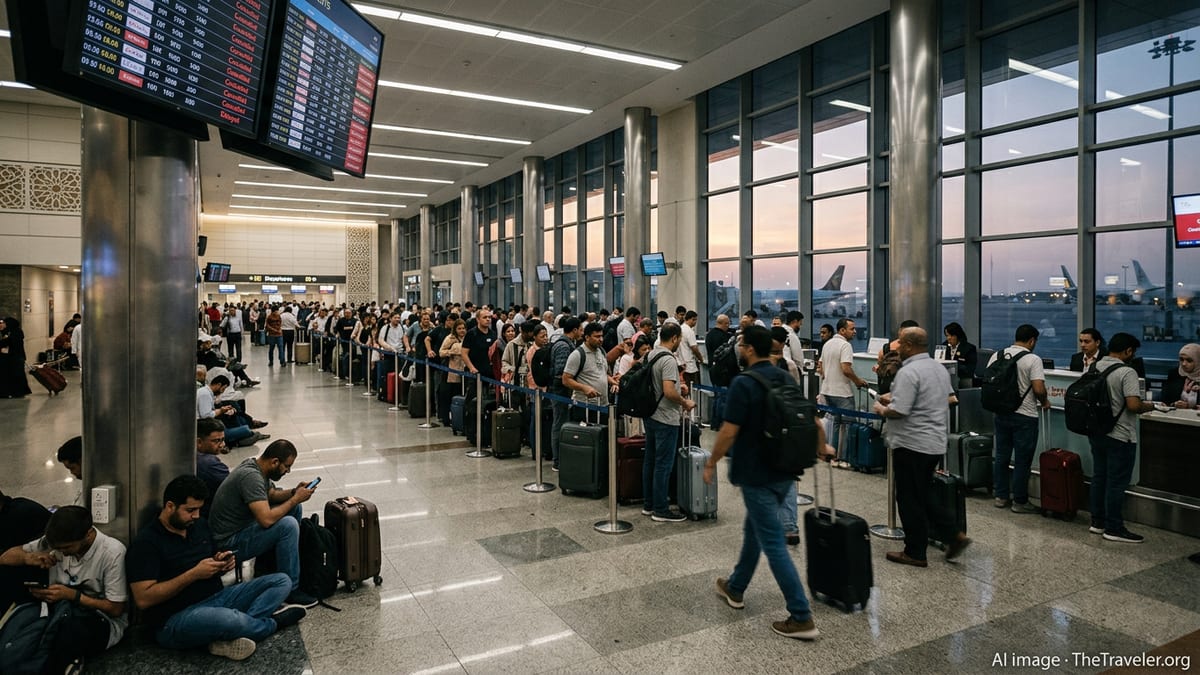
Escalating Strikes Turn Gulf Skies Into a High-Risk Zone
The latest exchange of fire between the United States and Iran has pushed Gulf aviation back into crisis mode. Since late February 2026, when joint US and Israeli operations against Iranian targets triggered extensive missile and drone retaliation, commercial routes across the central Middle East corridor have been repeatedly disrupted. Military activity and interception debris near major hubs in Bahrain, Kuwait and Qatar have created a fluid risk picture that airlines are reassessing on a daily basis.
Recent reports describe Iran launching salvos of missiles and armed drones toward US-aligned states hosting American forces, including Bahrain and Kuwait, after new US strikes on Iranian radar and coastal sites around the Strait of Hormuz. Air-defense engagements and explosions in proximity to airports and critical infrastructure have intensified concerns that miscalculation or stray projectiles could endanger civilian aircraft operating in congested airspace.
Regional analysis notes that Iran’s targeting pattern continues to focus on states that host US naval and air assets, such as the US 5th Fleet headquarters in Bahrain and key air bases in Qatar and Kuwait. While many incoming projectiles are intercepted before impact, the potential for shrapnel, falling debris and electronic interference around flight paths has led to recurring suspensions, diversions and precautionary closures at several Gulf gateways this year.
For airlines and passengers, the result is a patchwork of delays, reroutes and last-minute schedule changes. Carriers that once relied on direct, fuel-efficient tracks over the Gulf and Iran now face longer southern detours that add flight time and operational cost, while risk assessments must be updated each time military action flares.
Bahrain Steps Up Airspace Controls Alongside Gulf Neighbors
Against this backdrop, Bahrain is tightening its own airspace management in coordination with neighboring Gulf states. Publicly available information shows that the kingdom has already suspended or restricted air traffic at key moments during the current crisis, including precautionary pauses on arrivals and departures after Iranian-linked attacks on US and coalition targets in the region. At times, Bahrain International Airport has shifted to limited operations as traffic was rerouted to nearby Saudi airports.
Security briefings tracking the conflict describe how Bahrain, Kuwait, Qatar and Saudi Arabia have progressively synchronized defensive postures since the initial Iranian barrages in late February. This has included activation of air-defense systems, public alert messaging and close coordination between civil aviation authorities and military actors to segregate traffic and avoid conflict areas when interceptions are underway.
According to recent risk advisories for operators, Bahrain is now grouped with other Gulf states in a category where “extreme caution” is advised for civil overflights. Guidance circulated to airlines encourages robust, route-specific risk assessments before planning any transit in the Bahrain flight information region, particularly during periods of active military operations or when new missile launches are reported across the Gulf.
For Bahrain, which hosts the US 5th Fleet and sits just across the water from Iran’s coastline, the challenge is acute. The island’s small geographic footprint and proximity to military targets mean that even successful defensive interceptions can take place in close visual and acoustic range of commercial flight paths, requiring rapid adjustments by air-traffic controllers and airlines alike.
Western Partners Issue Stronger Warnings and Routing Guidance
While Gulf governments manage the immediate tactical response, Western aviation and security agencies are tightening their own advisories. Updated safety bulletins from European regulators describe a clear shift in recommended routing since the outbreak of the 2026 Iran war. Operators are being strongly discouraged from entering Iranian, Iraqi and Lebanese airspace, with specific calls to exercise caution when overflying Bahrain, Qatar, Kuwait, Saudi Arabia, the UAE, Oman, Jordan and Israel.
Recent notices from European and North American authorities outline scenarios in which airlines should avoid or limit exposure to the central Gulf corridor, especially during active missile or drone campaigns. These advisories generally cite risks from surface-to-surface and surface-to-air weapons, electronic warfare activity and the potential misidentification of civilian aircraft in a dense, militarized environment.
France, the United Kingdom and the United States have also updated their travel and security guidance for citizens in Bahrain, Qatar and Kuwait since the start of hostilities in late February. Publicly available travel notices reference the presence of US bases, the likelihood of further Iranian retaliation and the possibility of sudden airport closures or flight suspensions. Although these documents primarily target individual travelers, they also underscore that aviation and logistics links could be disrupted at short notice.
The outcome is that many global carriers now consult a growing stack of overlapping state advisories, insurance conditions and internal security assessments before assigning aircraft to Gulf routes. For some, the combination of official warnings and sustained military activity is sufficient reason to suspend overflights entirely, at least for widebody passenger operations.
Reroutes, Detours and the Rise of the Southern Bypass
With Iran, Iraq and adjacent high-risk sectors effectively off-limits to many airlines, a new geography of long-haul travel between Europe, Asia and Africa is taking shape. Aviation risk monitors describe Oman and more southerly corridors over the Arabian Sea as the preferred alternative, allowing carriers to bypass the most contested parts of the Gulf while still maintaining commercially viable routings.
This shift, which intensified after the coordinated US–Israeli strikes on Iran in late February, has turned Muscat and other regional waypoints into critical nodes for east–west traffic. Several operators have quietly refiled flight plans to hug the southern edge of the Arabian Peninsula, accepting additional fuel burn and flight time as the price of distance from active missile trajectories and air-defense activity.
For Bahrain and its neighbors, this rerouting trend carries economic and strategic implications. Airports that once thrived as transit hubs for ultra-short Gulf crossings and efficient long-haul connections may see some transfer traffic diverted south or north, particularly if risk premiums and war-risk insurance surcharges rise. At the same time, the ability of Gulf states to maintain safe, predictable corridors in their own airspace will be a key factor in how quickly airlines are willing to return to pre-crisis patterns.
Operationally, the reroutes demand tighter fuel planning, more complex contingency procedures and constant monitoring of developing threats. Dispatch teams must factor in the risk that a previously safe airway could be downgraded overnight following new strikes, forcing last-minute diversions that ripple through network schedules.
Global Aviation on Alert as Conflict Outlook Remains Uncertain
The broader aviation community is treating the Gulf as a dynamic conflict zone whose risk profile can change within hours. Specialized bulletins and security briefings circulated to airlines in March and April highlighted a cycle in which temporary lulls in missile and drone activity are followed by new flare-ups linked to developments in the US–Iran confrontation. Even after short-lived ceasefires or pauses, operators are urged to assume that further exchanges are possible and to plan accordingly.
Experts tracking the conflict note that the combination of advanced long-range weapons, dense civilian air traffic and overlapping military operations creates a complex environment where standard deconfliction mechanisms are under stress. The presence of multiple foreign militaries and coalition forces, coupled with the strategic importance of the Strait of Hormuz for global energy flows, means that missteps in airspace management could have consequences far beyond the immediate region.
For travelers, the practical impact is likely to be visible in longer routings, increased use of indirect connections and a greater incidence of schedule changes or cancellations on short notice. While major Gulf carriers have long experience navigating regional security crises, the intensity and geographic spread of the current confrontation have few recent parallels, prompting more conservative planning assumptions across the industry.
As Bahrain aligns its policies with those of the US, UK, Qatar, Saudi Arabia, Kuwait, France and other partners, the emphasis remains on preventing commercial aviation from being caught in the crossfire. How effectively these coordinated measures can insulate civilian flights from a volatile military landscape will be a central question for airlines and passengers as the 2026 Iran war enters its next phase.