


Bali, Thailand and Vietnam all promise warm seas, palm trees and street food, but the price you pay for two weeks on the road can be very different. With prices in Southeast Asia shifting since borders fully reopened, it is worth looking at current 2026 costs rather than relying on pre pandemic lore. This guide compares a realistic two week trip for a couple in each destination, breaking down sample routes, accommodation, food, transport and activities so you can see where your money goes in the real world.
Get the latest updates straight to your inbox!
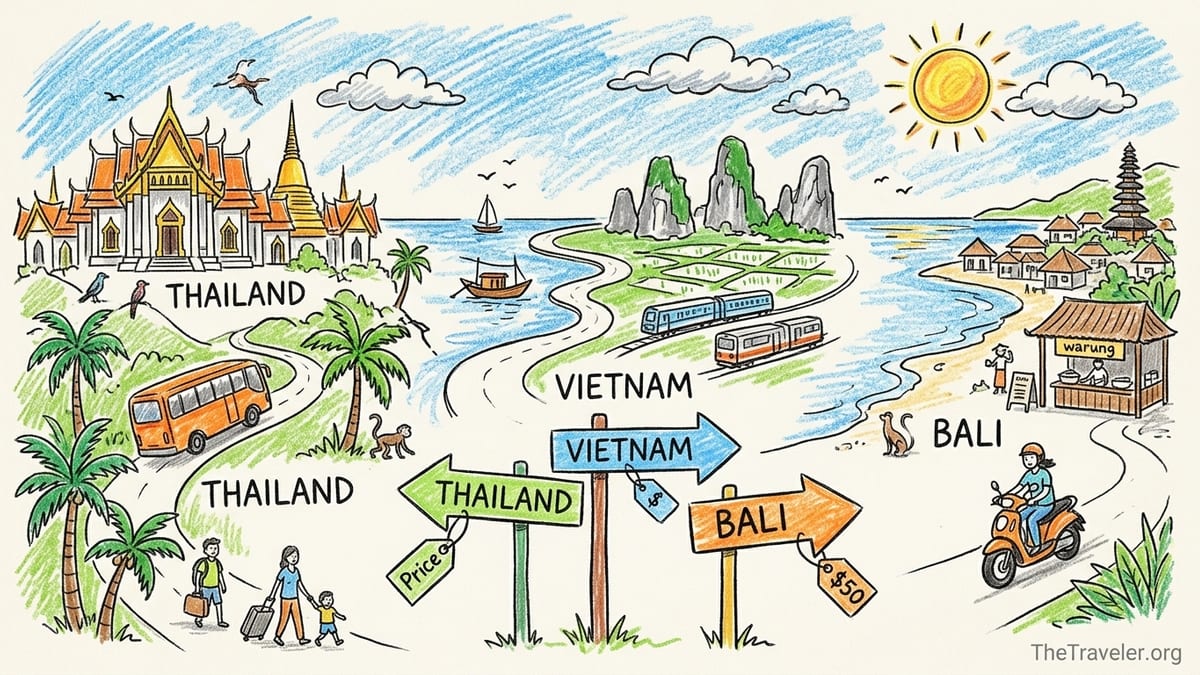
How Overall Costs Compare in 2026
For a mid range couple in 2026, Thailand usually comes out slightly more expensive per day than Vietnam, while Bali often sits in the middle once you factor in higher room rates but cheaper local food and scooters. Recent cost breakdowns for independent travellers put backpacker style budgets in Vietnam around 30 to 50 US dollars per person per day and mid range at roughly 80 to 150 US dollars. Similar style trips in Thailand now often sit a little higher on average, once you add internal flights to reach the islands or northern hills. Bali daily costs depend heavily on where you stay on the island, but accommodation and car hire push totals closer to Thai levels, while day to day eating and local transport can still feel cheaper than a big Thai beach town.
Across all three destinations, the biggest single variable is where you sleep. In 2026, hostel dorm beds and simple guesthouses in Vietnam and Thailand can still be found for the equivalent of about 8 to 20 US dollars a night in many towns, and budget double rooms around 20 to 35 US dollars. On Bali, beach areas like Canggu and Seminyak see basic doubles from about 30 to 50 US dollars and upwards, while inland towns such as Ubud still offer a spread of homestays under that. If you prefer private, air conditioned rooms in central locations with breakfast, expect Vietnam to come out cheapest overall, Thailand slightly higher, and Bali somewhere between them depending on season and area.
Transport is the second big divider. Vietnam is deceptively long, and a north to south itinerary for two weeks will add a couple of domestic flights or overnight trains. Thailand often requires at least one internal flight or long bus to link Bangkok, the north and the islands. Bali is compact enough that most trips rely on airport transfers, day drivers and taxi style apps, which can keep transport costs reasonable even though per kilometre prices are not as low as in Vietnam. When all of that is totalled for a two week holiday for two people, Vietnam usually works out as the lowest cost for a similar standard of travel, with Thailand and Bali both higher in slightly different ways.
Sample Two Week Route: Bali on a Mid Range Budget
A realistic two week mid range route for a couple on Bali could start with four nights in Canggu for the beach and cafes, four nights in Ubud for rice terraces and temples, three nights in Amed for snorkelling and a quieter coast, and a final three nights back in Seminyak or Sanur to be closer to the airport. This keeps driving days manageable, avoids multiple boat transfers to far flung islands, and focuses on areas where the price to experience ratio is still favourable.
Room rates in late 2026 for a private ensuite room with air conditioning and pool access in Canggu or Seminyak often range from about 45 to 90 US dollars per night, depending on whether you pick a simple guesthouse on a side street or a boutique hotel near the beach. Ubud still has homestays with breakfast that start around 30 to 50 US dollars per night for a double, rising to well over 100 US dollars if you want an infinity pool over the rice fields. In quieter Amed, mid range seafront bungalows can still be found for roughly 35 to 70 US dollars. A couple staying mostly in mid range guesthouses and a few nicer nights in Ubud is likely to average somewhere around 60 to 80 US dollars per night across two weeks.
Food on Bali can still be inexpensive if you eat where locals do. A plate of nasi campur or mie goreng at a simple warung often costs the equivalent of 1.50 to 3 US dollars. In tourist zones, a main course in a sit down restaurant that caters to visitors usually runs to about 6 to 12 US dollars before drinks, with Western style brunch dishes in Canggu in the same range. A couple mixing local eateries, coffee shops and a few nicer dinners might spend around 35 to 60 US dollars a day on food and drink if they are moderate with alcohol. A local beer in a small bar often costs about 2.50 to 4 US dollars, with cocktails in beach clubs higher.
For transport, most visitors either rely on app based taxis and private drivers or rent a scooter. A Grab or similar app ride from Bali airport to Canggu in 2026 has commonly been quoted in the region of 185,000 to just over 200,000 Indonesian rupiah, roughly 12 to 15 US dollars, depending on time of day and demand, while some travellers report paying a little over 200,000 rupiah at the airport counter to reach the same area. Daily scooter hire can still be found from about 5 to 10 US dollars per day, plus petrol. A full day with a private driver between Canggu, Ubud and sights such as Tirta Empul or Tegalalang rice terrace often costs about 40 to 60 US dollars for the car, which is economical if you are a couple. Over two weeks, a realistic transport budget for Bali for two people, excluding flights into Indonesia, might sit around 250 to 400 US dollars depending on how often you move and whether you are comfortable on scooters.
Typical paid activities on this Bali route include entry to temples such as Tirta Empul, Uluwatu and Tanah Lot, each usually a few US dollars per person, a day pass at a nicer beach club for 10 to 30 US dollars per person including a food and drink credit, and one or two organized trips such as a snorkelling boat in Amed or Tulamben for roughly 20 to 40 US dollars per person including gear. A sunrise hike on Mount Batur with transport from Ubud often runs to about 35 to 60 US dollars per person depending on group size. For a couple, setting aside around 250 to 400 US dollars for entrance fees, classes and a handful of tours across two weeks is realistic for a varied but not packed schedule.
Sample Two Week Route: Thailand Linking City, North and Islands
A classic two week Thailand itinerary for a first visit couples together Bangkok, the northern hills and the southern islands. A typical route might be three nights in Bangkok, four nights in Chiang Mai, then travel south for four to five nights on an island such as Koh Samui, Koh Tao or Phuket, before returning to Bangkok for a final night near the airport. This gives a taste of urban markets, temples, night bazaars and the beach, but the trade off is more money spent on internal transport.
Daily cost estimates compiled in 2026 by specialist Thailand budget sites suggest that backpacker travellers spending nights in dorms and eating mostly street food can still get by on around 30 to 45 US dollars per person per day in many regions, while mid range couples who prefer private rooms and air conditioning often hover more in the 60 to 120 US dollars per person per day band, especially once beach destinations are included. For a couple, that can mean a broad daily budget of roughly 120 to 200 US dollars before international flights if you like central, comfortable rooms and a few paid activities.
Bangkok room rates for a clean double in a mid range hotel within walking distance of the Skytrain or old town often fall around 35 to 80 US dollars per night, depending on neighbourhood and pool access. In Chiang Mai, guesthouses in the Old City remain cheaper, with doubles frequently in the 25 to 60 US dollar range. On popular islands such as Phuket or Koh Samui, however, beachfront and pool hotels now often charge from around 60 to well over 150 US dollars per night for a mid range room. A couple mixing cheaper northern nights and more expensive beach stays can expect an average nightly room rate comparable to or slightly above Bali.
Food in Thailand remains one of the strong value points. Rough Guides and similar sources still find that travellers sticking to street food and simple eateries can eat well for roughly 20 to 30 British pounds per day as a backpacker, which has translated in recent conversions to somewhere around 25 to 35 US dollars per day for one person in 2026, including drinks outside nightlife areas. Pad Thai, fried rice or noodle soups from a street stall often cost the equivalent of 1.50 to 3 US dollars per plate. In sit down Thai restaurants in tourist areas, mains frequently reach 4 to 8 US dollars, rising to more in fashionable Bangkok neighbourhoods. Beer prices are an important detail in Thailand because nightlife can quickly inflate a budget: a large bottle of Chang or Leo at a 7 Eleven is usually about 60 to 70 Thai baht, under 3 US dollars, while the same beer in a bar on a main tourist street might be 100 to 150 baht, in the 3 to 5 US dollar range.
Transport is where Thailand can overtake Vietnam and Bali in cost for a two week loop that covers both the north and the islands. Budget tools that model trips such as Bangkok to Chiang Mai and then Bangkok to Phuket show that if you book domestic flights a few weeks in advance, one way tickets on low cost airlines can still often be found in the range of 25 to 50 US dollars per person, with prices rising closer to 60 to 120 US dollars if booked very late or at peak holidays. A pair of these flights for two people can easily run to 200 to 350 US dollars of the total budget. Overnight trains between Bangkok and Chiang Mai are slightly cheaper but still need advance bookings for the most popular sleeper classes. Local transport is otherwise affordable: city metro rides in Bangkok typically cost the equivalent of 50 US cents to 2 US dollars per journey, and shared songthaews in the north are a few US dollars for medium distances.
For activities, Thailand offers plenty of paid options across such a route. Entrance to Bangkok landmarks such as the Grand Palace for foreign visitors is in the region of 15 to 20 US dollars per person. In Chiang Mai, a group cooking class with a market visit can cost around 30 to 50 US dollars per person, and a full day ethical elephant sanctuary visit with transport may be about 60 to 100 US dollars each, often including lunch. On the islands, a full day snorkelling trip or four island long tail boat tour tends to fall somewhere between 25 and 50 US dollars per person including lunch and equipment. A reasonable activities budget for a couple on this route would be around 300 to 500 US dollars over two weeks, depending on how many pricier day tours you choose.
Sample Two Week Route: Vietnam from North to Central or South
Vietnam offers exceptional value but is geographically long, so a two week trip needs careful planning to avoid spending too much of your budget on back to back flights and trains. One balanced route for a first timer is to focus on the north and centre: four nights in Hanoi, including an overnight cruise in Lan Ha or Ha Long Bay, four nights split between Ninh Binh and Phong Nha or Hue, and five nights in Hoi An for the beach, old town and day trips. Another common option is north to south, from Hanoi to Hoi An and then Ho Chi Minh City, but this usually adds at least one domestic flight.
Recent 2026 Vietnam budget breakdowns that collate prices from national statistics offices, online booking platforms and named tour operators suggest that backpacker daily budgets often fall around 30 to 50 US dollars per person per day, while mid range travellers using three star hotels and some domestic flights more commonly spend 80 to 150 US dollars per person each day, not counting long haul flights. The gap between budget and comfort levels is large, because dorm beds and street food remain very inexpensive compared with private transfers and resort style stays.
In Hanoi in late 2026, a solid mid range hotel room in the Old Quarter with breakfast is often priced somewhere between 30 and 70 US dollars per night, while guesthouses and homestays in places such as Ninh Binh or Phong Nha still list private rooms with bathrooms and Wi Fi for about 20 to 40 US dollars. In Hoi An, riverside and old town properties are higher, frequently 40 to 90 US dollars for comfortable rooms, with beach resorts and international brands reaching into much higher bands. For a couple spending half their time in the north and half based around Hoi An, an average room cost of perhaps 40 to 70 US dollars per night is entirely achievable without sacrificing comfort, and can be lower if you choose more homestays.
Food in Vietnam is a key reason overall costs tend to undercut Bali and Thailand for similar standards of travel. Informal street stalls serving pho, bun cha or banh mi in non tourist districts can still charge the equivalent of 1.50 to 3 US dollars per meal. In sit down restaurants that cater to visitors but focus on local cooking, mains are often around 3 to 7 US dollars. Coffee culture is strong, and a Vietnamese iced coffee in a local style cafe might be well under 2 US dollars. Alcohol is relatively affordable compared with many beach destinations, with local beer in simple bars often under 2 US dollars per bottle and happy hour cocktails modestly priced in the old towns.
National level data and recent traveller cost analyses show that domestic transport can unexpectedly eat into a Vietnam budget because the country is so long. A one way economy ticket on Vietnam Airlines or a low cost carrier between Hanoi and Da Nang or Ho Chi Minh City, booked ahead for off peak days, can still often be found for roughly 40 to 90 US dollars including luggage for international visitors, but last minute or peak period fares can rise higher. Overnight soft sleeper berths on popular north south train sections usually cost somewhere in the 30 to 60 US dollar range per person, cheaper than flying in some cases but not dramatically so. Local buses, ride hailing motorbikes and taxis are much cheaper, especially in smaller cities. If you limit a two week route to the north and central coast, you can often keep domestic transport for a couple under 250 to 350 US dollars in total.
Typical activities for this sample Vietnam route include a one or two night Ha Long or Lan Ha Bay cruise, entrance fees to historic sites in Hue and Hoi An, caving or national park tours around Phong Nha, and cooking classes or street food tours in Hanoi and Hoi An. A basic overnight bay cruise in a shared cabin can still be booked for somewhere around 120 to 200 US dollars per person in 2026, with luxury options much higher. Small group food tours might be priced in the 30 to 60 US dollar range per person, and entrance tickets to sites such as the Imperial City in Hue or the Hoi An ancient town ticket package are often under 15 US dollars per visitor. A couple allocating around 350 to 550 US dollars for activities on a two week trip that includes a bay cruise and a few guided experiences will usually have enough.
Accommodation: What Your Money Buys in Each Destination
When you compare similar levels of comfort side by side, Vietnam tends to deliver the lowest nightly rates, Thailand sits in the middle, and Bali can be equal to or higher than Thailand in the most in demand beach areas while remaining good value inland. In practical terms, in Vietnam in 2026 you can still find clean, centrally located three star hotels with breakfast for about 35 to 60 US dollars per night in many cities, and boutique properties with pools for not much more. If you are happy in well reviewed homestays outside the main tourist strip, those prices can fall further.
In Thailand, city hotels in Bangkok, Chiang Mai and Chiang Rai typically charge a bit more for similar quality. Rooms in large but modern mid range hotels near a Skytrain station in Bangkok often start around 50 to 80 US dollars, and characterful boutique stays in popular districts can run higher. On the islands and southern beaches, basic bungalows just back from the sand can still be around 30 to 60 US dollars, but beachfront rooms with pools easily reach 100 to 200 US dollars or more per night, which is where many mid range couples end up if they want sea views and on site facilities.
Bali occupies a different pattern because everything is on one island but the coastal strips command a premium. In inland Ubud or Sidemen, you can still book jungle or rice field homestays for around 30 to 60 US dollars and stylish small hotels for perhaps 60 to 120 US dollars per night. In Canggu, Seminyak and Uluwatu, however, many villas and hotels that international visitors favour price their one bedroom pool villas between roughly 90 and 200 US dollars and up per night. This makes Bali particularly good value if you are willing to stay a little back from the main surf strips or share costs between more people in a villa, but less of a bargain if you insist on central, private pool accommodation for only two.
Over two weeks, a couple who sticks to mid range doubles will often spend something like 900 to 1,400 US dollars on accommodation in Vietnam, 1,200 to 1,800 US dollars in Thailand, and 1,200 to well over 2,000 US dollars on Bali, depending heavily on whether they choose villas and beachside hotels or simpler guesthouses and inland stays. Those numbers shift down considerably for backpackers in dorms but the relative pattern between countries stays similar.
Food, Drink and Daily Living Costs
All three destinations still reward travellers who are happy to eat in local style venues, but there are practical differences. Vietnam generally offers the lowest cost prepared meals in informal settings. Everyday dishes such as pho, com tam or bun bo in non tourist areas often cost the equivalent of 1.50 to 3 US dollars. In Hanoi or Ho Chi Minh City, street food and simple eateries are concentrated in dense areas, which can keep your food walking distance and cheap. A couple could feasibly eat three local meals a day in Vietnam for around 12 to 20 US dollars total if they skip Western cafes and imported wine.
Thailand is marginally more expensive but still very good value, with pad kra pao, curries and noodle dishes often around 1.50 to 3 US dollars from street stalls and 3 to 6 US dollars in casual restaurants. In tourist centred islands and Bangkok nightlife zones, though, restaurant and bar prices rise, especially for imported alcohol. Beer and cocktails in Thai beach bars and rooftop venues can rival European city bar prices, so couples who go out several nights a week will feel that in their budget.
On Bali, street side warungs serve classic local plates such as nasi goreng, sate and gado gado, often for 2 to 3 US dollars each, but a large number of visitors end up in international cafes and restaurants in Canggu, Seminyak and Ubud. Here, smoothie bowls, pizzas and poke bowls regularly cost between 6 and 12 US dollars per dish, and flat whites are only slightly cheaper than in Australian or European cities. Alcohol in beach clubs is where spending can climb fastest, with cocktails often 10 to 15 US dollars and minimum spend rules on premium loungers. Couples who mostly eat at warungs and mid range local restaurants on Bali can match or slightly exceed Vietnamese daily food costs. Couples who default to cafes and sunset bars will spend more per day than in Vietnam and roughly on par with popular Thai islands.
Other daily costs follow a similar pattern. Sim cards and basic mobile data remain inexpensive in all three, often under 10 US dollars for two weeks of usable data if bought on local networks. Laundry services charged by the kilogram are common and affordable, and toiletries from local brands are cheap, though imported products are closer to Western prices.
Internal Transport and Getting Around
Transport inside each country is where the structure of your route matters as much as the prices themselves. In compact Bali, you are mostly paying for car time rather than distance. A metered or app booked car from the airport to Canggu is often just over 200,000 Indonesian rupiah in 2026, which lands in the mid teens in US dollars, while a similar ride to Ubud can be slightly more. Day rates for private drivers hover around 40 to 60 US dollars, so two or three long sightseeing days can cover most of your intercity transfers. Scooter hire remains widely used, though visitors need to consider safety and licence requirements.
Thailand has a more developed long distance network. Domestic flights link Bangkok with Chiang Mai, Chiang Rai, Phuket, Krabi and the islands off Surat Thani. Budget airlines selling advance tickets in the 25 to 50 US dollar range per person per leg keep the cost per kilometre low, but the need for at least two or three such flights on a north plus islands loop quickly pushes the transport line of your budget into the hundreds of dollars for two weeks. Overnight trains and government buses can soften that if you are flexible on comfort and time. Inside cities, Bangkok’s Skytrain and metro are efficient, and in Chiang Mai, songthaews and tuk tuks cost a few dollars per ride.
Vietnam sits between those extremes. The country’s long S shape means that a north to south itinerary covering Hanoi, Da Nang or Hoi An, and Ho Chi Minh City often includes at least one internal flight, sometimes two, with typical 2026 fares for foreign visitors around 40 to 90 US dollars per person when booked ahead. Trains along the Reunification line offer an alternative, but for a two week trip you may only have time for one overnight journey if you want full days at destinations. Within cities, ride hailing motorbike apps and taxis keep short hops cheap, and intercity buses between nearby locations such as Hanoi and Ninh Binh or Da Nang and Hoi An are low cost. If you design a Vietnam route that focuses on one half of the country, your overall transport outlay can end up lower than in Thailand, even though the country is longer.
Activities, Tours and Hidden Extras
Comparing countries purely on room and food overlooks the cost of the experiences that often define the trip. Thailand concentrates high profile, relatively expensive tours in a few hotspots: ethical elephant programs near Chiang Mai, diving day trips in the Gulf and Andaman, and island hopping tours from Krabi and Phuket. Many of these run in the 60 to 150 US dollar per person range for a full day, particularly for sanctuary style animal experiences and scuba diving with two or three tanks. Over two weeks, a couple who books three or four such day tours will likely spend 400 to 600 US dollars between them on activities alone.
Vietnam’s signature paid experiences, such as cruising Ha Long or Lan Ha Bay, exploring large caves in Phong Nha, and guided motorbike loops in rural northern provinces, are priced a bit lower on average, especially when you step away from luxury operators. A shared overnight bay cruise in a standard cabin can be arranged for around 120 to 200 US dollars per person. Guided caving and national park day trips might be in the 40 to 80 US dollar range. Because many historic sites, museums and town entrance tickets are a few dollars each, you often get more sightseeing for less money on regular days between the larger tours.
Bali’s activity costs are varied. Surf lessons on the main beaches often cost about 20 to 35 US dollars for a couple of hours including board hire. Group snorkelling trips and shared boat excursions are commonly in the 20 to 40 US dollar range per person. Spiritual experiences, yoga classes and wellness activities cover a broad range, from drop in yoga in Ubud for under 15 US dollars to multi day retreats in the hundreds or thousands. Many temples and waterfalls have modest entry fees of 1 to 3 US dollars, but photographing popular spots can come with extra charges for parking and local guides.
Hidden extras should not be overlooked. These include airport departure taxes where they still apply, baggage fees on low cost airlines, scooter parking and fuel, ATM withdrawal fees, visa or e visa charges where applicable, and travel insurance. These costs are similar across the region, though visa rules differ by nationality, and can add several hundred dollars to a two week trip for a couple when everything is included.
So Which Is Cheaper for Two Weeks?
For a couple planning a two week trip in 2026 and staying in comfortable mid range accommodation, Vietnam usually comes out as the most affordable of the three destinations, especially if you limit yourself to one half of the country to avoid multiple domestic flights. Your per day spend on rooms, meals and everyday experiences is likely to be lowest here, with a two week itinerary covering Hanoi, the bay, the central region and perhaps one southern city often achievable on a noticeably smaller budget than a similar length trip in Thailand or Bali for the same level of comfort.
Thailand is not expensive in absolute terms, but a classic three centre route linking Bangkok, the northern hills and the islands involves more internal flights and some higher room and activity prices in the beach areas. For mid range couples who enjoy a few beers in bars, cooking classes and boat trips, Thailand often ends up being the priciest of the three for a packed two week itinerary, even though food and basic accommodation can be impressively cheap in some regions if you stay longer.
Bali can be tuned either way. Two weeks that combine Canggu, Ubud and a quieter coastal area, with mostly guesthouses and homestays and meals in warungs, can be reasonably priced and in line with a moderate Thai or Vietnamese budget. Two weeks that focus on private pool villas in Canggu or Uluwatu, regular sunset sessions at beach clubs and private drivers every other day will quickly push Bali into the same cost territory as popular Western beach resorts, even though the island still offers very affordable local food.
If pure cost is your deciding factor, and you are happy with guesthouses, street food and a handful of paid tours, Vietnam is generally the cheapest option for two weeks right now, followed by a carefully planned Bali or Thailand trip that stays mostly in one region and uses overland transport. If you want a blend of city, jungle and islands and are comfortable spending more for convenience, Thailand delivers the classic images with a higher but still manageable budget. Bali remains an appealing compromise if you like the idea of staying on one island, trading slightly higher room prices for easier logistics and the chance to settle in.
Whichever country you choose, the most powerful way to control costs is to limit how often you change bases, book internal flights a few weeks ahead where needed, eat in local venues more often than not, and pick a few standout paid experiences rather than trying to do everything on the list.