


More news on this day
Travelers across the United States faced fresh disruption today as operations at Baltimore/Washington International Thurgood Marshall Airport saw 139 flight delays and two cancellations involving Southwest Airlines, United Airlines, American Airlines and Delta Air Lines, affecting key routes to Chicago, Atlanta, Dallas and several other cities.
Get the latest news straight to your inbox!
Operational Snarls Hit Baltimore Departures and Arrivals
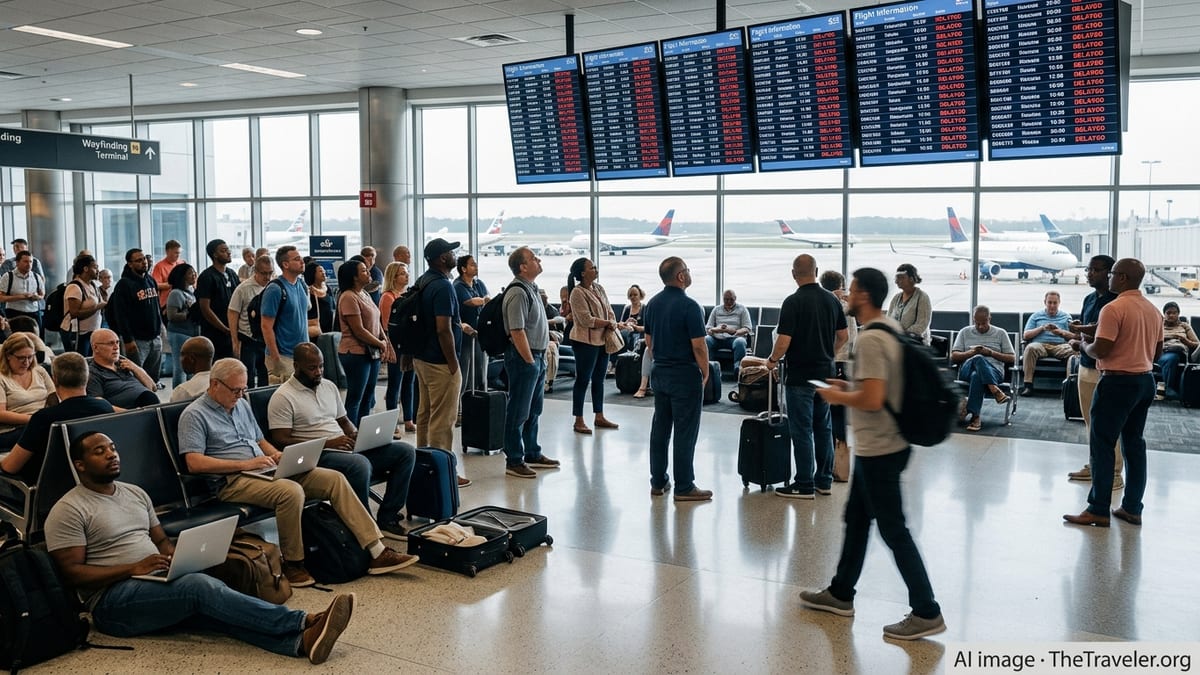
Publicly available flight-tracking dashboards and airport departure boards on Monday indicate that a cluster of delays built up at Baltimore/Washington International Thurgood Marshall Airport, with 139 flights running late and two listed as canceled across the day’s schedule. The disruptions span both departures and arrivals, and involve major domestic carriers Southwest, United, American and Delta.
Data from real-time tracking tools show rolling knock-on effects, with some aircraft arriving late into Baltimore and subsequently departing behind schedule. Even modest pushbacks of 30 to 60 minutes have compounded across the day, leaving passengers facing missed connections and reshuffled itineraries.
The disruption is not isolated to one airline or route pattern. While Baltimore functions as a significant base for Southwest and an important station for United, American and Delta, the delays recorded today cut across different terminals, time bands and destinations, suggesting a mix of congestion, weather and operational factors rather than a single underlying issue.
Although the overall number of outright cancellations remains low relative to the size of the schedule, the high volume of delayed flights has had a visible impact inside the terminal, with boarding times repeatedly revised and aircraft holding for new departure slots.
Chicago, Atlanta and Dallas Among the Hardest-Hit Cities
The ripple effects from Baltimore are being felt most sharply on routes linking the airport with major hubs such as Chicago, Atlanta and Dallas. These cities serve as critical transfer points in the networks of all four affected airlines, which means a delayed departure from Baltimore can cascade into further disruptions across the country.
According to live departure and arrival boards, multiple services between Baltimore and Chicago have operated behind schedule, including flights linked to both Chicago O’Hare and Chicago Midway. This is particularly impactful for United and American passengers who rely on Chicago for onward connections to the West Coast and Midwest.
Atlanta, the primary hub for Delta, has also seen delays on services to and from Baltimore. Flight-tracking tools show several services operating outside their scheduled windows, nudging connection times at Hartsfield-Jackson Atlanta International Airport into riskier territory for travelers with tight layovers.
Dallas, served through both Dallas/Fort Worth International Airport and Dallas Love Field, has recorded disruptions on itineraries tied back to Baltimore. Southwest’s point-to-point network, along with American’s hub-and-spoke operation at DFW, means that delays on Baltimore legs can reverberate across routes to the Mountain West, Texas and the Southeast.
Weather, Congestion and Airline Operations Under Scrutiny
While no single cause has been officially identified, publicly accessible tools from aviation authorities and independent trackers point to a familiar combination of influences behind today’s pattern of disruption. National Airspace System bulletins, regional radar imagery and historical delay statistics all suggest that intermittent weather, airspace congestion and routine operational issues can easily align to slow down a busy corridor such as the Mid-Atlantic.
Industry data compiled by the US Department of Transportation in recent years highlights how airline delays are often categorized across several buckets, including air carrier issues such as maintenance and crew availability, weather, national airspace constraints and late-arriving aircraft. When multiple categories intersect, even a broadly on-time system can experience localized pressure at particular airports.
Analysts who study flight-performance trends note that large network carriers and major low-cost operators alike are vulnerable when schedules are tightly timed around peak hours. A single late inbound flight into Baltimore can delay its next departure to Chicago or Atlanta, which then reaches its hub late and disrupts additional rotations for the rest of the day.
Comparisons with previous disruption days at major US hubs show that the most severe knock-on effects often surface several hours after the initial trigger, once it becomes clear that aircraft and crews are out of their planned positions. Today’s Baltimore delays appear to be following that familiar pattern, with mid-morning and early afternoon slippages feeding into evening schedules.
Nationwide Ripple Effects for US Travelers
The impact of Baltimore’s slowdowns has not been confined to direct routes into Chicago, Atlanta and Dallas. As the day’s operations have unfolded, delays have extended to a broader set of destinations, including smaller regional airports that depend on timely inbound connections from major hubs.
Publicly available reporting on recent disruption events shows how quickly a localized issue can spread. When a Baltimore flight lands late in a hub city, it can force a missed connection for travelers heading on to secondary markets, who may then need to be rebooked on later services with limited remaining capacity.
Travel-planning platforms and passenger-rights organizations frequently caution that this type of rolling disruption is especially challenging because it does not always result in a clear-cut cancellation. Instead, travelers contend with a sequence of incremental delays, aircraft swaps and reseating that can add hours to a journey without triggering automatic compensation under many policies.
For Baltimore in particular, its role as both an origin point and a connecting stop intensifies the effect. A delayed morning departure to a hub city can cause knock-on delays for aircraft that return to Baltimore later in the day, creating a feedback loop of minor schedule slips that aggregate into significant travel headaches by evening.
What Passengers Can Expect in the Coming Hours
Based on patterns observed in past days of heavy disruption, operations at Baltimore/Washington International are likely to remain under pressure into the evening as airlines work through the backlog of delayed services. Recovery often depends on the availability of spare aircraft, rested crews and improved airspace conditions on congested routes into hubs like Chicago, Atlanta and Dallas.
Real-time dashboards show airlines continuing to adjust departure times and swap equipment on select routes in an effort to restore reliability on their core schedules. Travelers booked on tonight’s departures may see gate changes and further time adjustments as operations teams seek to consolidate or resequence flights.
Consumer advocates regularly advise travelers facing rolling delays to monitor both the airline’s official channels and independent flight-tracking tools, keeping a close eye on minimum connection times at onward hubs. With Baltimore-linked routes feeding into some of the nation’s busiest airports, even relatively short hold-ups can render a previously comfortable layover unworkable.
As Baltimore’s disrupted schedule plays out across Chicago, Atlanta, Dallas and beyond, the situation offers another reminder of how interconnected the US air travel system has become. A wave of 139 delays and two cancellations at a single airport can, over the course of a day, reshape travel plans for passengers in dozens of cities nationwide.