


Colombo’s Bandaranaike International Airport can feel surprisingly confusing the first time you land, especially because almost all international passengers funnel through a single integrated terminal. The building is compact but busy, the road system has recently changed, and arriving travelers often receive conflicting advice about where to meet drivers, buy SIM cards, or find transport into Colombo. This guide walks you step by step through the arrivals experience, explains the terminal layout in plain language, and highlights the exact spots where first-time visitors most often get turned around.
Get the latest updates straight to your inbox!
The Reality Behind the “Single Integrated Terminal”
Bandaranaike International Airport, serving Colombo and labeled CMB on tickets, is often described as having multiple terminals. In practice, almost all international flights currently arrive into one main passenger complex that functions as a single integrated terminal. Different airlines may use different clusters of gates, but from a traveler’s point of view, arrivals all converge onto the same lower level for immigration, baggage claim, and customs. Domestic and some regional operations use a separate smaller building, yet you are unlikely to touch that unless you are on a very specific local connection.
This single-building setup is both the airport’s strength and its weakness. On the plus side, you do not have to worry about shuttle buses between terminals or long transfers. On the minus side, the internal logic is not intuitive. Walkways can feel like a maze of duty-free stores, corridors, and low ceilings, and wayfinding signs are not as clear or plentiful as at larger hubs in the region. Many travelers emerge from the aircraft expecting a big, open arrivals concourse with panoramic views and instead find a series of narrow halls where crowds quickly build around immigration.
Another source of confusion is terminology. Airlines and travel agents may still refer to “Terminal 1” or “the international terminal,” while construction updates talk about “Terminal 2” as a future project. For now the new international terminal is still under development and not yet open to passengers. When you land in Sri Lanka, assume you are going into the main integrated passenger building and follow the standard flow to immigration, baggage reclaim, and ground transport.
If you have a self-arranged driver or a friend meeting you, it is important to understand that everyone, regardless of origin or airline, exits into the same public arrivals hall. There is no dedicated arrivals exit by airline. This is why that single hall often feels chaotic at peak evening hours when long-haul flights from Europe and the Middle East arrive within a short window.
Step-by-Step: From Aircraft Door to Baggage Claim
Once the aircraft doors open, you will typically disembark via an airbridge directly into the departures level corridor, then be guided down toward immigration. Occasionally, during busy periods or for certain stands, you may use a bus from a remote stand, but the end point is the same: a corridor leading to immigration on the arrivals floor. Overhead signs indicating “Arrivals” and “Immigration” are present but can be easy to miss if you are tired or following the crowd without looking up.
The first major bottleneck is immigration. Counters are divided roughly by nationality and visa status. Visitors who have secured their Electronic Travel Authorization in advance join the regular foreign-passport queue; Sri Lankan passport holders and some other categories have separate lines. Confusion often arises here among travelers who believe they can obtain an on-arrival ETA instantly, only to find that the processing counter is limited and queues can move slowly. A common real-world scenario is a late-night arrival from Doha or Dubai where passengers who did not arrange their ETA in advance spend an extra 30 to 60 minutes in line while others sail through to baggage claim.
After passport control, you descend toward the baggage reclaim area. At the base of the escalators are flight information screens listing belt numbers for recent arrivals. Many first-time visitors miss these screens and wander up and down the hall checking each carousel in turn. Take ten seconds to stop here and confirm your flight number and assigned belt. Trolleys are free and are usually stacked near the entrances to the hall, but they can run short when several wide-body flights land back-to-back; if you see one as you enter, it is worth taking it immediately instead of planning to fetch one later.
While you wait for your bags, you will notice a ring of duty-free shops offering everything from electronics to large boxes of tea and bottles of spirits. These stores are technically before customs, so anything you buy here counts as duty-free on arrival. Many Sri Lankan families stock up on appliances or gifts at this stage, which contributes to congestion around certain belts. If you only have hand luggage, look for the clearly marked route that bypasses the carousels and leads directly toward customs; it is easy to overlook because it feels like a side passage rather than a main exit.
Clearing Customs and Entering the Arrivals Hall
Once you collect your luggage, you will funnel toward the customs area. Here you typically choose between a green channel for “Nothing to declare” and a red channel if you are carrying goods above allowances or restricted items. Officers may run bags through an x-ray scanner or conduct spot checks, especially on flights that are known to bring in large quantities of electronics or high-value goods. For most tourists, this step is straightforward, but it can feel tense because the space is narrow and the lines can back up when several flights converge.
Immediately after customs you pass through sliding doors into the main public arrivals hall. This is where many first-time travelers feel disoriented. Instead of a single, clearly organized space, the hall is a long rectangle crowded with currency exchange counters, mobile phone and SIM card kiosks, hotel booths, tour operators, and waiting friends and relatives held back behind barriers. Sound echoes, announcements can be hard to hear, and hand-written name boards compete with printed placards from hotels and taxi firms.
A typical scenario: a couple arriving from London pre-booked a driver through their guesthouse in Colombo. The guesthouse owner told them the driver would be “right outside arrivals.” When they step out of customs they see at least three lines of people holding signs, plus a cluster of tour desks. In reality, the driver is standing closer to the center of the hall near the official information counter, but the couple initially walks all the way to one end of the building, then back again, fighting through the crowd with fully loaded trolleys. Understanding that all pre-arranged drivers wait along the central barrier in this single hall can save you ten or fifteen minutes of confusion.
Important services are also concentrated here. Several banks and money changers operate side by side, allowing you to exchange cash into Sri Lankan rupees. Mobile operators typically have booths offering tourist SIM packages with data; buying a SIM here is convenient because staff are used to activating them for foreign phones on the spot. If you plan to rely on ride-hailing apps like PickMe or Uber to leave the airport, setting up your SIM and data before you exit the building will make ordering your car much easier.
Ground Transport Exits and the New Traffic Plan
Bandaranaike’s ground transport area has undergone a series of adjustments in recent years to address chronic congestion around the arrivals forecourt. Authorities have tightened rules on how long private cars can wait and have discouraged “driverless” vehicles parked idling in front of the terminal. As a result, the exact place where you meet a taxi, ride-hail, or private driver may differ slightly from older guidebooks or blog descriptions that relied on the previous traffic pattern.
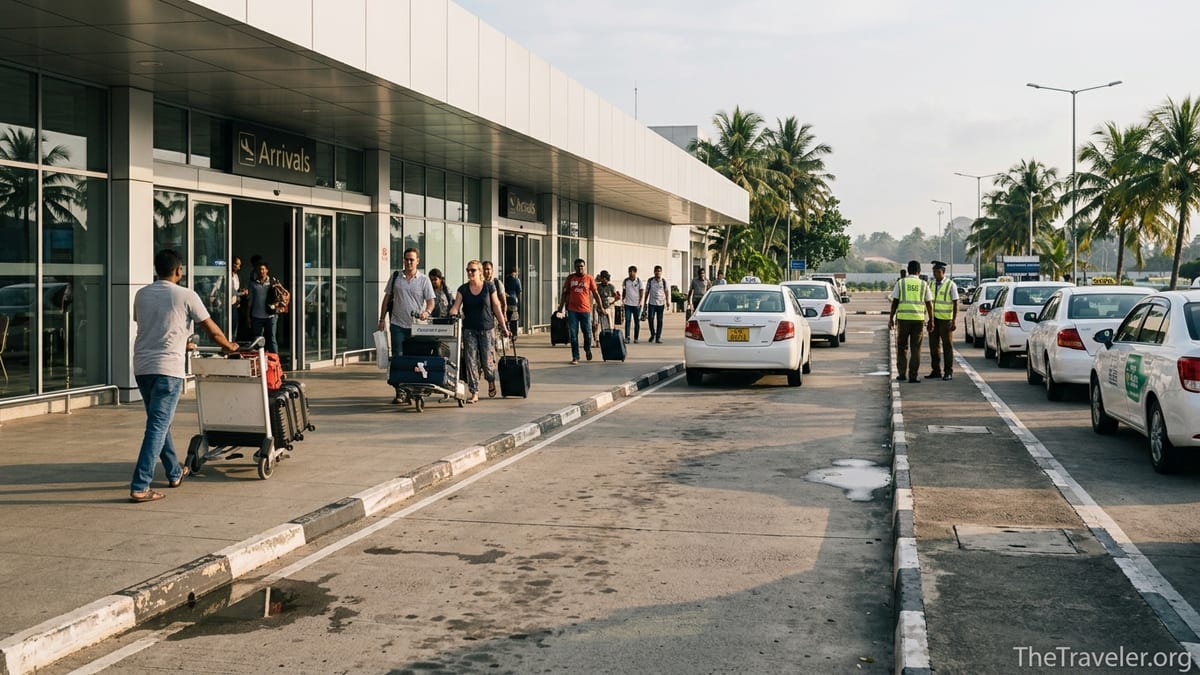
Immediately outside the arrivals exit doors is a covered forecourt. On one side you will find rows of vehicles from tour companies and private drivers who arrived shortly before their passengers’ flights. On the other side is the general pick-up lane, where cars pull in briefly to load travelers and luggage. Security staff, including police and airport officials, keep vehicles moving and will ask drivers to circulate if they linger. This is why locals often recommend that friends and family wait at an off-site parking or a nearby roadside café until the arriving passenger calls them after clearing customs and collecting bags.
For metered taxis and pre-paid vehicles, there are dedicated counters inside the arrivals hall where you can arrange a ride before stepping outdoors. Once you pay or register your trip, staff will direct you to a specific lane or numbered stand. For example, a traveler landing late in the evening might go to the official taxi counter inside, receive a printed slip with a vehicle number, then be led out through the central doors to a marked taxi bay. Typical fares for a standard car from the airport to central Colombo are often in the range of a few thousand Sri Lankan rupees, depending on traffic and exact destination, while rides arranged through apps may be somewhat cheaper.
Ride-hailing apps such as PickMe and Uber now have clearly designated meeting points slightly away from the busiest part of the arrivals curb. After you order your car in the app, you may be instructed to walk toward the far end of the terminal, where there is a cluster of branded desks or a signed pick-up zone. Many travelers, tired from a long flight, order the car while still standing inside the hall, then wait by the central exit doors. The driver arrives at the side pick-up point instead and cancels after several minutes, leading to mutual frustration. Checking the in-app map carefully and asking a nearby official to confirm the correct direction to the ride-hail zone helps avoid this common misunderstanding.
Where First-Time Travelers Most Often Get Confused
Confusion at Bandaranaike is rarely about language; English is widely used on signs and among staff. Instead, it often stems from the way the single terminal spaces are stitched together. One frequent problem is losing track of companions in the flow between immigration and baggage claim. Families may assume that after passport control there is a large, open waiting area, only to find themselves funneled down narrow corridors where stopping is difficult. If you are traveling with a group, agree in advance to regroup by the baggage information screens or at a specific carousel number, rather than trying to wait at the first bottleneck.
Another classic confusion point is the transition from the secure area to the public arrivals hall. Because the sliding doors open straight into a crowd of greeters pressed up against a barrier, some passengers hesitate, thinking they may have missed a step or an additional checkpoint. Others walk out and are immediately surrounded by unofficial taxi touts offering rides and hotels. The sensory jump from the relatively controlled customs area to the bustling hall can be jarring, especially for travelers arriving from quieter airports. Reminding yourself that this is the official exit and that everyone comes through the same doors can ease that moment of doubt.
Meeting drivers is perhaps the single most common headache. Hotels sometimes describe the meeting point vaguely as “outside arrivals” or “by the main gate.” In reality, there are several sets of doors along the façade and multiple lanes outside, and traffic rules mean that drivers may not be able to stand exactly where you exit. A typical scenario involves a family who booked a car to drive them onward to Kandy. The driver parks in a nearby short-stay lot to avoid extra charges, walks to the barrier inside the hall with a paper sign, then escorts them back out to the car. The family, expecting to see the vehicle itself right at the door, spends ten anxious minutes scanning the curbside traffic before noticing the sign among dozens of others.
Finally, ground transport choices can feel overwhelming for tired newcomers. Inside arrivals you may be offered an official taxi, a private car to a distant resort city, a minibus shared transfer, and a suggestion to use the public bus into Colombo, all within the first few minutes. Because all these offers are clustered in a relatively small area, it is easy to agree to something more expensive than necessary simply to escape the crowd. Taking two or three minutes on a bench inside the hall to decide your preference before engaging with sellers can lead to a calmer, better-value choice.
Practical Layout Tips for a Smooth Arrival
Thinking of the terminal in simple layers can help. The arrivals flow is essentially a straight line: aircraft to immigration, down to baggage claim, through customs, into the public arrivals hall, then out to the forecourt and road system. There are very few side branches that you actually need. If you find yourself heading down an empty corridor with no other passengers in sight, you have probably taken a wrong turn. In that case, do not hesitate to ask a uniformed staff member for directions back to immigration or baggage claim.
As you emerge into the public hall, imagine it cut into three functional zones along its length. Near the center are the information desk and the densest cluster of waiting drivers holding name boards. One side tends to host more of the currency exchange counters and some hotel/tour desks, while the opposite side is where you are more likely to see telecom kiosks for SIM cards. Farther toward the ends of the hall you transition to doors that lead toward specific vehicle pick-up lanes, ride-hail stands, and bus stops. Using this mental map, you can move with purpose: sort your phone and cash first, find your driver or taxi counter second, then head out through the door closest to your chosen transport.
For onward travel into Colombo, typical options include the official airport taxis, app-based rides, private transfers, and the public bus that runs to the city’s main bus terminal. The bus is the cheapest but least convenient if you have large luggage or arrive late at night, as it involves walking a short distance from the terminal to the stop and may be crowded. Many visitors choose app-based rides such as PickMe because fares are normally lower than fixed-rate counters and you see an approximate price in advance. For example, a daytime ride from the airport to a midrange hotel in central Colombo might cost in the low thousands of rupees via an app, compared with a somewhat higher price from a counter, depending on demand and traffic.
If your destination is farther afield, such as the southern beaches or the Cultural Triangle around Sigiriya, you may find desks inside the arrivals hall selling direct transfers. In these cases, the price will understandably be higher, but you gain the convenience of stepping straight into a vehicle after a long flight. A common pattern is a couple arriving mid-morning and booking a private car from one of these desks to drive them directly to a guesthouse in Sigiriya, avoiding an overnight in Colombo. When comparing offers, ask clearly whether tolls on the expressway are included and whether you can pay by card or need cash.
The Takeaway
Bandaranaike International Airport is not a gleaming, ultra-modern hub, but understanding how its single integrated terminal works goes a long way toward making your arrival smooth. Almost every international traveler passes through the same sequence of spaces, and knowing in advance what comes next removes much of the stress. Expect a compact immigration zone, a functional but crowded baggage hall lined with duty-free shops, a slightly chaotic public arrivals hall, and a forecourt shaped by evolving traffic rules.
The main places where newcomers get confused are predictable: unclear queues at immigration, missing the baggage-belt screens, feeling overwhelmed by the busy arrivals hall, struggling to spot a pre-booked driver among a sea of name boards, and misjudging where to meet taxis or ride-hail cars under the updated traffic plan. By visualizing the layout as a straight path from aircraft to road, preparing your visa and onward transport in advance, and pausing briefly inside the hall to organize money and connectivity, you can turn what might have been a disorienting first hour into a manageable and even interesting introduction to Sri Lanka.
Give yourself a little extra time, expect some crowding at peak hours, and do not hesitate to ask uniformed staff to point you toward the correct exit, taxi bay, or ride-hail stand. With those simple strategies, the quirks of Colombo’s main airport become less of an obstacle and more of a colorful starting point for your journey through the island.
FAQ
Q1. Is there more than one international terminal at Bandaranaike Airport?
There is one main integrated passenger terminal handling almost all international arrivals and departures, so you do not need to worry about transferring between separate international terminals.
Q2. Where exactly do I meet my pre-booked driver?
After customs you enter the public arrivals hall. Pre-booked drivers wait behind the barrier in this hall, usually near the central information desk, holding signs with passenger names.
Q3. Can I get a SIM card at the airport on arrival?
Yes. Mobile operators have kiosks in the arrivals hall immediately after customs, and staff are used to setting up tourist SIM packages and activating data plans on the spot.
Q4. What is the easiest way to get from the airport to central Colombo?
For most visitors, an official taxi or a ride-hailing app such as PickMe or Uber is simplest. Prices are moderate for the distance, and you are dropped directly at your hotel.
Q5. How do the new traffic rules affect pick-ups at arrivals?
Vehicles are no longer allowed to wait for long in front of the arrivals doors, and driverless parked cars are discouraged, so your driver will time their arrival closely and may park in a nearby lot until you call.
Q6. Is it safe to use ride-hailing apps from the airport?
Ride-hailing services are widely used by locals and visitors. Follow in-app instructions to the designated pick-up spot near the terminal and double-check the vehicle details before getting in.
Q7. Where is the public bus stop to Colombo?
The airport bus to Colombo’s main bus terminal departs from a stop just outside the terminal area. After exiting arrivals, follow signs or ask staff to direct you to the bus stand used by the airport route.
Q8. Are there ATMs and currency exchange counters in arrivals?
Yes. Several bank counters and currency exchange booths operate in the arrivals hall, and ATMs are available, so you can get Sri Lankan rupees before leaving the terminal.
Q9. What if I get separated from my travel companions inside the terminal?
Agree in advance on a default meeting point such as the baggage information screens or a specific carousel number. If you do get separated, these are the easiest places to find each other again.
Q10. How long does it usually take to get through arrivals at Bandaranaike?
At quieter times you may clear immigration, baggage, and customs in under an hour. During peak evening waves it can take 60 to 90 minutes, especially if immigration lines are long.