

For many travelers, Greece is a once in a lifetime dream trip. With ancient ruins, island-dotted seas and whitewashed villages, it can also feel overwhelming to choose where to start. The country is larger and more varied than it appears on a map, and each region offers a different mix of history, beaches, nightlife and quiet village life. For a first-time visit, choosing the right areas can make the difference between a rushed checklist and a relaxed trip you want to repeat.
Athens and the Saronic Gulf: Essential First Stop
For almost any first trip to Greece, Athens is the natural starting point. The Greek capital is the country’s main international gateway and the best place to connect with its ancient past. The Acropolis, the Parthenon and the surrounding archaeological sites provide a concentrated introduction to classical Greece, while the neighborhoods clustered beneath the rock show a lively, modern city that is constantly evolving. Staying in or near the central districts of Plaka, Syntagma or Koukaki keeps most major sights within walking distance and makes it easier to adjust to the pace and rhythm of the country.
Beyond the headline monuments, first-time visitors should allow time for simple wandering. The pedestrian streets around the Acropolis Museum, the café terraces of Thissio and the markets of Monastiraki show different faces of the city, from laid-back to boisterous. Athens has invested in its waterfront and cultural spaces over the past decade, and areas like the Stavros Niarchos cultural complex or the renovated National Gallery reward travelers who can spare an extra day. Even a short visit offers a sense of how contemporary Athenians live alongside their history rather than in its shadow.
Athens is also an ideal base for easy first-day or last-day excursions. The nearby Saronic Gulf islands, including Aegina, Hydra and Poros, sit just off the Attica coast and are accessible by frequent ferries from Piraeus. These islands are close enough for a day trip yet feel very different from the capital, with harborside promenades, neoclassical mansions and pine-covered hills. They are a gentle introduction to Greek island life without the longer travel times required for the Cyclades or Crete, and they work particularly well if you have limited days but still want at least a taste of island atmosphere.
Santorini and the Cyclades: Iconic Island Scenery
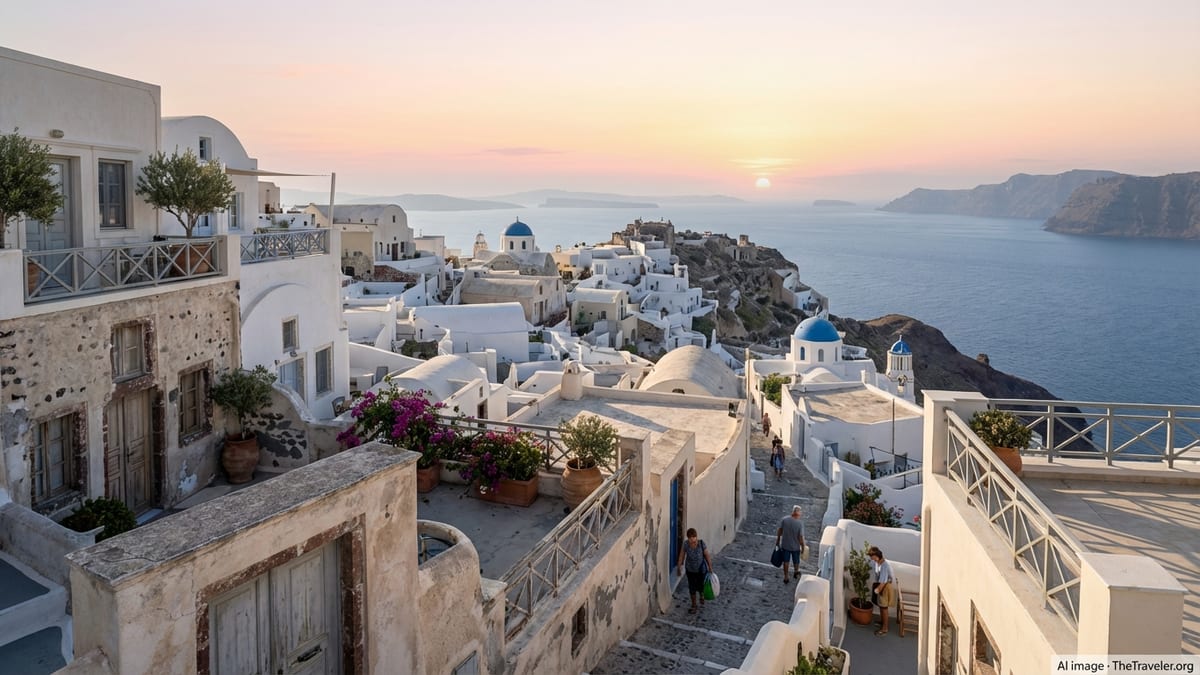
When many people picture Greece, they imagine white houses scrambling down cliffs toward a deep-blue sea. That scene is most closely associated with Santorini and the wider Cyclades group. For a first-time visitor who wants the classic postcard view, Santorini remains a powerful draw, with its caldera villages clinging to the rim of a submerged volcanic crater and the famous sunset views around Oia and Fira. These settlements are compact, walkable and densely packed with hotels, restaurants and small shops, which makes them easy to explore even on a short stay.
At the same time, it is important to approach Santorini with realistic expectations. In recent years the island has grown steadily busier, especially on days when multiple cruise ships are in port. Authorities have been paying closer attention to visitor numbers and safety, including monitoring volcanic and seismic activity and reviewing infrastructure. Travelers who choose Santorini should book well ahead, avoid the very peak weeks if possible and check for any local advisories before arrival. For a first visit, staying two or three nights is usually enough to enjoy the views, visit a winery and explore the archaeological site of Akrotiri without feeling overwhelmed.
First-time travelers often find that pairing Santorini with a calmer Cycladic island makes for a more balanced trip. Islands such as Naxos and Paros offer long sandy beaches, larger main towns and easier access to traditional inland villages. Naxos is known for combining excellent family-friendly beaches with mountain settlements that feel far removed from the tourism of the coast. Paros has become popular as a base for island-hopping, but still offers relaxed fishing harbors and older quarters in Parikia and Naousa. For a first visit, planning three to five nights between these islands after a short stay in Santorini can deliver the famous Cycladic scenery at a slower pace.
Crete: A Miniature Country for Longer First Trips
Crete is Greece’s largest island and feels almost like a country within a country. For first-time visitors with ten days or more, it can be an excellent choice, particularly if you prefer to settle in one place rather than hop among several islands. Crete offers ancient sites, mountain landscapes, coastal towns and long beaches, so it suits travelers who want variety and are comfortable renting a car. Distances are longer than on smaller islands, and the island is roughly 250 kilometers from end to end, so focusing on one or two regions works better than trying to circle it all at once.
On a first trip, many travelers gravitate to the northwest, basing themselves in or near Chania. The city’s old Venetian harbor, lighthouse and narrow streets lined with townhouses and small hotels create a romantic atmosphere that feels historic without being a museum. From Chania, it is possible to take day trips to well-known beaches such as Elafonisi or Balos, as well as to mountain villages where local life follows a slower rhythm. Eating in Crete is often a highlight, with a strong emphasis on local olive oil, seasonal vegetables and simple grilled meats, and travelers frequently comment that portions are generous and prices good value compared with more glamorous islands.
Heraklion and eastern Crete offer a different introduction to the island. Near Heraklion, the archaeological site of Knossos provides a glimpse into Minoan civilization and is often combined with a visit to the Archaeological Museum in the city center. Families in particular may appreciate the mix of culture, beaches and modest water parks and attractions scattered along the north coast. First-time visitors should be aware that package tourism has a strong presence in some resort zones, and parts of the north shore can feel busy in high summer. Choosing smaller coastal towns or inland guesthouses can deliver a more relaxed and authentic first impression.
The Peloponnese: Classical Sites and Coastal Towns
For travelers interested in ancient history who prefer to avoid additional flights or long ferry journeys, the Peloponnese peninsula is a strong option for a first trip. Connected to the mainland by a narrow isthmus, it is easily reached from Athens by car or bus in a few hours. The region concentrates some of Greece’s most important archaeological sites, including ancient Mycenae, Epidaurus and Olympia, in a landscape of rolling hills, olive groves and small coastal towns. This combination allows visitors to explore major ruins during the cooler morning and evening hours and relax in seaside cafés or on smaller beaches in between.
The town of Nafplio on the eastern side of the Peloponnese is particularly appealing for first-time visitors. Once the capital of the modern Greek state, it has a compact old town of neoclassical houses, a waterfront promenade and an imposing fortress rising above the harbor. Nafplio functions well as a base for exploring nearby sites while still offering enough atmosphere, dining and shopping to fill an unstructured day. Compared with some islands, it sees more Greek weekenders outside the main tourist season, which gives visitors a sense of domestic travel patterns and local life.
Elsewhere in the Peloponnese, the western coast around Pylos and the southern fingers of the peninsula, including Mani, attract travelers looking for quieter beaches and dramatic limestone landscapes. These areas have been seeing gradual growth in small-scale tourism but still feel far removed from the busiest island resorts. For a first-time visitor with a rental car and a week or more, a circuit that combines Nafplio, one of the major archaeological sites, and a coastal village stay can be a satisfying alternative to a classic island itinerary.
Northern Greece and Thessaloniki: City Breaks and Mountains
Northern Greece is increasingly on the radar of first-time visitors who want cooler temperatures, greener landscapes and a mix of city and nature experiences. Thessaloniki, the country’s second city, offers a lively waterfront, layered history and a strong café and food culture. It is well connected by air to other European cities and works either as a standalone city break or as a starting point for exploring nearby regions. Compared with Athens, it has fewer world-famous monuments but a more compact center, which many visitors find easier to navigate on a short stay.
From Thessaloniki, it is relatively straightforward to reach the beaches of Halkidiki, known for their clear water and forested headlands. The region’s peninsulas vary in character, with some stretches developed for family-oriented summer tourism and others quieter and less built-up. First-time visitors who are comfortable driving often choose a small hotel or rental near the sea and use it as a base for day trips to different coves. Inland, the mountains of northern Greece appeal to hikers and travelers seeking traditional stone villages, rivers and cooler air, especially in late spring and early autumn.
For travelers whose first association with Greece is purely islands and ruins, northern Greece can be a pleasant surprise. The region receives a significant share of European visitors who are drawn by its combination of coastal and inland scenery and by the perception that it can offer better value and fewer crowds than the most famous southern destinations in peak season. For a first trip that emphasizes landscapes, local food and less hectic beaches, pairing Thessaloniki with a few days in Halkidiki or a mountain village can be a rewarding choice.
When to Go and How Long to Stay
Timing has an outsized impact on a first trip to Greece. Spring and early summer, roughly from May through June, and early autumn, from September into early October, are generally considered the most comfortable periods for a first visit. Temperatures are usually warm enough for swimming without the extremes that can occur in late July and August, and the most popular destinations feel energetic but not yet overwhelmed. During these shoulder seasons, accommodation prices can be more moderate and local businesses have time to interact with visitors in a less pressured way.
High summer remains the busiest period, particularly on islands like Santorini, Mykonos, Rhodes and parts of Crete. During these weeks, ferries, flights and hotels can sell out earlier, and midday heat in cities such as Athens can make sightseeing feel tiring. Travelers who have no choice but to visit in July or August should plan more rest time, book well ahead and consider balancing a well-known destination with a quieter area. In contrast, the late autumn and winter months bring lower prices and fewer tourists, but also cooler temperatures, reduced ferry schedules and closures on smaller islands. For a first visit focused on outdoor swimming and island life, this off-season period is usually less suitable.
As for trip length, many first-time visitors try to see as many places as possible in a single journey. In practice, Greece rewards a slower approach. A stay of seven to ten days works well for combining Athens with one island or one mainland region. If you can manage two weeks, it becomes easier to add a second island or a loop through the Peloponnese without feeling rushed. Moving every two or three nights is generally the upper limit before fatigue sets in, especially when ferry timetables, rental cars and frequent packing are involved.
Choosing the Best Areas for Your Travel Style
With so many appealing regions, the best areas for a first-time trip depend heavily on your interests and travel style. Travelers who care most about classical history and museums often prioritize Athens, Delphi or the major sites of the Peloponnese, adding only a short island stay for contrast. Those who are drawn primarily to beaches and coastal views usually reverse that balance, focusing on the Cyclades, Crete or Halkidiki with a brief opening or closing stay in the capital. Couples may gravitate toward Santorini, Chania or Nafplio for romantic settings, while families often prefer destinations like Naxos, parts of Crete or the more sheltered beaches of the Saronic Gulf where logistics are simpler.
Budget and appetite for crowds also play a role. Highly photogenic islands that appear frequently in films and advertising campaigns tend to command higher prices and attract more visitors, especially in peak season. Less publicized areas, from secondary Cycladic islands to smaller Peloponnese towns, can provide a more relaxed and affordable introduction to the country, at the cost of slightly more research and planning. First-time travelers who prioritize authentic local interactions may feel more at home in destinations where tourism is important but not overwhelming, such as Naxos, Paros, parts of Crete, northern Greece or mainland towns like Nafplio and Kalamata.
Transport preferences matter as well. If you enjoy ferry travel and do not mind the occasional delay or schedule change, island-hopping among two or three nearby islands can be one of the most memorable aspects of a Greek trip. If you prefer more predictable schedules and the ability to stop at viewpoints or small villages, focusing on a mainland region with a rental car may be more comfortable. Many first-time visitors find that once they understand these trade-offs on their first trip, it becomes easier to design return journeys that focus more deeply on their favorite type of Greek experience.
The Takeaway
Greece’s appeal for first-time travelers lies in its variety as much as in its famous postcard scenes. Athens offers an essential grounding in the country’s past and present, while islands in the Cyclades and Crete provide the dramatic coastlines, sunsets and seaside villages that many travelers dream about. The Peloponnese and northern Greece add quieter classical sites, coastal towns and mountain landscapes that show a broader picture of the country beyond its most heavily photographed spots. Each of these areas can serve as a cornerstone of a first trip, depending on how much time you have and what you most want to experience.
Rather than trying to see everything at once, it is usually wiser to choose one or two main regions and accept that the rest will wait for a future visit. A well-paced itinerary that balances city and sea, famous sights and unhurried days, will leave stronger memories than a packed schedule that blurs together. With thoughtful planning and realistic expectations about distances, crowds and climate, your first journey to Greece can deliver both the icons you have seen on screens for years and quieter moments of discovery that feel entirely your own.
FAQ
Q1. How many areas should I visit on a first trip to Greece
Most first-time visitors are happiest focusing on two or three main areas, such as Athens plus one or two islands or a single mainland region.
Q2. Is Santorini worth visiting for first-time travelers despite the crowds
Santorini can still be rewarding if you stay two or three nights, visit major viewpoints early or late in the day and avoid the very peak travel weeks.
Q3. Should I choose Crete or the Cyclades for my first visit
Pick Crete if you prefer to settle in one large, varied island, and the Cyclades if you want shorter ferry hops, smaller islands and the classic whitewashed village look.
Q4. Do I need a car for my first trip to Greece
In Athens and compact islands you can rely on walking and public transport, but on Crete, the Peloponnese and parts of northern Greece a car adds significant flexibility.
Q5. When is the best time of year for a first visit to Greece
Late spring and early autumn, roughly May to June and September to early October, usually offer warm weather, swimmable seas and more manageable crowds.
Q6. Is it better to visit islands or mainland areas on a first trip
Both have strong appeal. Many travelers combine Athens with one island and one mainland region to experience ancient sites, local towns and beaches in a single itinerary.
Q7. How far in advance should I book accommodation
For popular islands and peak summer weeks, booking several months ahead is prudent, while shoulder-season trips to less busy regions can often be arranged with shorter notice.
Q8. Are Greece’s smaller or lesser-known islands suitable for a first visit
Yes, provided you are comfortable with slightly fewer transport links and amenities. They can offer a quieter, more local introduction than the busiest destinations.
Q9. Can I visit Greece in winter as a first-time traveler
You can, especially for city sightseeing in Athens or Thessaloniki, but many island hotels and services close, and the weather is cooler and less suited to beach activities.
Q10. How long should my first trip to Greece be
A week is enough for Athens and one region, while ten to fourteen days allow time for an additional island or mainland loop without feeling constantly rushed.