


Planning a Christmas market escape to Europe in 2026 means juggling opening dates, airfares, hotel prices and crowds that can swell to festival levels by early December. With several major markets already publishing their 2026 calendars, it is possible to sketch out realistic long weekend trips from the United States that combine good value with plenty of time for lights, glühwein and gift shopping.
Get the latest updates straight to your inbox!
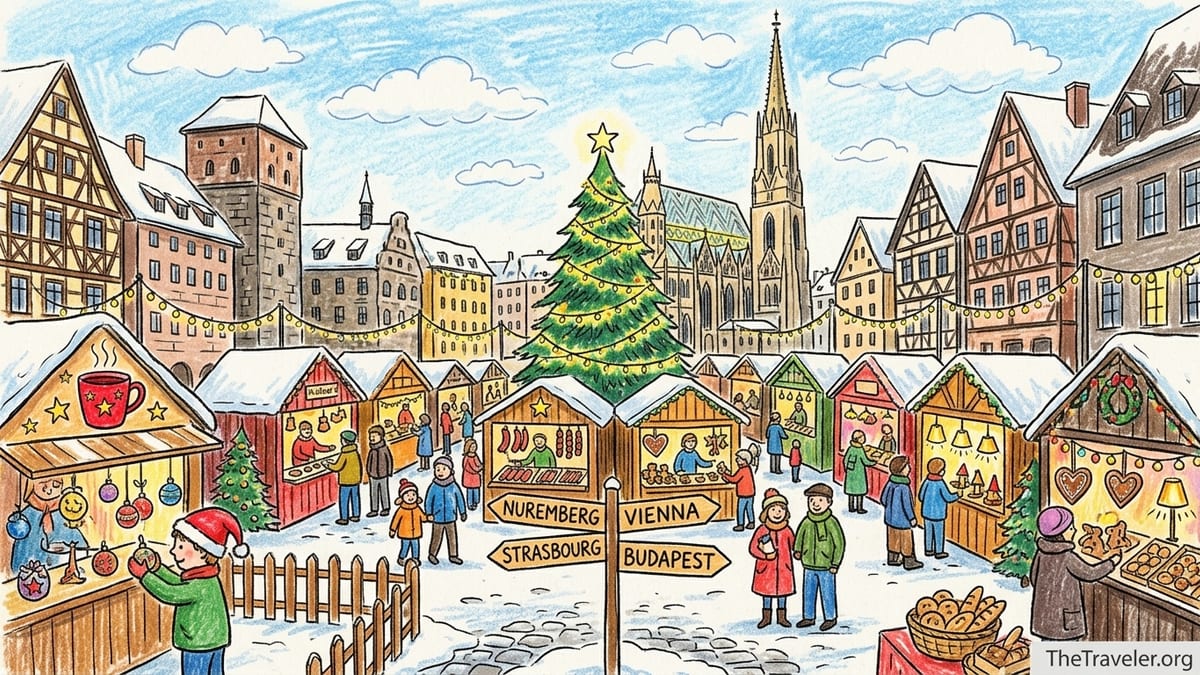
Nuremberg Christkindlesmarkt, Germany: Tradition and Tight Streets
Nuremberg’s Christkindlesmarkt is one of Europe’s most famous Christmas markets and among the first to publish firm 2026 dates. The city’s tourism office confirms that the market on Hauptmarkt will run from Friday 27 November to Thursday 24 December 2026, with the ceremonial opening by the Nuremberg Christkind on the evening of 27 November. Stalls spread from the main square into nearby streets, with separate areas for the children’s market and partner cities, so the entire old town feels like one continuous event.
Crowds are intense around the opening weekend and the two Saturdays before Christmas, when German day trippers arrive by car and regional train. Visitors report that the square can feel shoulder to shoulder from mid-afternoon into the evening on these days, while midweek evenings in early December are noticeably easier for moving between stalls. The market attracts well over a million visitors each year, and local authorities add extra signage and crowd control around the narrow lanes leading off Hauptmarkt.
For a long weekend from the United States, many travelers fly into Frankfurt or Munich and continue to Nuremberg by train. Advance purchase tickets on German Rail between Frankfurt Airport and Nuremberg often start around 25 to 40 euros each way in 2nd class when bought well ahead, while flexible fares can be closer to double that. Hotels in the old town near Hauptmarkt, such as mid-range chain properties around the station and on Königstrasse, often quote weekend rates in early December 2026 in the region of 130 to 200 euros per night for a standard double, with prices creeping higher for the opening weekend.
A realistic three-night itinerary could have you arrive on Friday afternoon, drop bags at a hotel within walking distance of the old town walls, then head straight to the opening ceremony and first lap of the market. Saturday could focus on the partner cities and children’s markets, combined with a visit to the Imperial Castle and a longer lunch at a traditional franconian restaurant away from the main square to escape the crowds. On Sunday, an early stroll around the market before most day trippers arrive makes room for last-minute shopping before a midday train back to Frankfurt or Munich for the evening flight home.
Strasbourg, France: Capital of Christmas on the Rhine
Strasbourg brands itself as the Capital of Christmas, and the city has already set out its main 2026 market dates. Official information from the municipality indicates the Christmas markets on the Grande Île will run from Friday 27 November to Thursday 24 December 2026, with chalets around the cathedral, Place Broglie and Place Kléber. The giant fir tree on Place Kléber and extensive light displays across the historic center add a strong visual backdrop that continues even after stalls close for the evening.
The atmosphere is particularly busy on Friday and Saturday nights when visitors from Paris, Germany and Switzerland pour in by high speed and regional trains. Hotels in the central island and in the station district often introduce minimum stay rules on peak December weekends. By late October, mid-range properties around the station typically show sample rates of around 160 to 230 euros per night for market Fridays in early December, with more characterful boutique hotels in the Petite France district coming in higher, especially for superior river view rooms.
Access from the United States generally involves flying into Paris Charles de Gaulle or Frankfurt, then taking a high speed train. Advance purchase fares on the TGV from Paris to Strasbourg can start around 25 to 40 euros each way in second class if booked early, while last minute seats can be substantially more. From Frankfurt, direct intercity trains to Strasbourg usually run in under two hours and, when booked ahead, can be similar in price to the TGV. A Friday evening arrival is workable, but landing in Europe on Thursday and traveling to Strasbourg on Friday morning gives more buffer for winter delays and jet lag.
A concise weekend plan might place your base near the station or Petite France, allowing you to walk everywhere. Friday afternoon could be devoted to wandering the streets around the cathedral and Place Broglie, saving the main market exploration for after dark when the lights are at their best. Saturday could combine a boat tour on the Ill, museum visits and a late afternoon circuit of the smaller specialty markets before an Alsatian dinner and final stroll under the illuminations. On Sunday morning, visitors catching mid-afternoon trains can still squeeze in hot chocolate at a café off Rue des Grandes Arcades and a last look at the tree on Place Kléber before heading back to the station.
Vienna, Austria: Grand Squares and Multiple Markets
Vienna has several major Christmas markets rather than a single flagship. City tourism information for 2026 lists the Viennese Christmas Market at Rathausplatz as running roughly from mid November to 26 December, with 2026 dates given as 13 November to 26 December for the market and associated ice rink in some English language materials. Other markets, such as the more local-feeling offerings at Spittelberg and in front of Schönbrunn Palace, normally open around mid November as well and some run into early January, although visitors should check final 2026 dates closer to travel.
The large scale of Vienna’s squares means the Rathausplatz market can feel busy without the same level of compression found in older, denser city centers. That said, the weeks of 5 and 12 December 2026 are likely to be among the busiest as pre-Christmas domestic tourism peaks and tour groups from across Europe arrive by coach. Hotels near the Ringstrasse and in the Innere Stadt traditionally command higher rates in early December, with four star central properties often pricing weekend stays in the range of 180 to 260 euros per night for a double. Travelers willing to stay a couple of metro stops out, in districts like Neubau or Leopoldstadt, can sometimes find modern chain hotels dipping below 150 euros per night on the same dates.
From the United States, Vienna is well served by both non-stop and one stop connections from major East Coast hubs. Economy return fares from cities such as New York or Boston into Vienna around early December 2026 are difficult to pin down this far out, but recent years suggest that sale fares of around 650 to 850 US dollars are possible when booking several months ahead, with prices rising closer to departure and around Thanksgiving. The City Airport Train and regular suburban trains connect Vienna Airport to the city center in around 15 to 20 minutes, typically costing a little under 20 euros each way for the dedicated airport service and less for regular rail.
A three night stay could focus one evening on the Rathausplatz market, another on the Schönbrunn Palace market and a third on the narrower, more intimate streets of Spittelberg. You might arrive on Thursday, check into a hotel near the MuseumsQuartier, and devote the first evening to the Rathausplatz stalls and skating. Friday could combine indoor sightseeing at the Hofburg and Kunsthistorisches Museum, followed by mulled wine and handicrafts at Spittelberg. Saturday might involve a half day at Schönbrunn, staying on into the evening as the palace courtyard fills with music and lights, before a Sunday morning coffee and cake stop at a traditional café and an afternoon flight home.
Budapest, Hungary: Value for Money on the Danube
Budapest has emerged as one of the stronger value destinations for Christmas markets, especially for visitors comparing prices with Austria, Germany and France. Travel sites that track official announcements report that the city’s two main markets, at Vörösmarty Square and in front of St Stephen’s Basilica, plan to open on Friday 13 November 2026. The Basilica market is expected to continue into early January 2027, while craft stalls on Vörösmarty Square tend to close a few days after Christmas with some food outlets staying open through New Year’s Eve.
Costs on the ground are generally lower than in western Europe, though prices have risen in recent seasons. Local media coverage in 2025 described mulled wine at the markets starting around 1,500 to 1,900 Hungarian forints for a cup of roughly 3 deciliters, which at recent exchange rates works out in the region of 4.5 to 6 US dollars. Simple street food dishes such as lángos with basic toppings and grilled sausages often price in a similar range at the time of writing, while more elaborate portions and sit down meals can cost more. Three star and simple four star hotels within a ten to fifteen minute walk of the Basilica or the riverfront frequently advertise December weekend doubles in the region of 90 to 150 euros, particularly on non-peak weekends earlier in the month.
From the United States, Budapest usually requires one connection in a European hub such as Frankfurt, Amsterdam or London. Round trip economy fares from East Coast cities for early December dates have in recent years commonly appeared in the 650 to 900 US dollar range when purchased during airline sales several months in advance. Once in Budapest, a shared airport shuttle or ride share into the city center generally costs considerably less than similar services in western European capitals, and a single ticket on the airport bus and metro combination is typically priced in low single digit euros.
A realistic long weekend itinerary might have you arrive Thursday evening and settle into a hotel in District V near the river. Friday could be devoted to daytime sightseeing on Castle Hill and in the Jewish Quarter, before an evening at the Basilica market to experience the light projections on the church façade. Saturday could start with a visit to a thermal bath, followed by an afternoon and evening wandering between the stalls at Vörösmarty Square and along Váci Street. On Sunday morning, a final coffee and cake stop in a historic café before the airport allows for a relaxed end to a relatively budget friendly Christmas market escape.
Cologne, Germany: Cathedral Markets and Rhine Backdrops
Cologne is another heavyweight in the European Christmas market scene, with several distinct markets spread along the Rhine and around the cathedral. While final 2026 dates are still being confirmed at the time of writing, recent official calendars indicate that the main markets typically open in the last full week of November and run through 23 or 24 December, with some smaller or alternative markets running slightly different schedules. The central market next to Cologne Cathedral and the Alter Markt in the old town are easy to combine on foot and often appear together in tour operator brochures.
Visitor reports from recent years suggest that Friday and Saturday evenings at the cathedral market can become extremely crowded, especially when river cruise groups and coach tours arrive simultaneously. Weekday afternoons and early evenings generally feel calmer, with more space to browse woodcraft, glass ornaments and regional food specialties. Accommodation within a short walk of the cathedral and central station tends to book out earliest. Mid-range hotels in this zone often show December weekend rates in the range of 140 to 210 euros per night for a standard double, while simpler properties and guesthouses further along the Rhine promenade or across the river in Deutz can come in somewhat lower.
Cologne is reachable both as a dedicated destination and as a stop on a multi city Christmas market itinerary that might also include nearby Bonn or Düsseldorf. For travelers arriving from the United States, the city can be accessed via flights into Frankfurt or Amsterdam followed by a high speed rail connection. Sample advance purchase fares on ICE and Thalys type services from Frankfurt Airport to Cologne can start around 20 to 35 euros one way in second class if purchased early. Given the compact nature of the historic center, visitors on short breaks can realistically cover several markets and key sights in two full days without relying heavily on public transit.
A practical two or three night plan might set Friday aside for arrival, check in and an initial lap around the cathedral market. Saturday could then combine a morning stroll through the Stadtgarten market or the harbor themed market near the Chocolate Museum with an afternoon break in one of the city’s traditional brauhäuser for a glass of Kölsch and a hearty lunch. The evening would offer a chance to revisit a favorite market or explore a smaller themed one. On Sunday, a final cathedral visit and some last minute shopping near Hohe Strasse fit comfortably before heading back to the station for the train to your onward flight.
Planning Costs and Crowds from the United States
For travelers from North America, flight costs are usually the single biggest line in the budget for a Christmas market weekend. In recent pre-pandemic and post-pandemic seasons, economy class returns from major East Coast airports to hubs such as Frankfurt, Munich, Paris and Vienna in late November and early December have often ranged from roughly 650 to 1,000 US dollars when booked several months ahead, with prices shifting sharply around Thanksgiving and early December business travel peaks. West Coast departures typically start higher, with many itineraries requiring at least one connection in Europe or on the East Coast.
On the ground, a sensible daily budget for a mid-range traveler in these cities might bundle accommodation, food, transit and moderate shopping. In 2025 and 2026 price levels, many visitors report spending in the region of 150 to 250 euros per day for two people in cities such as Vienna, Nuremberg and Strasbourg when staying in central three to four star hotels, eating at a mix of casual and mid-range restaurants and making modest market purchases. Budapest often comes in below this range, while particularly busy weekends or stays in high end boutique hotels can cost more. Travellers who are content with simpler guesthouses, public transit over taxis and careful souvenir choices can bring overall costs down.
Crowd management is another key planning factor. Across Europe’s best known markets, the same patterns usually repeat. Opening weekends attract locals and media attention, midweek evenings in late November and early December are often pleasantly busy without being overwhelming, and the final full weekend before Christmas is typically the most crowded of all. American visitors planning short trips may want to avoid arrival on a Saturday in early or mid-December whenever possible and instead aim for Thursday arrivals, which provide more flexibility to enjoy markets at their quieter times.
Weather also plays into cost and comfort calculations. Late November and early December can bring cold rain, fog or light snow in central Europe, while heavier snow tends to be less common in the big cities themselves. Booking flexible or refundable rates on at least part of your itinerary can help manage potential disruption from winter storms affecting transatlantic flights. Packing strategies that layer thermal base layers, waterproof outerwear and insulated footwear will generally serve better than relying on one very heavy coat that becomes uncomfortable in crowded indoor spaces.
Sample Long Weekend Itineraries and Booking Strategy
For a first time Christmas market visitor in 2026, one practical template is a Thursday to Monday trip centered on a single main market city with good flight connections. Nuremberg via Frankfurt, Vienna directly, or Budapest via a major hub all fit this pattern. You might land Friday morning after an overnight flight, use Friday and Saturday for intensive market time, keep Sunday flexible for indoor sightseeing and gift shopping, and depart Monday morning. This structure gives some buffer for jet lag and winter delays without requiring a full week away from home.
More experienced travelers sometimes combine two nearby markets into one slightly longer trip. Strasbourg and nearby German towns along the Rhine, or a pairing of Cologne and another Rhineland city, are examples. A seven night itinerary could start in Strasbourg for three nights, taking a day to visit a nearby wine route village, then continue by train to Cologne for three more nights focused on cathedral side markets and neighborhoods along the river, before flying home from Frankfurt or Düsseldorf. Careful planning of open jaw flight tickets and train connections can keep travel time manageable.
Regardless of the exact route, a common booking strategy involves securing flights first when a reasonable fare appears, then reserving cancellable accommodation in or near the historic center of the chosen market city. Central locations often reduce the need for public transport and make it easier to retreat to the hotel when temperatures drop or crowds swell. Once official 2026 market dates are confirmed for your chosen destination, you can adjust arrival or departure by a day if needed, as long as airline change conditions and hotel policies allow.
Travel insurance with coverage for medical expenses, trip interruption and winter related delays can be a worthwhile addition for December travel. Reading the policy carefully, particularly regarding coverage in the event of airline schedule changes or strikes, helps avoid unwelcome surprises. Finally, building in at least one mostly unstructured afternoon or evening in each city leaves space for the unscripted pleasures of Christmas markets: wandering down a side street, discovering a regional pastry you have never heard of, or listening to an impromptu choir under a lit-up cathedral façade.
Conclusion: Choosing the Right Market for Your 2026 Escape
With firm 2026 dates already available for several flagship markets, including Nuremberg’s Christkindlesmarkt, Strasbourg’s Capital of Christmas festivities, Vienna’s Rathausplatz market and the main Budapest fairs, American travelers can begin to shape concrete plans for next December. Each city offers its own balance of atmosphere, costs and logistics. Nuremberg provides classic German tradition in a compact old town, Strasbourg layers Alsatian culture onto a grand historic setting, Vienna pairs imperial architecture with multiple markets, and Budapest stands out for strong value relative to western Europe.
The best choice will depend on your appetite for crowds, your budget and how comfortable you feel navigating trains and connecting flights in winter. Those prioritizing value might lean toward Budapest, while visitors dreaming of storybook half-timbered houses and centuries old rituals could favor Nuremberg or Strasbourg. Travelers who want a city break with as many museums and concert halls as market stalls may find Vienna the most satisfying base.
Whichever destination you choose, early planning is crucial. Monitoring airline fares six to nine months ahead, booking cancellable central accommodation as soon as you commit to dates, and tracking official city announcements for any adjustments to 2026 market schedules will all help you secure a smoother and more affordable trip. By combining realistic budgeting with a flexible itinerary, your 2026 European Christmas market weekend can deliver both festive atmosphere and practical comfort.