


The United Kingdom is rolling out a fully digital permission to travel system known as the Electronic Travel Authorisation, or ETA. For millions of visitors who previously entered the country visa free, this has become a new pre travel requirement, similar to the US ESTA or Canada’s eTA. Understanding who needs an ETA, how to apply and how it affects airport transit is now essential trip planning for anyone heading to London, Edinburgh or beyond.
Get the latest updates straight to your inbox!
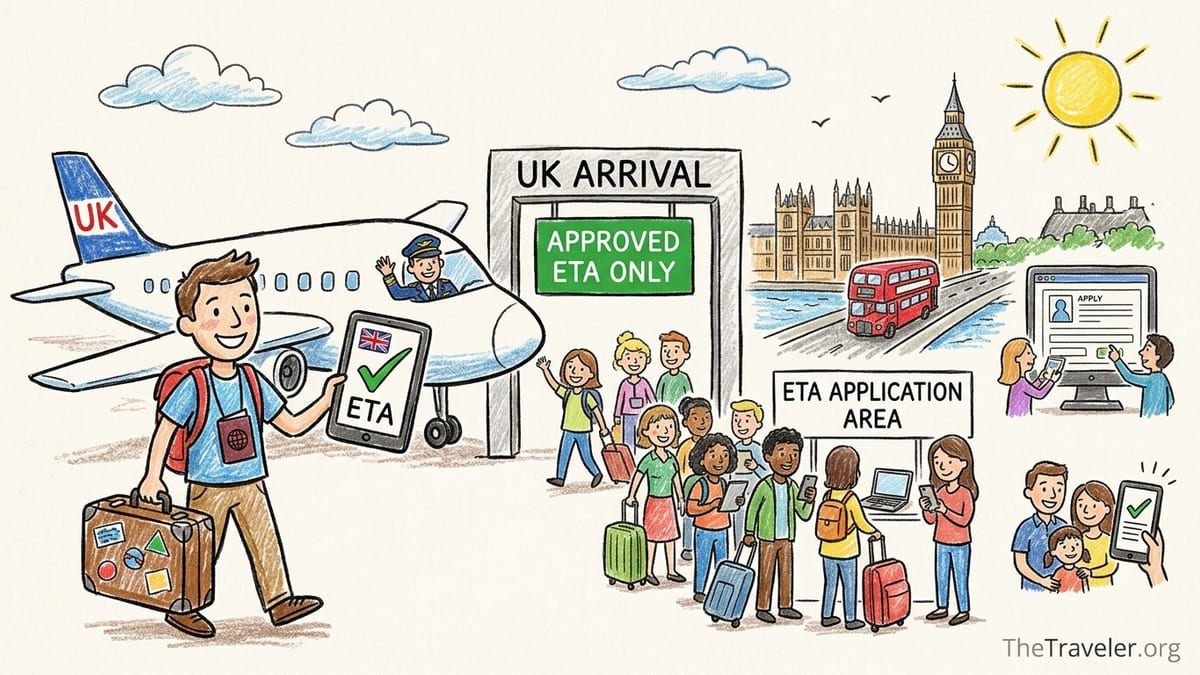
What the UK ETA Is and Why It Matters for Tourists
The UK Electronic Travel Authorisation is an advance permission to travel that many non visa nationals must obtain before boarding a plane, ferry or train to the United Kingdom. It is requested and issued entirely online and is checked electronically by airlines and other carriers before you are allowed to travel. The ETA does not replace a visa where one is required and it is not, in itself, permission to enter the UK. Immigration officers at the border still make the final decision, but you will not usually be allowed to start your journey without an approved ETA linked to your passport.
The Home Office describes the ETA as part of a broader move to a fully digital border, giving UK authorities information about travellers before they arrive. In practice, this means that if you are flying from Doha to London Heathrow with Qatar Airways, or from Dubai to Manchester with Emirates, your airline will check that you hold the correct authorisation in the same way they already check for visas or residence permits. If the ETA is missing or refused, you can be denied boarding even if you already hold a ticket.
For tourists, the ETA mainly affects those who previously enjoyed short stays of up to six months without any paperwork beyond a passport. In the past, for example, a Canadian or Japanese visitor could simply arrive in London for a two week holiday. Under the new rules, that same traveller generally needs an ETA approved in advance, unless they now require a visa. The scheme is being introduced in stages by nationality, so the impact depends entirely on the passport you carry rather than where you live.
The ETA scheme is also used for certain short term work visitors, such as some creative workers, and for people transiting through the UK on the way to a third country. Leisure visitors make up the bulk of users, though, from city break tourists to cruise passengers disembarking in Southampton or Dover for a day on shore. Planning ahead by securing the ETA well before you leave home will reduce the risk of stressful last minute problems at check in.
Who Needs a UK ETA Now
Whether you need an ETA depends on your nationality as shown on your passport and the purpose and length of your trip. The UK distinguishes between visa nationals, who always need a visa before travel, and non visa nationals, who can visit for short stays without a visa. The ETA requirement targets non visa nationals. If you are already required to hold a UK visitor visa, the new system does not change that requirement and you do not apply for an ETA.
Nationals of several Gulf states were among the first to be brought into the ETA system. Travellers holding passports from Qatar, Bahrain, Kuwait, Oman, Saudi Arabia and the United Arab Emirates now apply for an ETA instead of a standard visitor visa for short tourist visits. For example, a family from Riyadh planning a ten day shopping and sightseeing trip in London, staying in a hotel near Hyde Park, now completes ETA applications online instead of booking a biometrics appointment for a visa. Once approved, they can reuse the same ETA for additional trips during its validity period.
From 8 January 2025, the list widened significantly to include many countries that previously enjoyed visa free visits. Official guidance and the ETA National List now include, among others, Australia, Canada, Japan, Israel, Malaysia, Brazil, Argentina and several Caribbean states such as Barbados and Antigua and Barbuda. A Canadian couple flying Air Canada from Toronto to Edinburgh for the Edinburgh Festival, or an Australian backpacker arriving on a budget airline at London Stansted, must now hold an ETA if they are visiting for tourism or other short stays covered by the visitor rules.
Most European Union nationals, along with citizens of Norway, Iceland, Liechtenstein, Switzerland, Andorra, Monaco, San Marino and Vatican City, can also apply for an ETA rather than travelling entirely document free beyond their passports. Irish citizens remain a key exception and continue to move freely within the Common Travel Area without requiring an ETA or UK visa for normal visits. In addition, some people with existing UK immigration status, such as those with an eVisa linked to a work or study permit or EU Settlement Scheme status, do not apply for an ETA when travelling using that status.
Who Is Exempt and When You Still Need a Visa
Not everyone heading to the UK will need, or even be allowed to apply for, an ETA. Irish citizens are the clearest exemption, as the rules confirm that they do not normally need permission to enter or remain in the UK for visits, so they can continue to travel with just their Irish passport. People who are lawfully resident in Ireland but hold another nationality may qualify for a specific exemption if they meet set conditions, for example travelling directly from within the Common Travel Area and holding proof of legal residence in Ireland. Those exemptions are narrowly defined and worth checking carefully before travel.
British citizens do not need an ETA to enter the UK on their British passports. The same generally applies to certain other types of British nationality, such as British Overseas Territories citizens, when they are travelling to the UK in accordance with their status. Another important group who usually do not need an ETA or a visitor visa are British National (Overseas) passport holders. They can normally visit the UK without either, although many BN(O) status holders now live in the UK under specific visa routes, in which case they travel using their existing immigration status.
If you are from a country on the UK’s visa national list, the ETA is not available and you must still apply for a visitor visa in advance for tourism. For example, Indian, Pakistani, Nigerian or Chinese passport holders visiting family in Birmingham or sightseeing in Bath still follow the standard visitor visa process through UK Visas and Immigration, including an online application, biometrics and supporting documents. Trying to apply for an ETA with a passport that requires a visa will simply result in an unsuccessful or invalid application.
There are also situations where even a non visa national must seek a full visa instead of relying on an ETA. If you intend to work in most roles, study a longer course, join family permanently or stay for more than six months, a specific work, study or family visa is necessary. For instance, an American who has secured a job in London with a technology company must obtain an appropriate work visa and cannot use an ETA. A Brazilian student enrolled in a three year degree at a UK university also needs a student visa rather than travelling as a visitor, even if they hold a nationality that appears on the ETA list for tourists.
Cost, Validity and What the ETA Allows You to Do
The UK ETA carries a fixed application fee of 20 pounds per person, payable online during the application. The government has emphasised that this price is broadly comparable to similar systems elsewhere, noting, for example, that the US ESTA currently costs around 40 US dollars and the planned EU ETIAS is expected to be around 20 euros. Because the ETA is electronic, there are no extra courier or document handling fees, and applicants do not need to attend a visa application centre just to provide fingerprints for a short visit.
Once granted, an ETA is generally valid for two years or until the passport it is linked to expires, whichever comes first. The authorisation is digitally connected to the specific passport number used during the application, so if you renew your passport you will need to apply for a new ETA even if the two year period has not yet ended. In practice, this means that a traveller from Dubai who receives an ETA in March 2026 on a passport expiring in December 2026 can only use it until the passport’s expiry date, not for the full two years. After renewing their passport, they would apply again.
An approved ETA covers multiple trips to the UK while it remains valid, for visits of up to six months at a time under the standard visitor rules. It can be used for tourism, short term business meetings, attending conferences, short courses that are not the main reason for coming to the UK, or visiting family and friends. For example, a Japanese national who visits London in April for a ten day holiday, then returns in September for a trade fair at ExCeL London, can typically use the same ETA for both journeys, provided nothing has changed that would affect their immigration status or suitability.
Holding an ETA does not guarantee entry. It simply confirms that you have permission to travel to the UK. On arrival, Border Force officers can still ask about your plans, finances and return arrangements, and they may refuse entry if they are not satisfied. They can also cancel or curtail an ETA in certain circumstances, especially if later information suggests the traveller may not meet the visitor rules or presents a security or immigration risk. That said, most genuine tourists who answer questions clearly and comply with the rules pass through the ePassport gates or staffed desks without difficulty.
Transit Rules: When You Need an ETA for a Layover
The ETA scheme also applies to many people who are only transiting the UK on their way to another country. The key distinction is between airside transit, where you remain within the secure international part of the airport without going through UK border control, and landside transit, where you pass through passport control, collect bags or change airports before leaving again. Current guidance explains that airside transit passengers are temporarily exempt from the ETA requirement. In other words, if you stay airside and do not go through passport control, you may not need an ETA, although you might still need a transit visa depending on your nationality.
For landside transit, the position is different. Travellers who intend to pass through UK border control, even if they plan to leave again within a short time, are treated in a similar way to visitors and generally require an ETA or visa if they are non visa nationals. An example would be a Canadian traveller flying from Toronto to London Gatwick, collecting their luggage, then taking a separate low cost flight from London Luton to Athens the next morning. Because they have to enter the UK to change airports and possibly stay overnight in an airport hotel, they are normally expected to hold an ETA if they do not already have a visa or immigration status.
Transit rules can become more complicated for nationals who are on the UK’s direct airside transit visa list. Some of these passengers need a specific transit visa even if they do not plan to clear immigration. Others may qualify for transit without visa arrangements if they hold certain documents, such as valid visas for the US, Canada, Australia or New Zealand and confirmed onward tickets. In many of these cases the ETA is not an option and the visa regime continues to apply, so checking the official transit guidance well before booking complex itineraries is essential.
When planning flights, it is wise to consider whether you might want to leave the airport to explore for a few hours. A Gulf passenger flying from Muscat to New York via London Heathrow who holds an ETA might decide to book a longer connection and take the Heathrow Express into central London for lunch near Covent Garden. Without an ETA, leaving the airport would be much more difficult or impossible if they do not otherwise qualify for entry. Building an ETA into your plans therefore increases flexibility during long layovers, especially in major UK hubs such as Heathrow, Gatwick and Manchester.
How to Apply: Official Step by Step Process
The UK government provides two official channels to apply for an ETA: a secure website and a dedicated mobile application known as the UK ETA app. The process is the same in both routes and most applicants complete it within a few minutes. You begin by confirming your nationality, travel purpose and that you are applying for yourself or for someone else, such as a child. You then provide passport details, including passport number, issue and expiry dates, and the country that issued the document. It is important that these details match your passport exactly, as mistakes can lead to problems at the airline check in desk.
Next, you are asked for personal information such as full name, date of birth, current address and contact details, together with answers to background and security questions. These questions cover areas such as previous immigration history, criminal convictions and any association with certain organisations or activities. You may also be asked to upload a digital photograph or allow the app to capture one using your phone’s camera. The application system will then prompt you to pay the 20 pound fee using a debit or credit card. Major international cards are generally accepted, including Visa and Mastercard, and some applicants report that virtual cards or travel cards issued by banks such as Revolut or Wise also work.
Once payment is complete, most straightforward applications are decided automatically, often within minutes. However, the official advice is to apply several days or even weeks before travel in case further checks are needed. For example, a Brazilian tourist applying during a busy travel season, such as June or July, might find that their application is referred for manual review, extending the decision time. There is currently no priority or fast track fee to speed up processing, so applying as soon as you have firm travel plans, and ideally before booking non refundable flights or accommodation, is a sensible approach.
When the ETA is approved, you receive confirmation electronically. The permission is stored digitally rather than as a physical sticker or letter, and you do not usually need to present a printout at the border. It is still wise to carry a copy of the confirmation email or a screenshot on your phone, particularly if you are changing airlines or if your name includes special characters that may cause issues with scanning. You can check whether your ETA is still valid using an official online service that confirms its status against your passport details. If your application is refused, you will receive a brief explanation and may need to consider applying for a visa instead.
Practical Tips and Common Pitfalls for Tourists
Real world experience from travellers and airlines shows that many ETA related problems stem from small, avoidable errors. One common issue is entering passport details incorrectly. A single wrong digit in your passport number or an incorrect expiry date can mean that the ETA is not recognised when the airline runs its checks. At a busy airport like London Heathrow or Dubai International, this can result in being turned away at the check in counter. Always double check each field before submitting and again after receiving your approval, comparing it carefully to your physical passport.
Another frequent pitfall involves passport renewal. Because the ETA is electronically tied to one specific passport, getting a new passport effectively cancels the usefulness of the old ETA for travel. A Japanese visitor who obtains an ETA in February, then renews their passport in May after running out of blank pages, must apply for a new ETA using the new passport before boarding a flight in August. Airlines cannot manually transfer an existing ETA to a new document, and arrival at the gate with mismatched details can lead to last minute stress or missed flights.
Families should also consider how the rules apply to children. Each person in a travelling party, including infants and teenagers, needs their own ETA if their nationality requires one. A family from Melbourne visiting relatives in Manchester, with two adults and two children aged 8 and 12, will therefore submit four separate applications and pay four fees. Parents or guardians can complete and pay for the applications on behalf of their children, but should ensure all names and birth dates are entered exactly as in the passports and that the contact email address used will be monitored regularly in case of queries.
Finally, remember that the ETA does not change what you can do as a visitor. UK visitor rules still apply, including restrictions on working and time limits on study. Border officers can ask for evidence of your plans and finances. A Canadian tourist planning a month long road trip from London to the Scottish Highlands in a rental car may be asked about their itinerary, hotel bookings and proof of funds. Carrying a clear summary of your plans, confirmation emails from accommodation providers such as major hotel chains, and proof of your return or onward ticket can make the process smoother.
Looking Ahead and Final Checks Before You Travel
The UK government has stated that ETA requirements will eventually cover almost all non visa national visitors who do not already hold a UK immigration status. The list of nationalities has already expanded twice and may be adjusted again over time as visa policies change. For example, Colombia was removed from the list of countries eligible for an ETA when its nationals were moved into the visa national category for visitor travel. Because of these shifts, travellers should not assume that rules valid on a previous trip still apply. Checking the latest guidance in the weeks before departure is the safest course.
Airlines, ferry operators and Eurostar trains all have responsibilities to make sure passengers hold the right permission to travel. Carriers receive fines if they transport people who lack the required visas or ETAs, so they have a strong incentive to follow the rules strictly. Even if a check in agent appears sympathetic, they are normally unable to override system warnings. In practice, this means you should treat the ETA as just as important as your passport or ticket. Have it approved and verified before you head to the airport or station, rather than hoping to resolve issues at the last minute.
Before you travel, review your documents carefully. Confirm that your passport is valid for the entire length of your stay, that your ETA will still be valid on both the outbound and return journeys, and that flight bookings are made in the same name and spelling as your passport. If your travel involves complex routes, such as flying from North America to India with a change of airport in London, double check whether you will be transiting airside or landside and whether your nationality requires anything beyond the ETA, such as a transit visa.
For most tourists, the ETA will quickly become a routine part of travel planning, much like arranging travel insurance or checking baggage rules. Once you understand the basics of who needs it, how much it costs and how it affects transit, applying is straightforward. Taking a few minutes to complete the application well ahead of time provides peace of mind that when you arrive in the UK, whether for a West End theatre weekend or a coastal escape in Cornwall, the border formalities will be as smooth as possible.