


Singapore Changi Airport has a reputation for being more than just a place to catch a flight, and nowhere is that more obvious than in its dining scene. Spread across four terminals and the vast Jewel complex, the airport offers everything from budget friendly local hawker staples to polished restaurants where you might forget you are in a terminal at all. This guide focuses on the most interesting and consistently praised options that are worth planning into your layover, whether you have 45 minutes before boarding or a full afternoon between flights.
Get the latest updates straight to your inbox!
How Dining Works at Changi: Terminals, Transit and Jewel
Before you pick a restaurant, it helps to understand how Changi is laid out. Terminals 1, 2 and 3 are linked airside, so once you clear immigration for any of these terminals you can move between them on foot or by Skytrain without passing through security again. Terminal 4 is separate and connected to the main complex by shuttle bus, which matters if you are tight on time between a T4 departure and restaurants in Jewel or the other terminals.
Every terminal has both public area dining before immigration and transit area dining after immigration. If you are on a layover without entering Singapore, you will be limited to the transit options, although these include substantial food courts and several sit down restaurants in each terminal. Travellers starting or ending a trip in Singapore, or those with a longer connection and the right visa, can exit immigration and walk to Jewel or the public halls of any terminal for a wider range of restaurants.
Prices are higher than downtown Singapore but still vary widely. A plate of chicken rice or a bowl of laksa in a food court typically runs around S$6 to S$9, broadly in line with mid range food courts in the city. At branded restaurants in Jewel, expect closer to S$15 to S$25 per person for a basic main. Knowing roughly what you want to spend and how long you have between flights will help narrow down the best options for your situation.
Most airport restaurants open by mid morning and many close around 10 p.m., but each terminal preserves at least a handful of 24 hour eateries and convenience style counters for very late or early departures. Operating hours can change with traffic patterns, so it is wise to have a backup option in mind if you are arriving particularly late at night.
Signature Local Flavours: Hawker Style Eats Without Leaving the Airport
For travellers who want a first or last taste of Singaporean flavours, Changi’s hawker style food courts are an obvious starting point. The concept mirrors the city’s famous hawker centres, with multiple small stalls and a shared seating area, but in an air conditioned airport setting. Portions tend to be generous and prices are usually the lowest you will find inside the terminals, which makes these food courts popular with both airport staff and budget conscious travellers.
One of the most talked about examples is Straits Food Village in Terminal 3’s transit area. This food court leans heavily into local classics such as Hainanese chicken rice, laksa, nasi lemak and fried carrot cake, presented in a setting that loosely recreates old Singapore streets. Expect to pay about S$7 to S$10 for mains, which is higher than a downtown hawker stall but noticeably cheaper than a full service restaurant in the same terminal. The atmosphere can feel surprisingly local, especially during meal times when ground staff and cabin crew mix with transit passengers at the communal tables.
In Terminal 1’s staff oriented Orchis Food Court, which sits just off the public landside area, prices are closer again to everyday Singapore. Travellers who do not mind navigating a slightly more utilitarian environment often praise it for simple dishes like economical rice, wanton noodles and kopi, with many options around or just below S$6. Because it primarily serves airport workers, it can be busy at shift change times and the signage is less polished than in the main passenger halls, but that is part of the appeal if you are seeking something that feels more like a neighbourhood canteen than an airport concession.
Across the terminals and in Jewel, you will also see local chains such as Toast Box, Ya Kun Kaya Toast, Heavenly Wang and similar kopitiam style cafes. These are a good option for a quick breakfast set of kaya toast with soft boiled eggs and coffee, usually between S$6 and S$8 depending on the drink you choose. For travellers landing early in the morning or leaving on red eye flights, these cafes provide an easy way to try a classic Singaporean breakfast without committing to a full sit down meal.
Jewel Changi: Destination Dining Under the Rain Vortex
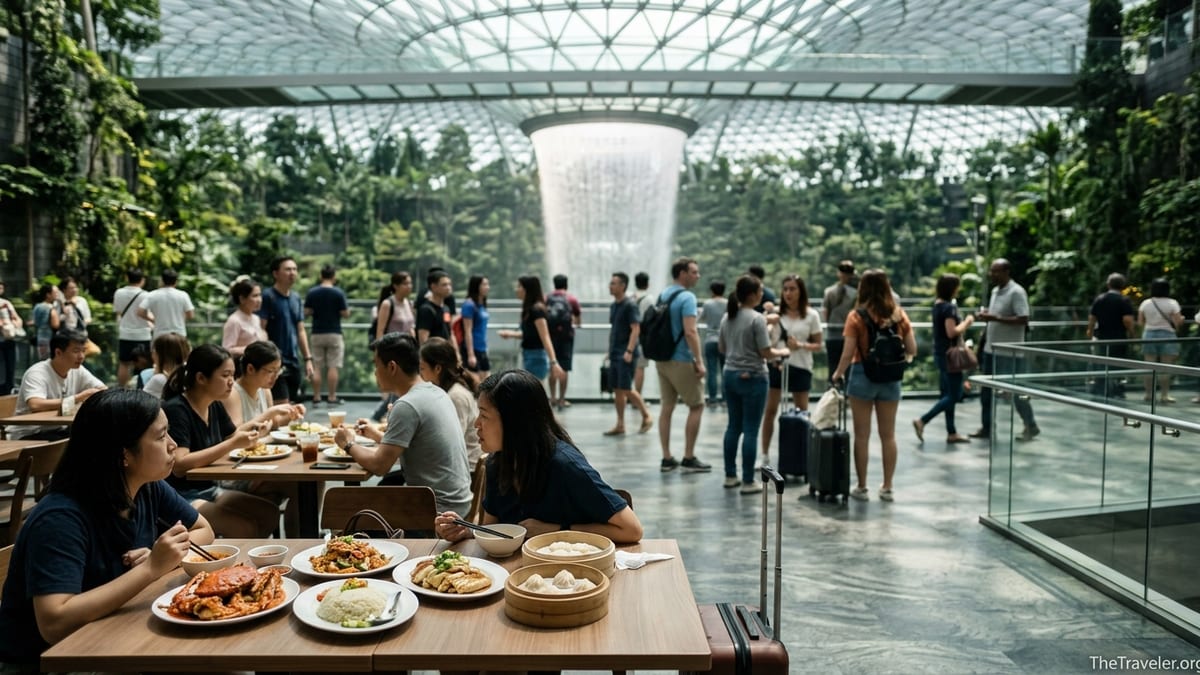
If your schedule allows you to head into the public area, Jewel Changi has become the airport’s de facto dining hub. The nature filled complex, anchored by the giant Rain Vortex indoor waterfall, houses more than a hundred food and beverage outlets, from quick bites to occasion worthy restaurants. It is less convenient for very short layovers but ideal if you have several hours to spare, are beginning or ending your trip in Singapore, or are meeting friends and family landside.
Among the most sought after restaurants in Jewel is Shake Shack, the New York burger chain that opened its first Singapore outlet here. Travellers often note that queues can form during peak lunch and dinner periods, particularly on weekends, but off peak you can usually order and sit down within 10 to 15 minutes. A ShackBurger with fries and a drink will typically land around S$18 to S$22, similar to downtown Singapore pricing. The setting, with views toward the lush interior of Jewel, makes it feel more like a casual city restaurant than an airport fast food outlet.
For those who would prefer a Chinese or Asian focused meal, Jewel offers several strong options. Din Tai Fung serves its internationally known xiao long bao, fried rice and noodles in a spacious dining room that works well for families and groups. Prices are comparable to its city branches, with a basket of soup dumplings in the S$10 to S$15 range and rice or noodle dishes around S$12 to S$18. Nearby, chains such as Kam’s Roast and Tai Er draw travellers who want roast meats over rice or spicy sauerkraut fish. These restaurants are often recommended by Singapore based frequent flyers who use Jewel for meetups before long haul flights.
Jewel is also where you will find well known Singaporean names such as Jumbo Seafood, which specialises in chilli crab and other seafood dishes. This is not a fast option and is best suited to long layovers or pre departure gatherings. A chilli crab meal with sides can easily reach S$50 or more per person, so it is more of a special occasion splurge than a routine airport dinner. If your goal is simply to taste chilli crab rather than settle in for a drawn out feast, consider sharing dishes or visiting during off peak hours when service tends to be quicker.
Standout Spots Inside the Transit Areas
Many travellers never step outside the secure areas, particularly if they are on a through ticket with a short connection. Changi’s airside dining has improved in recent years and a handful of restaurants are now destinations in their own right, especially in Terminals 2 and 3. The advantage is that you never need to factor in immigration queue times or the walk to Jewel, and you remain close to your departure gate.
In Terminal 3 transit, Encik Tan and similar quick service stalls draw lines for local noodles and rice dishes that are both familiar to Singaporeans and accessible to visitors. A typical bowl of curry noodles or fishball noodles costs in the S$6 to S$8 range, and many travellers comment that the flavours compare well with mid tier food courts in the city. Because orders are placed and collected at the counter, it works well if you have only 30 to 40 minutes before boarding and just want a hot, comforting meal.
Terminal 2’s transit area features Straits Food Village, which combines multiple stalls into one themed food street. In practice this means you can mix and match dishes such as satay, roti prata, biryani and char kway teow at the same table. Prices vary by stall but fall mostly in the S$7 to S$12 bracket for mains. Compared with the larger and more tourist oriented Jewel outlets, Straits Food Village feels more functional and can be crowded at traditional mealtimes, yet it is often singled out by aviation staff as one of the better representations of Singapore hawker food that remains inside the secure zone.
For travellers in Terminal 4, the Food Emporium in the public area is frequently cited as the best bet for a proper meal. Here you will find a mix of local and regional options, including rice and noodle dishes, at prices that are often slightly lower than in Jewel. A simple roasted meat rice set, for example, may be around S$7 to S$9. The trade off is that T4 is physically separate from the other terminals, so it is not practical to come here from T1 to T3 on a short connection.
International Comforts: Burgers, Pizza and Familiar Chains
Not every traveller wants to experiment with new flavours in transit. Changi recognises this and offers a full spread of global comfort food, from burgers and fried chicken to pizza, pastries and chain coffee. For families with children or passengers who have just come off a red eye, the predictability of a familiar brand can be a welcome relief.
Alongside Shake Shack in Jewel, you will find established names such as A&W, Starbucks and various bubble tea chains. A&W’s root beer floats and curly fries remain a nostalgic draw, particularly for visitors from countries where the brand no longer operates widely. Expect to pay around S$10 to S$14 for a combo meal. For coffee and pastry on the go, international coffee houses share space with local bakers, so you can choose between a chain style latte and muffin or a pandan chiffon cake from a Singapore brand.
Inside the transit zones, fast food counters sit close to many of the boarding gates. Burgers, fried chicken and sandwiches are available almost around the clock, with prices generally a few dollars higher than downtown. These are rarely the most exciting or best value choices, but they are useful if your priority is speed and a menu that requires no explanation. If you are travelling as a group with mixed tastes, one practical strategy is to let those who want familiar food order from a chain while others head to a nearby local stall, then meet at a shared seating area.
Western style casual restaurants are also present, particularly in Jewel and the public areas of the terminals. Chains that focus on pasta, pizzas and grills cater well to families and groups who want table service but still need a straightforward menu. A pizza to share will usually cost around S$25 to S$30, with individual mains in the S$18 to S$25 range. These venues tend to feel closest to an ordinary shopping mall restaurant, which can be comforting after several days of intensive travel.
Planning Your Meal: Timing, Budget and Transit Logistics
Because dining options in Changi are spread across multiple terminals and the Jewel complex, planning matters more here than at a smaller airport. If you have a tight connection, your best bet is almost always to stay within the transit area of your arrival terminal or the terminal from which your next flight departs. In practice, passengers in Terminals 1 to 3 can walk or take the Skytrain between transit zones, but it is still wise to allow at least 15 to 20 minutes each way for walking, waiting and wayfinding.
For longer layovers of three hours or more, heading out to Jewel or the public areas can make sense. Clearing immigration is usually swift for eligible nationalities, but queues can lengthen during banked arrival waves and holiday peaks. Give yourself a buffer on the return, aiming to be back at security at least 60 to 90 minutes before your next flight, particularly if you are not familiar with the layout of the terminals.
On the budget side, food courts and staff oriented canteens are generally the most economical, followed by local chains and casual diners in the public halls. Jewel and high profile branded restaurants are typically the most expensive, which is worth bearing in mind if you are feeding a family. As a rough guide, a single traveller can eat quite well at a food court for S$8 to S$12, or at a mid range restaurant in Jewel for S$20 to S$30 before drinks. Service charges and goods and services tax are usually included in the menu prices at full service restaurants, but it is always worth checking the fine print at the bottom of the menu.
One final consideration is what you feel like eating before a particular flight. Rich or very spicy meals right before a long haul overnight flight may not suit every stomach. Lighter options such as fish soup, congee, salads or grilled meats over rice are available across the terminals and in Jewel, and can be a more comfortable choice before spending 12 hours in the air. Conversely, if you are about to land at your final destination in time for sleep, a heavier chilli crab or burger meal might be exactly what you want as a celebratory end to the journey.
The Takeaway
Singapore Changi’s dining scene reflects the airport’s broader reputation as a place that aims to be an attraction in its own right. Instead of settling for a single tired cafeteria, travellers can choose between hawker style food courts, well known local brands, global fast food and full scale restaurants in a tropical garden setting. The experience you have largely comes down to how much time and money you want to spend, and whether you are willing to step outside the transit area into Jewel or the public halls.
For a quick and affordable taste of Singapore, food courts such as Straits Food Village and staff focused canteens like Orchis offer solid versions of classic dishes at grounded prices. If you want to stretch your legs and experience something closer to a city mall, Jewel’s collection of names like Shake Shack, Din Tai Fung and Jumbo Seafood can fill an entire afternoon before your next flight. With a little planning around terminals, queues and return times, your layover meal at Changi can shift from a rushed necessity to a highlight of the trip.
FAQ
Q1. Can I eat at Jewel Changi during a layover without clearing immigration?
You need to clear immigration and enter Singapore to visit Jewel, as it sits in the public area connected to the terminal arrival halls. Transit passengers without entry clearance must stay within the airside zones and use the restaurants in the transit areas instead.
Q2. How long of a layover do I need to comfortably eat at Jewel?
For most travellers, a layover of at least three to four hours between flights is advisable if you want to exit immigration, walk to Jewel, enjoy a relaxed meal and return through security with a safety buffer.
Q3. Are there good vegetarian or halal options at Changi Airport?
Yes, many food courts and branded outlets clearly label vegetarian dishes, and there are multiple halal certified stalls and restaurants, particularly among local chains and fast casual Asian concepts. Checking signage at the entrance is usually enough to confirm.
Q4. What is the approximate cost of a meal at Changi’s hawker style food courts?
At most airport food courts you can expect to pay around S$6 to S$10 for a main dish such as chicken rice, noodles or curry, which is slightly more than in many city hawker centres but still good value for an airport.
Q5. Is it worth seeking out the staff canteens as a visitor?
Staff oriented canteens like Orchis in Terminal 1 are open to the public areas and offer lower prices and a more local feel, but they can be busy and signage is less tourist focused, so they suit travellers comfortable navigating a more utilitarian environment.
Q6. Are there 24 hour restaurants in Changi Airport?
Each terminal maintains at least some 24 hour dining options, usually a mix of fast food, convenience style counters and a few local chains, which makes it possible to find a proper hot meal even on very late or early flights.
Q7. Do restaurants at Changi accept credit cards and contactless payment?
Most airport restaurants accept major credit cards and contactless payments, including mobile wallets. Smaller stalls in food courts may prefer card or mobile payment over cash, but it is increasingly rare to find outlets that are cash only.
Q8. Can I bring food from the airport onto my flight?
In general you may bring most solid takeaway food onto your flight, subject to airline rules and any customs restrictions at your destination. Be mindful of strong smells in the cabin and of liquids limits if your food comes with large amounts of soup or sauce.
Q9. Are queues a problem at popular Jewel restaurants like Shake Shack and Din Tai Fung?
Queues can build during weekend lunches and evenings, and on public holidays, but they tend to move steadily. Visiting outside peak meal times, or putting your name down early and walking around the mall while you wait, can reduce the impact.
Q10. Is it better value to eat in the city instead of at the airport?
Downtown Singapore generally offers lower prices and more variety, especially at neighbourhood hawker centres, but if you have limited time or do not want to manage additional transport, Changi’s better food courts and mid range restaurants still deliver reasonable value for the convenience.