


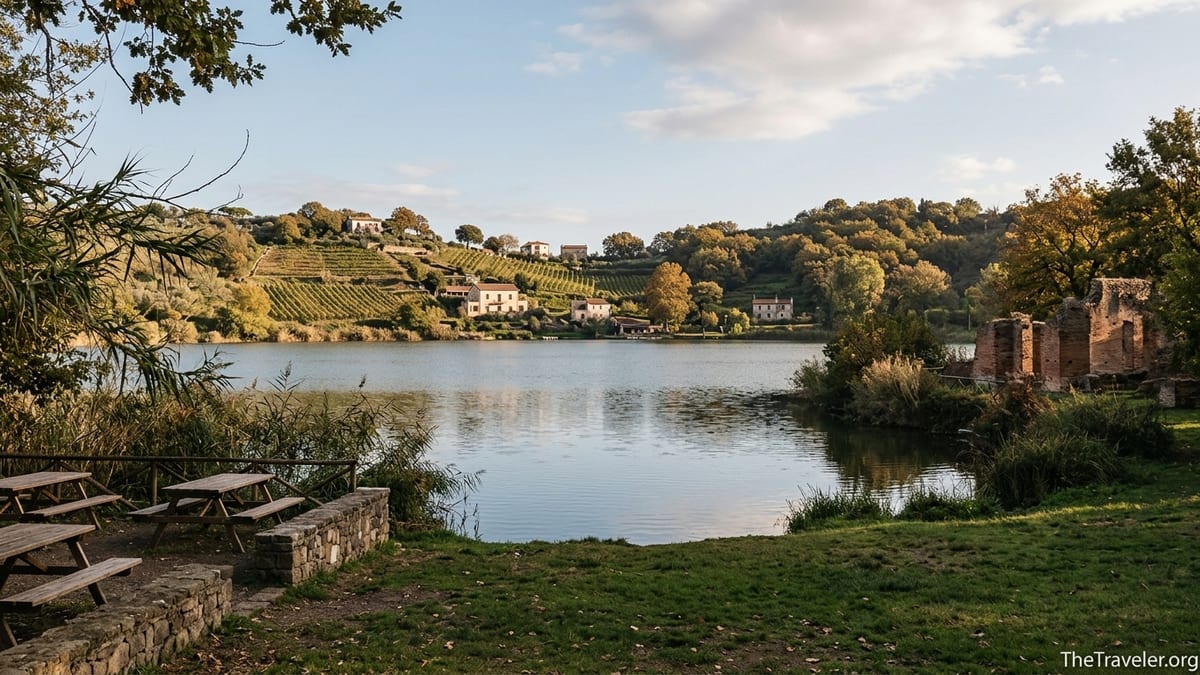
On the surface, Lake Averno is the perfect place for a quiet walk: a circular trail around a small volcanic lake, birdsong in the reeds and gentle slopes of vines and forest. But step away from the path and this crater in the Campi Flegrei, just outside Naples, opens up into something far richer. Here you can taste wine grown on ancient volcanic soil, stand among Roman ruins once linked to the underworld, soak in natural thermal baths and sit down to farmhouse lunches that stretch all afternoon. For travelers willing to linger, Lake Averno offers one of the most atmospheric day trips in southern Italy.
Get the latest updates straight to your inbox!
Soak Up the Myths at the “Gate of Hades”
Long before it was a peaceful lakeside escape, Lake Averno was feared. Roman writers described this dark volcanic crater as the entrance to Hades, and its Latin name, Avernus, is linked to the idea that birds would not fly over its fumes. While the lake today is calm and green rather than sulphurous, you can still feel the weight of those stories when morning mist hangs low over the surface and the surrounding woods are quiet.
As you move away from the standard walking trail, look for traces of the Roman world that once clustered around this strategic spot. On the eastern shore, beside the road, stand the brick remains of a great circular hall often called the Temple of Apollo, though archaeologists now identify it as part of a monumental bath complex. The walls still rise several metres high, with traces of niches and openings that hint at its original dome. Even from outside the fenced area, you can see how impressive it would have been when hot mineral waters fed its pools.
From here, it is a short drive or taxi ride to the Archaeological Park of Cuma, where the myths that swirl around Averno come into sharper focus. At Cuma you can walk down the trapezoidal passage known as the Antro della Sibilla, the cave where the Cumaean Sibyl was said to deliver oracles to heroes and emperors. Guides on site often explain how, in Virgil’s Aeneid, Aeneas passed by Lake Averno and Cuma on his way to the underworld, tying this quiet landscape into one of Rome’s founding legends.
For a more atmospheric experience, many travelers find late afternoon the best time to visit these sites. The light softens over the lake, and the ruins take on a golden hue. Planning your day so that you explore Cuma and the sibyl’s cave first, then finish with a slow walk along Averno’s shore as the sun sets behind the Campi Flegrei hills, is an easy way to connect the dots between mythology and the present-day landscape.
Wine Tasting on Volcanic Slopes
One of the most rewarding ways to go beyond the lakeside path is to taste the volcanic soil itself in a glass of local wine. On the eastern side of Lake Averno, agriturismi and small wineries cultivate Falanghina and Piedirosso vines along the inner walls of the crater. The best-known address is Le Cantine dell’Averno, a family-run wine estate and farmhouse restaurant set amid rows of vines that plunge toward the water.
Le Cantine dell’Averno typically offers tastings built around their Campi Flegrei Falanghina, a fresh white with marked mineral notes, and Piedirosso, a lighter-bodied red suited to local dishes. While prices change, visitors can expect tasting menus that pair three or four wines with a series of seasonal plates for roughly the cost of a mid-range restaurant meal in Naples. Menus often highlight baked pasta with provola cheese, slow-cooked rabbit, vegetables grown on the property and desserts flavored with citrus from the orchard.
What makes this experience special is the setting. Tables are arranged in a rustic dining room with vaulted ceilings or, in good weather, outside under pergolas overlooking the lake and vineyards. The family owners are usually present, pouring wines and explaining how their vines run right down to the crater’s inner slopes. For travelers without a car, taxis from Pozzuoli or Lucrino can drop you at the entrance; some guests arrange for the driver to return at a fixed time, allowing them to relax and taste without worrying about transport.
If you are interested in the agricultural side, it is worth calling ahead to ask about vineyard walks or short tours of the cellar. Some visitors manage to time their trip with harvest activities in late summer or early autumn, when crates of grapes line the courtyard. Even outside harvest season, peering into the small fermentation room and barrel cellar gives a sense of how intimately wine, landscape and family life are woven together here.
Farmhouse Dining and Lakeside Picnics
Beyond wine tastings, Lake Averno is a rewarding place to plan a long, lingering meal. Agriturismi such as Le Cantine dell’Averno operate as both wineries and farmhouse kitchens, serving fixed menus at lunch and dinner that change with the seasons. It is common to find antipasti platters loaded with bruschetta, local salumi, marinated vegetables and fried bites, followed by a pasta course and one or two meat dishes. Portions can be generous, so many travelers choose lunch here as the main meal of their day trip.
Because these farms work with their own produce and small local suppliers, menus at Lake Averno often read like a snapshot of Campania’s countryside. In winter, expect dishes built around hearty legumes, broccoli rabe and slow-cooked pork. Spring and early summer bring artichokes, fava beans and lighter preparations of fish from nearby coastal waters. In the height of summer, tomatoes, basil and eggplants dominate the table, often accompanied by simple grilled meats.
Travelers on a tighter budget, or those who prefer a more flexible schedule, can turn the area into an ideal picnic spot. Small grocery shops and bakeries in Lucrino and Pozzuoli sell fresh bread, local cheeses such as provola and caciocavallo, cured meats and seasonal fruit. It is easy to assemble a spread for the price of a casual lunch in the city. Once at the lake, look for shaded benches and low stone walls near the water where locals often sit; while the shoreline is mostly natural and not heavily developed for tourism, there are enough clearings to lay out a simple picnic and watch fishermen on the opposite bank.
A practical note: this is not a swimming lake, and local residents generally advise against entering the water. Treat Averno as a scenic backdrop for dining rather than a place to cool off. If you want to combine your visit with a swim, plan to stop at one of the lidos a short distance away on the coast at Lucrino or Miseno, where sandy beaches and controlled bathing areas face the Bay of Pozzuoli.
Hidden Roman Engineering: Tunnels, Ports and Baths
Lake Averno is a natural amphitheatre of Roman engineering. During the late Republic, the Romans transformed this crater into the inner harbor of Portus Julius, a military base linked by canal to the nearby Lucrino and the sea. While the waterway itself is no longer visible in its original form, remnants of this massive project still dot the hillsides and shoreline, rewarding curious visitors.
One of the most striking examples is the Grotta di Cocceio, an 800-metre tunnel cut through volcanic tuff that once connected the shores of Lake Averno with the acropolis of Cuma. Access for casual visitors is often restricted due to conservation and safety concerns, and current conditions can change from year to year. Even when closed, standing near its blocked entrances and reading on-site panels gives a real sense of the audacity behind Roman infrastructure, especially when you picture chariots and soldiers moving under the hill between the lake and the ancient city.
Closer to the water, on the eastern shore, the so-called Temple of Apollo offers another perspective on Roman life here. Archaeological studies suggest it was actually a grand bath complex built in brickwork, with a circular hall likely topped by a dome. Today only sections of wall and the drum of the main room remain, but you can still trace the outlines of windows and doorways. If you walk the road that skirts the lake in this area, pull over at small lay-bys to view the ruins from different angles and imagine the vaulted ceilings that once echoed with bathers’ voices.
To connect these scattered traces into a fuller picture, many travelers spend an additional hour or two at the archaeological museums in nearby Baia or in central Naples on a different day. There you can see mosaics, sculptures and inscriptions from the Campi Flegrei region, including objects recovered from villas and maritime structures around Averno and the coast. Understanding how the elites of the Roman world used this area as a retreat gives new depth to what at first glance looks like a quiet provincial lake.
Thermal Baths and Coastal Detours
One of the advantages of basing part of your day around Lake Averno is the easy access to other Campi Flegrei highlights within a short drive or train ride. The nearby Stufe di Nerone thermal baths, just outside Lucrino, are a long-running local favorite. Set among gardens at the foot of low hills, this spa uses hot mineral waters from the same volcanic system that formed Averno. Visitors can move between thermal pools of different temperatures, steam grottoes and relaxation areas for a fee comparable to a mid-range spa visit elsewhere in Italy.
The atmosphere at Stufe di Nerone is typically relaxed and informal, attracting both Neapolitans and travelers. It makes a comfortable contrast with the more rugged feel of the crater lake. Some visitors plan their day so they walk or picnic around Averno in the morning, then spend the hotter afternoon hours alternating between cool shade and warm pools at the baths. Simple cafeterias or snack bars on site usually serve light meals, so you can stay several hours without leaving.
For a change of scenery, head toward the coast at Lucrino, where small lidos line the shoreline. These private or semi-private beach clubs rent sun loungers and umbrellas and offer showers and basic facilities. Prices vary with the season, but many travelers find a daybed here comparable in cost to other Italian seaside spots around Naples. From these beaches you can look back toward the Campi Flegrei hills and appreciate how close the sea is to Lake Averno, despite the very different atmosphere.
If you have your own vehicle, consider combining Lake Averno with a stop at the submerged Roman city of Baia, where boat tours with glass bottoms or snorkeling excursions reveal mosaics, columns and villa walls under shallow water. Although these activities depend strongly on weather and local operators’ schedules, they underline how intimately the Roman world, volcanic geology and the sea intertwine in this stretch of coast.
Planning Your Visit: Getting There and Getting Around
Lake Averno sits near Pozzuoli, roughly 20 kilometers west of central Naples. Many visitors arrive by public transport, using the Cumana railway line that runs from Naples toward the Campi Flegrei. A common approach is to take the train to Lucrino station, then walk or take a short taxi ride inland to the lake. The walk from Lucrino to Averno takes around 20 to 30 minutes at a comfortable pace, mostly on flat ground, though traffic and narrow verges in spots mean some travelers prefer a taxi.
If you choose to walk from the station, bring comfortable shoes and water, particularly in summer. The approach road is lined with a mix of houses, small farms and roadside bars, giving a glimpse of everyday life in this volcanic hinterland. As you crest the low rise and the crater opens ahead, the first view of the lake is striking: a near-circle of water ringed by wooded slopes and pockets of vines, with very little obvious tourist infrastructure on the shore itself.
Driving offers more flexibility, particularly if you want to combine Lake Averno with other sites like Cuma, Baia or the thermal baths. Parking is available in small gravel or informal lots near agriturismi and vantage points around the lake, though spaces can be limited on weekends when local families come for lunch. If you plan to drink wine at a farmhouse restaurant or join a tasting, it is wise to designate a driver or arrange a return taxi from Pozzuoli or Naples in advance.
Conditions at specific sites, such as the Grotta di Cocceio tunnel or particular viewing areas, can shift with conservation work and local regulations. Before setting out, it is sensible to check information from the Campi Flegrei archaeological park or local tourism offices and to be ready to adjust your plans if certain ruins are temporarily inaccessible. Even with occasional closures, the combination of lake, vineyards, myths and nearby thermal baths offers plenty to fill a relaxed day.
The Takeaway
Lake Averno rewards travelers who treat it as more than a quick photo stop. Yes, the circular path around the water is pleasant and provides classic crater views, but the real appeal lies in stepping beyond the trail. A glass of Falanghina on a farmhouse terrace, the brick curve of a Roman bath wall, the cool passage of the sibyl’s cave and the warmth of a nearby thermal pool all reveal layers of history and everyday life that sit just below the surface.
Because it lacks the crowds and heavy development of better-known Campanian attractions, Averno offers a slower, more local experience. You are more likely to share a lakeside bench with fishermen and weekend walkers than with tour groups, and lunches stretch on at a pace that reflects family rhythms rather than bus schedules. For visitors to Naples looking for a day that combines mythology, nature, wine and genuine hospitality, Lake Averno and its surroundings make a compelling detour.
FAQ
Q1. Where exactly is Lake Averno located?
Lake Averno sits in the Campi Flegrei volcanic area near Pozzuoli, about 20 kilometers west of central Naples in southern Italy.
Q2. Can you swim in Lake Averno?
Swimming is not recommended and is generally avoided by locals. Visitors treat the lake primarily as a scenic and historical site rather than a bathing spot.
Q3. How do I get to Lake Averno by public transport from Naples?
You can take the Cumana railway toward the Campi Flegrei and get off at Lucrino station, then walk around 20 to 30 minutes or take a short taxi ride to the lake.
Q4. Are there guided tours of the Roman ruins around Lake Averno?
Formal tours at the lake itself are limited, but local guides and tour companies in Naples and Pozzuoli sometimes offer combined visits that include Lake Averno, Cuma and nearby sites like Baia.
Q5. Is it necessary to book ahead for wine tastings at Le Cantine dell’Averno?
Advance reservations are strongly advised, especially on weekends and during high season, because seating is limited and tastings are often tied to set menus.
Q6. What is the best time of year to visit Lake Averno?
Spring and autumn offer comfortable temperatures and quieter paths. Summer can be hot but is pleasant in the mornings and evenings, while winter is cooler and more atmospheric.
Q7. Can I visit Lake Averno and the Cuma Archaeological Park in one day?
Yes. Many travelers spend a few hours exploring the ruins and the sibyl’s cave at Cuma, then continue to Lake Averno for a walk, wine tasting or late lunch.
Q8. Are there places to eat directly at the lake?
Yes. Agriturismi and farmhouse restaurants such as Le Cantine dell’Averno sit close to the water and vineyards, serving fixed menus and local wines based on seasonal produce.
Q9. Is Lake Averno suitable for children and families?
Families often enjoy the easy paths and open spaces, but parents should keep an eye on younger children near the water and along roads, as safety barriers are limited in places.
Q10. Do I need a car to enjoy Lake Averno and nearby attractions?
A car offers more flexibility for combining the lake with Cuma, Baia or thermal baths, but it is still feasible to visit using trains, local taxis and moderate walking.